A ballistic missile attack late on Tuesday hit the Darnytska power plant and a residential building in Kyiv, killing one person and injuring 13, as Ukraine's president said allied warnings failed for a second night and a fragile energy ceasefire came under strain.
Published 13 October 2026 · 23:53 GMT
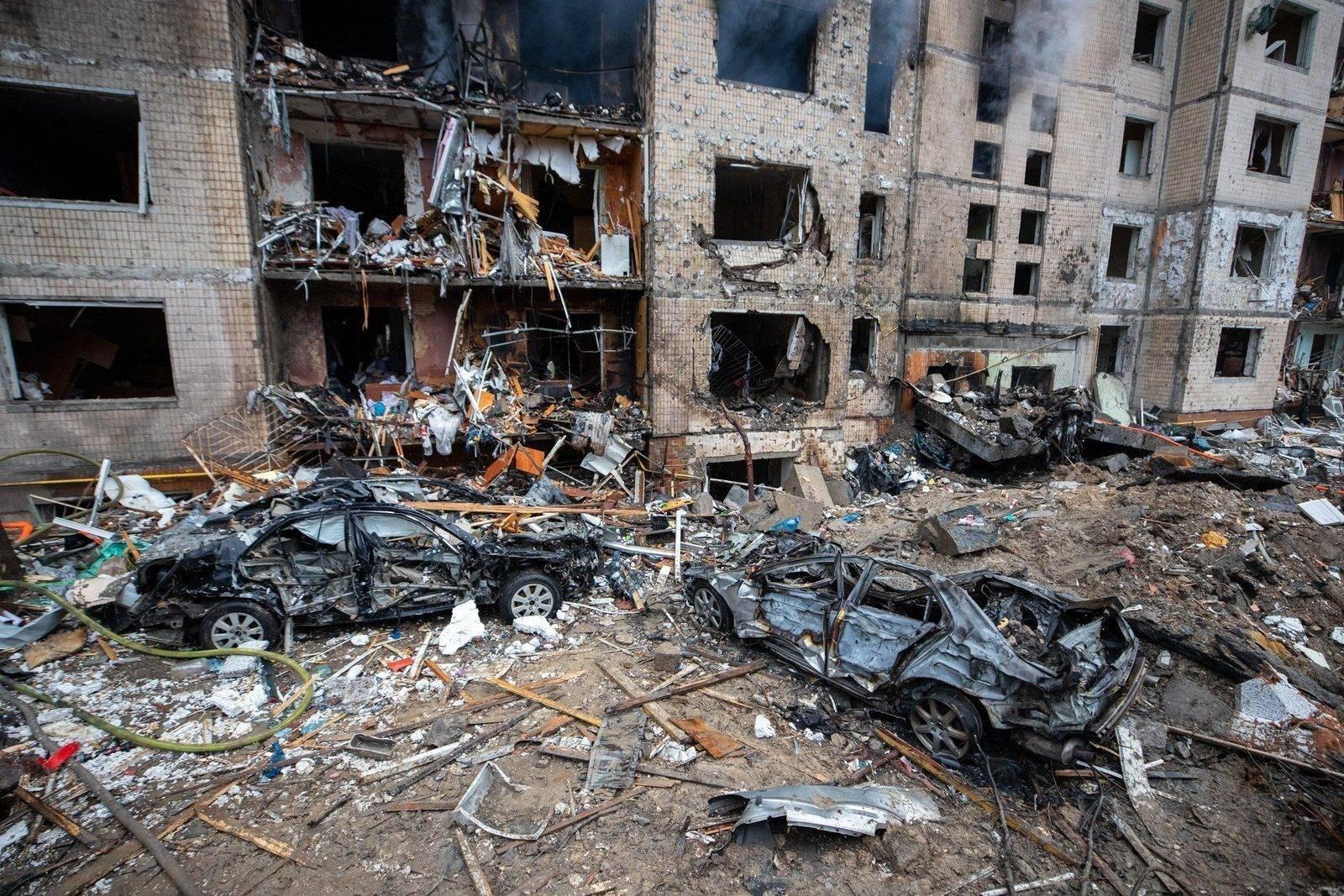
Late on Tuesday evening, ballistic missiles struck the Ukrainian capital, Kyiv, in the second night in a row that the city came under Russian missile attack. One of the targets was Darnytska CHP-4, a combined heat and power plant that supplies the city with heating and electricity. A residential building was also hit. Ukrainian President Volodymyr Zelensky said the strikes arrived with no early warning from Ukraine's partners, a claim that turned a battlefield attack into a diplomatic row about intelligence, warnings, and a ceasefire that was only two days old.
Kyiv Mayor Vitali Klitschko said one person was killed and 13 people were injured in the strike on the apartment block, four of them in a serious condition. Apartments were ablaze, and residents were evacuated from the damaged building. The strike on the power plant raised the immediate question of how much of the city's heating and electricity capacity had been knocked out, just as the heating season makes such plants a matter of survival rather than comfort.
It came two days after United States President Donald Trump said an energy ceasefire had been agreed by Russia and Ukraine, an announcement Kyiv followed with reports of multiple Russian strikes. Ukraine supported an energy ceasefire, Zelensky said. Russia, he said, was targeting yet another power plant and the lives of ordinary people.
Several facts are now on the record. On Monday night, five Russian ballistic missiles struck civilian infrastructure in Kyiv, Zelensky said, and no early warning arrived from partners. On Tuesday, the Ukrainian air force said there was no warning before the strike either. The weapons used on Monday were identified by the Ukrainian Air Force as Iskander-type ballistic missiles launched from the Bryansk region of Russia, northeast of Ukraine. Their speed and the short distance to Kyiv can leave very little time for alerts, and on earlier occasions missiles have arrived ahead of intelligence alerts, the air force has said.
The political context is a pressure campaign. Reuters and other outlets have reported that American officials threatened to cut off intelligence sharing and weapons sales unless Kyiv stops attacking Russian refineries, and that Ukraine relies heavily on American intelligence for early warnings of missile strikes. Zelensky said Ukraine had not targeted Russian refineries since Trump's announcement on Sunday. Trump, speaking to reporters on Tuesday, denied that intelligence sharing had stopped. He said Washington was helping Ukraine and sharing intelligence, and that it was working with both Kyiv and Moscow to end the war. Asked about Russian strikes on Ukrainian energy sites, he replied that Ukraine had hit many sites the day before, and he declined to say whether Russia had broken a ceasefire.
Ukrainian officials have offered a technical explanation alongside the political one. Foreign Minister Andriy Sybiha told the Warsaw Security Forum that Kyiv continued to receive American intelligence, and attributed the delayed warning to the special type of weaponry Russia deployed. Two senior Ukrainian officials said they were investigating the incident, and one described a malfunction in an early-warning system that had previously given Kyiv reliable notice of Russian air attacks. The air force said Ukraine would work with its partners to address gaps in that information.
What is not yet known matters as much as what is. The full extent of the damage to Darnytska CHP-4 has not been made public, and neither has a timetable for repairs. A power plant can be hit, damaged, or put out of service, and those are very different outcomes for a city heading into winter. Until engineers report, the practical effect on Kyiv's heating and electricity remains an open question.
Nor is it settled why the warnings failed. Three explanations are in circulation: the missiles flew too fast and too short a distance for alerts to be issued in time; an early-warning system malfunctioned; or intelligence was withheld as political pressure. The first two explanations point to technical fixes. The third points to a crisis of trust inside the alliance.
It is also unclear whether the energy ceasefire ever took hold at all. Trump announced it on Sunday. Kyiv reported strikes after it. Trump would not say whether Russia had broken it. And it is unknown whether further launches are coming, although Zelensky said Ukrainian intelligence expects Russia to prepare more.
Because heat in Kyiv is not a comfort, it is infrastructure. Combined heat and power plants like Darnytska CHP-4 produce electricity and feed district heating at the same time, so a single hit can darken homes and cool radiators together. Russia has struck Ukrainian energy infrastructure in previous winters, and the pattern is well understood: each plant lost before the cold raises the load on the plants that remain, and each repair consumes crews, parts, and weeks.
The warning question matters for a different reason. Early warnings are what turn a missile strike into a survivable event: sirens send people to shelters, and minutes decide whether a residential building is occupied or empty. If warnings arrive late, or not at all, the same strike kills more people. That is why Zelensky framed the missing warning as a life-and-death issue rather than a technical complaint, and why the question of who knew what, and when, will not fade with this week's news. The stakes were underlined by a recent visit to Kyiv by Germany's chancellor, where European backing for Ukraine's defence was on the table.
The analytical core of this story is the warning gap, and three explanations compete. The first is physics. Iskander-type ballistic missiles fly fast and, launched from Bryansk, reach Kyiv in minutes. Warnings depend on detecting a launch, confirming a trajectory, and sounding sirens, and that chain can simply be too slow. The Ukrainian air force has acknowledged that missiles have arrived ahead of alerts before, which gives this explanation a record behind it.
The second explanation is malfunction. A senior Ukrainian official described a failure in an early-warning system that had previously given reliable notice. Systems fail, and a failure on two consecutive nights would be a serious operational problem, but a fixable one. The third explanation is politics: that intelligence was withheld to pressure Kyiv over its refinery campaign. Zelensky pointedly did not name a country, and Sybiha said intelligence cooperation continued.
That ambiguity itself is destabilising. If Kyiv cannot tell whether a missing warning was an accident or a message, every future strike carries a political charge. The same ambiguity hangs over the energy ceasefire, where the parties cannot agree on whether a violation occurred. NATO's public pledges of support sit uneasily beside a warning system that failed twice, and that gap between promise and performance is the story to watch.
The first consequence is behavioural. Sirens only save lives if people trust them, and trust is built on warnings that arrive before the explosion, not after. Two nights of silent strikes teach residents that the alert may not come, which pushes people toward sleeping in shelters, leaving the city, or simply giving up on the system.
The second consequence is diplomatic. Zelensky is due in London on Wednesday, where the warning failure and the energy ceasefire are expected to dominate talks, alongside new military support and further sanctions aimed at Moscow. If the investigation finds a technical cause, the fix is engineering and money. If it finds a political cause, the fix is a negotiation about what the alliance owes Ukraine, and what Ukraine owes in return.
The third consequence is strategic. If warnings become a bargaining chip, the character of the alliance changes, and the war's conduct changes with it. Meanwhile, the question of how far sanctions on Russian hydrocarbons can bite remains central to whether economic pressure can substitute for military pressure.
What comes next is concrete. Engineers will assess Darnytska CHP-4 and publish what can be repaired, and how fast. The Ukrainian investigation into the warning failure will report, and its findings will either close the question or open a much larger one. In London, Zelensky will test whether allied support can be made faster and more reliable. And through it all, the test that matters most is the simplest: whether the next Russian launch is met by a siren, a shelter, and a ceasefire that holds, or by silence.
Western coverage has centred on the warning gap and the ceasefire. The dominant question in London, Washington, and Brussels is whether the missing alerts were a technical failure or a political signal, and whether an energy ceasefire announced on Sunday was ever real. Trump's denial that intelligence sharing had stopped has been reported alongside the reports that Washington threatened to cut it, leaving the alliance story unresolved and the pressure on Kyiv visible.
Eastern coverage has treated the strikes as a message about leverage. In this reading, energy infrastructure is the pressure point Russia uses to shape negotiations, and the timing, just after a ceasefire announcement, shows that Moscow negotiates while it strikes.
Southern coverage has focused on the civilian cost and the precedent. Strikes on heating plants in October mean cold homes in January, and the pattern of energy infrastructure as a target is watched far beyond Ukraine, from the Middle East to Africa, where power stations are also strategic prizes. The lesson drawn is bleak: when energy becomes a weapon, the poorest households pay first, and international agreements that cannot protect a power plant protect very little.
Russian ballistic missiles struck the Darnytska CHP-4 combined heat and power plant, which supplies Kyiv with heating and electricity, and a residential building. Kyiv's mayor said one person was killed and 13 were injured in the apartment-block strike, four of them in a serious condition, as apartments caught fire and residents were evacuated.
Zelensky said Ukraine received no early warning from its partners before the strikes, the second night in a row that Kyiv reported a missing alert. Ukraine relies heavily on allied intelligence for warnings of ballistic missile launches. Officials are investigating whether the failure was caused by missile speed, a system malfunction, or withheld intelligence.
On Sunday, US President Donald Trump said an energy ceasefire had been agreed by Russia and Ukraine. Kyiv then reported multiple Russian strikes, including on energy infrastructure. Trump would not say whether Russia had broken the ceasefire, and it remains unclear whether the arrangement ever took hold as a working agreement.
Engineers must assess the damage to Darnytska CHP-4 and set a repair timetable before the heating season. The Ukrainian investigation into the warning failure will report its findings. Zelensky is due in London for talks on military support and sanctions, while the risk of further Russian launches remains.
