Five men walked out of custody on bail, a sixth was arrested in London, and the prime minister says Tehran 'played a part' — but what actually happened in the Cotswolds at three in the morning remains the strangest part of the story.
Published 2 October 2026 · 18:00 GMT
A local farmer saw masked men and three white vans blocking a country lane at 3 a.m., called the police, and set off the strangest terror investigation in Britain this year — one that now stretches from a Cotswold airbase to the Foreign Ministry in Tehran.
The whole affair began with an ordinary phone call. In the early hours of last Sunday, in the hamlet of Whelford a few miles from RAF Fairford in Gloucestershire, a local farmer — described in press reports as a woman — saw something wrong: three white vans blocking a narrow country road near the perimeter of the base, and a group of masked men standing around them. She rang the police. Within hours, Gloucestershire was the centre of a declared 'major incident', the nearby village was evacuated, five men were under arrest, and a bomb-disposal robot was trundling across a Cotswold field. It was the sort of scene Britain has rehearsed for years and almost never uses.
The five arrested were all British nationals, all in their early to mid-twenties, all living in London — some 90 miles from where they were found. They were detained on suspicion of explosives offences and preparation of terrorist acts. A bomb squad was deployed; three vans were impounded and searched. And then, almost immediately, the story began to misbehave. The Times reported that one of the five had himself called emergency services shortly before being arrested — a detail that sits oddly with any picture of a coherent attack cell. Police confirmed that while petrol was recovered from the vans, no improvised explosive device was found. Nobody was injured. Nothing detonated. The farmer's masked men had, so far, produced no bomb.
Monday brought the second act, and the one that turned a provincial oddity into an international row. All five men were released on police bail, without charge, just over a day after their arrest. Assistant Commissioner Laurence Taylor, the head of Counter Terrorism Policing, stressed that they 'absolutely remain under investigation' and were subject to 'stringent conditions' — the wording was unusually emphatic, as if anticipating the criticism to come. The criticism came from Washington. President Donald Trump said he was 'surprised' the men had been granted bail. 'I wouldn't have done that,' he told reporters. His secretary of state, Marco Rubio, went further, saying he was 'disturbed' by the decision and that foreign actors were 'clearly' involved. Trump had earlier praised British police and said the suspects had planned 'big damage', adding — according to The National — that the men had been 'under view' by British and American authorities for some time. The diplomatic temperature was rising, and the investigation had barely said anything yet.
It still had said little about what the five were supposed to have been doing. Three vans, petrol, masks, Londoners in the Cotswolds at 3 a.m. — the ingredients read like the setup to a heist film, not a terror plot. Analysts quoted in British media cautioned that bail did not necessarily signal weakness in the case; counter-terrorism investigations routinely release suspects to avoid tipping off wider networks while digital forensics grind on. But the optics were terrible: five men arrested amid bomb robots and evacuations, then walking out of custody 30-odd hours later while the American president shook his head on television.
Five masked men, three white vans, a farmer's phone call — and now the prime minister is talking about Tehran. The strangest thing about Fairford is how little of it makes sense.
Wednesday is when the story detonated, and the bomb went off not in Whelford but on the BBC. Prime Minister Andy Burnham, in a morning interview, said there were 'strong indications that Iran played a part in what happened over the weekend at RAF Fairford' — while stressing that the case remained 'an ongoing, complex, and serious police investigation'. It is an extraordinary thing for a British prime minister to say: a public, televised attribution of a suspected attack to a foreign state before anyone has been charged. Burnham added that Britain was working closely with the United States, whose bombers have been using the base for missions against Iran in recent months. The careful phrasing — 'indications', 'ongoing', 'complex' — was the language of a man who knows he is lighting a fuse.
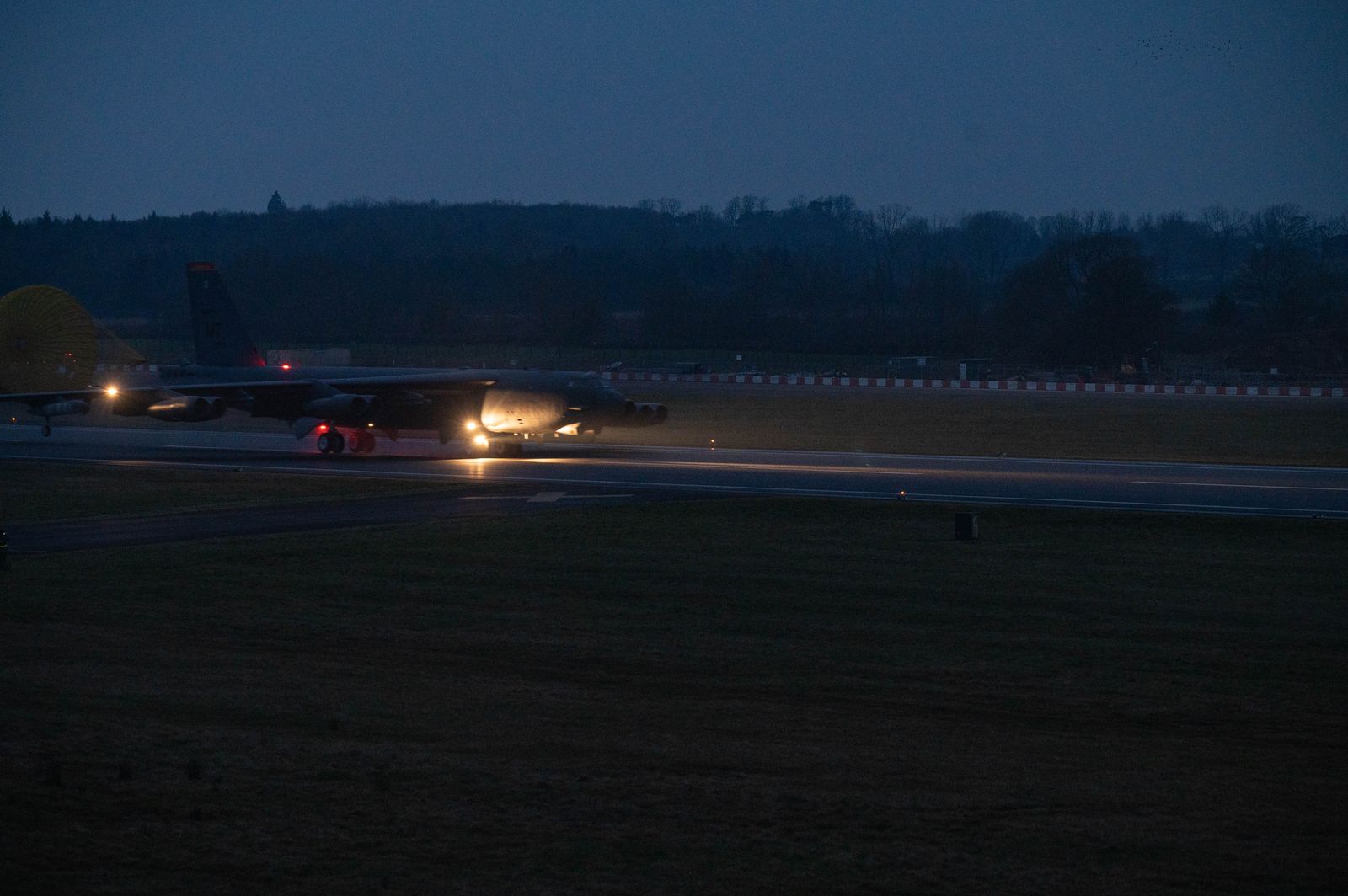
RAF Fairford is not a sleepy provincial aerodrome. It is a Royal Air Force base that functions as a forward operating station for the United States Air Force, and it has been the departure point for American bombers flying missions against Iran during the US-Israel war — with Britain's authorisation, as Kurdish outlet Rudaw and others have noted. Just three days ago, on Tuesday, a B-1 bomber was photographed taking off from Fairford, the image carried worldwide by the Associated Press. If Iran — or anyone acting at its direction — sent operatives to probe, map, or strike a base that launches bombers at Iranian soil, then the war did not stay overseas. It came home to a lane in Gloucestershire, and it was noticed by a farmer, not by a radar. That is the significance of Fairford: it is the hinge between a distant air war and domestic security, and someone appears to have tested it.
The response from Tehran was swift and furious. Iran's embassy in London said it 'categorically rejects and strongly condemns' speculation of Iranian involvement, calling the suggestion unfounded and malicious. Foreign Minister Abbas Araghchi took to X, where he wrote that Burnham was 'barking up the wrong tree', adding — with a flourish that will be quoted back at him — that releasing 'supposed terrorists working for foreign states really says it all'. On Thursday, Iran summoned the British ambassador in Tehran. Within five days, an incident that began as a suspicious-vehicles call had acquired the full furniture of an international crisis: a prime minister's accusation, a foreign minister's insult, a summoned ambassador, and the American president's open dissatisfaction with British bail law.
And then came Thursday's development — the one that gives Burnham's Wednesday claim something to stand on, or something to collapse under. Counter Terrorism Policing announced that a 27-year-old man, a dual UK-Iranian national, had been arrested in the Borough of Westminster in central London 'on suspicion of preparation of terrorist acts under Section 5 of the Terrorism Act 2006'. A second man, aged 26 and a UK national, was questioned under caution, and searches were carried out at two properties in the same area. Vicki Evans, the Senior National Coordinator for Counter Terrorism Policing, said the investigation was 'hugely complex', with specialist teams 'interrogating multiple lines of enquiry', and added the sentence that will dominate the coverage: 'We're looking at all possible angles — including possible foreign state involvement.' The arrest is not a charge, and a dual-nationality arrest is not proof of state direction. But it is the first concrete link between the Cotswolds incident and anything resembling the Iranian angle the prime minister described.
Thursday also delivered the subplot that no serious account of this affair can ignore. Benjamin Netanyahu, the Israeli prime minister, told Fox News that Israel had warned Britain about the attack in advance — and then complained that London sanctioned Israeli settlement products almost immediately afterwards. 'We gave the Brits the intel that there was going to be an attack, and it's an Iranian-sponsored attack,' Netanyahu said. 'And pretty much the next day, they slapped sanctions on us.' The claim has not been corroborated by British officials, and its vagueness is doing a lot of work: Netanyahu did not explicitly tie his warning to Sunday's incident, and the sanctions he cited were announced weeks earlier, on September 8. But the statement matters because it shows how quickly Fairford has been drafted into other countries' narratives — the Israeli prime minister using a still-unexplained British arrest to litigate his own grievances on American television.
None of this makes sense without the war. Over recent months, the United States and Israel have waged a sustained campaign against Iran, and RAF Fairford — British soil, American bombers — has been an open part of it. Britain authorised the use of the base for strikes on Iranian missile sites. That authorisation made Fairford a target in the eyes of Tehran and its sympathisers, whatever the strict legal status of the base. Retaliation against far-flung staging posts is textbook asymmetric response: you cannot sink an American aircraft carrier, but you can send five men with petrol and masks to the perimeter of the base that launched the bombers. Whether that is what happened here remains unproven — the police have charged no one with anything, and Evans's 'all possible angles' is as much a hedge as a promise. But the motive, if a foreign hand is ever established, requires no imagination.
The alternative explanations deserve equal airtime, because the facts are genuinely strange. Five Londoners drive 90 miles to a Cotswold lane in three separate vans; they wear masks; one of them calls 999 before being arrested; no explosives are found; they are bailed within a day. Counter-terrorism analysts note that the profile — five men, three vans, daylight petrol, self-inflicted 999 call — does not match a professional state operation so much as a chaotic, possibly incompetent attempt at something, or even a reconnaissance run by people who got cold feet and a farmer who got suspicious. The police themselves said they were examining whether the men might have been proxies 'knowingly or unknowingly working on behalf of a foreign state' — the 'unknowingly' being a remarkable admission that this could be a case of amateurs recruited over the internet, or a case of nothing at all. The gap between 'strong indications that Iran played a part' and 'five bailed men with jerry cans' is the space in which this investigation will either prove a prime minister right or embarrass him.
Geopolitics. The attribution question is the whole game. A prime minister publicly pointing at Tehran before charges is either a masterstroke of deterrence-signalling or a dangerous gamble: if the evidence holds, Britain has exposed an Iranian operation on its soil and must answer it; if it collapses, Burnham has accused a sovereign state of terrorism on the basis of five baffled Londoners and some petrol. The diplomatic choreography — Araghchi's X posts, the summoned ambassador, Netanyahu's televised claim, Trump's armchair bail critique — shows how quickly a local arrest becomes a stage for everyone else's crisis. Washington's public impatience with British due process is itself a geopolitical event: an ally second-guessing another ally's counter-terrorism in real time, on television, for domestic consumption.
Macroeconomics. Watch the risk pricing, not the headlines. Fairford's military value is inseparable from its economic function: it is a logistics node in a Western security architecture that underwrites shipping lanes, energy flows, and insurance rates. An attack — or even a credible attempted attack — on a US bomber base in England would be priced into risk models across the Atlantic alliance: force-protection spending rises, basing agreements get renegotiated, and the quiet subsidy that cheap American airpower provides to European security gets itemised for the first time. The US-Israel war on Iran is already the most expensive commitment of the decade; a domestic incident converts it from a line item in someone else's budget into a line item in Britain's.
Demographics. The human material of this story is as revealing as the geopolitics. The suspects are young British men in their twenties, Londoners, at least one a dual UK-Iranian national. This is the demographic that intelligence services on every side now fight over: young, mobile, digitally reachable, ethnically connected to the adversary's diaspora. Iran's intelligence services have a documented appetite for diaspora recruitment — low-cost, deniable, and executed by people with valid passports and local accents. If Thursday's arrest leads anywhere, it will lead into London's Iranian diaspora, a community of hundreds of thousands who have spent the war years watching their homeland bombed on television and their adopted country launching the bombers. Whatever the truth of Fairford, that community is about to be looked at very hard, and the political question of how hard is itself a story.
Historical patterns. Britain has been here before — the strange incident, the early attribution, the diplomatic escalation, the long wait for charges that may never come. The pattern of state-linked plots on British soil runs through the last decade: nerve agents in Salisbury, foiled bombings, MPs threatened, journalists intimidated. Each followed the same rhythm: an odd, almost amateurish operational footprint; a government that names the foreign hand early; a long, grinding investigation; and an evidentiary record that arrives years later, if at all. Fairford fits the rhythm almost too neatly, which is precisely why sceptics urge caution: the rhythm is also the rhythm of governments reaching for the foreign-state explanation because it is cleaner than admitting that five confused young men drove three vans to a bomber base and nobody knows why.
Structural trends. The deeper story is the erosion of the perimeter. Fairford is a strategic military installation, and it was compromised — or at least approached — not by cyber-attack or long-range strike but by five men in vans spotted by a farmer. The most expensive airpower on earth is protected at its home station by a fence, some cameras, and the vigilance of locals. This is the structural vulnerability of expeditionary basing in the 21st century: the base is a fortress abroad and a neighbour at home, subject to planning disputes, footpaths, and farmers. Every Western airbase that launches strikes against someone's homeland is now a soft target for that someone's sympathisers, and no amount of technology changes the arithmetic that a Cotswold lane runs past the fence. The farmer, not the radar, caught this one. Next time the farmer might be asleep.
Four questions will decide what Fairford becomes. First, will anyone be charged — and with what? The five original suspects remain on bail and 'absolutely under investigation'; the dual national arrested Thursday has not been charged either. A charge under Section 5 of the Terrorism Act 2006 would mean the police believe they can prove preparation of terrorist acts, which requires evidence of intent, not just petrol. Second, what does 'foreign state involvement' actually mean? Vicki Evans's phrase covers everything from an Iranian intelligence officer directing the operation to a Londoner recruited over encrypted chat to a man who once liked the wrong post. The distance between those possibilities is the distance between war and farce.
Third, the diplomacy. Iran has summoned Britain's ambassador; Britain has accused Iran's government; the United States is publicly unhappy with Britain's handling; Israel claims it warned everyone. Each of those threads can tighten independently of the evidence. If Tehran decides Burnham's accusation requires a response beyond words, the escalation ladder from here is short. And fourth, the political question in London: a prime minister has staked his credibility on 'strong indications' of Iranian involvement. If the investigation ends with minor charges or none at all, the opposition — and the press, and Tehran — will not let him forget it. The strangest thing about Fairford, five days in, is that the least explained part of the story is still the first part: five masked men, three white vans, a country lane at 3 a.m., and a farmer who did exactly the right thing.
From the Western perspective, this is the nightmare scenario that security establishments have been warning about for years: a foreign state — or its proxies — reaching into a domestic military installation that underwrites American airpower. The sequence reads as textbook Iranian asymmetric response. Britain authorised Fairford for strikes on Iranian missile sites; Tehran, unable to contest the air war directly, sends deniable operatives to probe or punish the staging base. Burnham's public attribution is therefore read in Western capitals as long-overdue candour: naming the threat is the first step of deterrence, and Thursday's arrest of a dual national suggests the investigation is catching up with the politics.
The Western lens also dwells on the bail decision, and not kindly. To Washington — and to a good share of the British press — releasing five terror suspects within a day of an incident at a US bomber base looks like weakness, whatever the procedural logic of British counter-terrorism law. Trump's 'I wouldn't have done that' and Rubio's 'disturbed' are not just theatre; they reflect a genuine Atlantic divergence on risk tolerance. The West's bottom line: the war on Iran has come home, and the homeland's defences are a fence and a farmer.
From the Eastern perspective, Fairford is a case study in how quickly the West manufactures a casus belli out of confusion. Tehran's denials are treated seriously here: Iran categorically rejects involvement, its embassy calls the speculation malicious, and Araghchi's 'barking up the wrong tree' lands as a fair description of an accusation built on five baffled Londoners and jerry cans of petrol. The Eastern read notes the conspicuous absence of evidence — no explosives, no charges, five men bailed within a day — and asks the obvious question: if Iran ran this operation, why does it look like a prank?
The Eastern lens also sees a political operation, not a police one. Burnham's televised attribution, delivered before a single charge, is read as London laundering its own complicity in the war on Iran into a victim narrative — Britain authorised the strikes from Fairford, and now claims the base's targeting proves Iranian aggression rather than Iranian retaliation. Netanyahu's Fox News appearance, in this telling, is the tell: Fairford is being harvested by everyone with an axe to grind, and the truth of what happened at 3 a.m. in Whelford is the least important thing in the room.
From the Global South perspective, Fairford is above all a story about whose wars get to arrive where. For much of the world, Western bases have spent decades launching strikes into other countries' homelands with impunity; the shock in London that the war might send something back is read with weary familiarity. Al Jazeera's coverage — Burnham's 'strong indications' set against Tehran's angry denial — captures the structural asymmetry: when the West bombs Iran from Fairford, it is strategy; when Iran is accused of touching Fairford, it is terrorism. The South's question is not whether Iran did it, but why only one direction of violence gets a legal vocabulary.
The Global South lens also reserves its sharpest attention for the procedure. Five men arrested in a blaze of bomb robots and evacuations, released on bail a day later, a prime minister naming a foreign state on television before any charge, an American president grading another country's bail law on air — this is how justice looks when it is performed for allies rather than practised for citizens. The South has watched this film before, in other capitals, with other accused foreigners. Its verdict is provisional but pointed: show the evidence, or admit that a farmer's phone call has been promoted into a casus belli.
Beijing just wrote the biggest liquidity check of the year — and changed nothing else.
The People's Bank of China will offer banks up to one trillion yuan a day — about $149 billion — in overnight funds from September 28 through October 8, covering the Golden Week holiday. It is the largest such cap since the tool's introduction in June 2026, up from 600 billion yuan in mid-September.
The calendar explains the timing. Golden Week sends hundreds of millions of Chinese traveling and spending; banks need cash the way airports need runways. The central bank is making sure the plumbing holds.
The scale, though, is the story. One trillion yuan a day is not holiday housekeeping. It is a backstop — a signal that whatever the holiday throws at the financial system, the PBoC has already covered.
And then, the other hand: nothing. Chinese banks left the one-year and five-year loan prime rates unchanged at 3.00% and 3.50% — the 16th consecutive month without a move.
Sixteen months of stillness in the price of credit, alongside the largest liquidity flood of the year. Beijing is watering the garden and refusing to lower the fence — liquidity yes, cheaper credit no.
Governor Pan Gongsheng gave the doctrine a name: slower loan growth is becoming "the new normal." Property and local-government borrowing are shrinking faster than emerging industries can borrow. The credit engine is being rebuilt mid-flight.
Liquidity is Beijing's answer to everything except the one question markets keep asking: where is the growth?
The PBoC is not idle elsewhere. It stepped up support with a net 200-billion-yuan injection through medium-term lending facility operations, reiterated its "moderately loose" stance, and kept its grip on the yuan.
The yuan, for its part, cooperated — rebounding after briefly dipping below 6.70 per dollar as US Treasury yields rose and the PBoC's grip eased.
The diplomacy helped. A US–China summit extended the trade truce to January — without new tariff cuts, but without new tariffs either. A truce, not a peace; markets will take it.
Step back and the contrast is the story. In Washington, yields cross 5% and traders bet on another hike. In Beijing, the central bank floods the system with cash and leaves rates untouched for a 16th month. Two central banks, two planets.
The logic is not mysterious. China's problem is not hot demand — it is cold credit. Pumping liquidity keeps the system liquid; cutting rates into weak demand would be pushing on the proverbial string.
The risk is the one Beijing knows best: banks awash in cash, with nowhere productive to lend it. Liquidity without lending becomes asset froth — the 2015 lesson, still fresh in institutional memory.
For the region, the signal matters more than the mechanics. A stable yuan and a liquid Chinese banking system through Golden Week is the foundation under Asia's supply chains. When Beijing sneezes, the region's exporters reach for tissues.
Watch what happens after October 8. If the trillion-yuan window closes quietly, it was holiday plumbing. If support lingers, it was something else — a central bank telling you, without saying it, that the economy needs the help.
Western coverage — Reuters and the financial wires — emphasizes the restraint: Beijing holding rates while flooding liquidity, a central bank running out of its favorite tools.
In this telling, 16 months of unchanged loan prime rates is the real headline — evidence of a policymaker boxed in by a hawkish world, a weak property sector, and the fear that rate cuts would only weaken the yuan. Liquidity is what you do when you've decided rates can't move.
Pan's "new normal" gets a skeptical hearing: an elegant phrase for a credit engine that no longer transmits. The question in Western commentary is whether "moderately loose" is a stance or a shrug.
Eastern coverage — Xinhua and Chinese outlets — emphasizes the calibration: targeted, seasonal, and exactly as doctrine prescribes.
In this telling, the trillion-yuan facility is textbook PBoC: precise, time-bound, and aimed at a known seasonal need. The unchanged rates are not paralysis but prudence — "moderately loose" means loose where it counts, steady where it matters, with the yuan's stability as the binding constraint.
The summit's truce extension gets equal billing: diplomacy buying the central bank room to maneuver, and the maneuver working — the yuan's rebound presented as policy competence, not luck.
Global South coverage — Malaysia's business press among it — emphasizes the neighborhood: what Beijing's plumbing means for everyone downstream.
The read from Kuala Lumpur: a liquid China through Golden Week is good news for ASEAN exporters, supply chains, and the region's own central banks. Yuan stability is a public good in Asia, and the PBoC just underwrote another week of it.
The caution in this coverage is borrowed from experience: when the region's biggest economy needs record liquidity to get through a holiday, the "new normal" of slower credit is everyone's normal too.
To read Beijing's move properly, you need the toolkit. Start with the overnight reverse repo — the instrument at the center of the trillion-yuan headline. In a reverse repo operation, the central bank lends cash to commercial banks overnight, taking bonds as collateral; the banks get the liquidity they need, the central bank gets the bonds back the next morning plus a sliver of interest. It is plumbing, not policy: the money created exists for a day, maybe rolled over, and its purpose is to keep the interbank market — the market where banks lend to each other — from seizing. The cap is the message. A trillion yuan a day says: whatever the holiday throws at the system, the PBoC has already covered.
The tool itself is young — introduced only in June 2026 — which makes the record cap more interesting. A new instrument's ceiling is normally discovered cautiously; jumping from 600 billion yuan in mid-September to a full trillion two weeks later is not calibration but declaration. It tells the banks, and through them the market, that the central bank will not be outbid by seasonal stress. The facility runs September 28 to October 8, covering Golden Week exactly. Time-bound, enormous, and explicitly temporary: the PBoC is writing a check it intends to tear up on the 9th. The question the article ends on — what happens after October 8 — is the only one that matters, because a backstop that lingers stops being a backstop and starts being a subsidy.
Then the medium-term lending facility — the MLF — through which the PBoC added a net 200 billion yuan. If reverse repos are the overnight overdraft, the MLF is the term loan: banks borrow for months, not hours, pledging collateral, at a rate the central bank sets. The MLF rate is the PBoC's quiet policy lever — it guides the loan prime rates without the drama of changing them. And the loan prime rates, the LPRs, are the number the article keeps returning to: 3.00 percent for one year, 3.50 percent for five, unchanged for the sixteenth consecutive month. The LPR is the benchmark for most new lending in China; holding it still while flooding the system with cash is the whole doctrine in one gesture. Liquidity yes. Cheaper credit no.
The sixteen months of stillness deserve their own reading, because stillness is also a decision — sixteen times over. In a world where Washington is hiking and yields cross 5 percent, cutting Chinese rates would narrow the already thin cushion against capital outflow and yuan depreciation; every basis point of easing is a basis point of incentive for money to leave. The PBoC's box, as the Western lens describes it, is real: a property sector that no longer transmits stimulus, local governments deleveraging rather than borrowing, and a currency whose stability is the binding constraint on everything else. Holding the LPR is not paralysis. It is the recognition that the price of credit is no longer the economy's binding constraint — and that moving it would cost more in currency stress than it buys in growth.
The calendar explains the timing, as the article says — but the calendar deserves its scale stated plainly. Golden Week is the largest annual human migration on earth compressed into seven days: hundreds of millions of Chinese traveling, spending, withdrawing cash, settling bills. The banking system's cash demand does not rise. It detonates. ATMs must be stocked, merchants' settlement accounts funded, the interbank market supplied with enough reserves to clear a week's worth of the world's second-largest economy changing hands. In normal years, the PBoC manages this with routine open-market operations. This year it wrote the biggest check in the tool's short history.
The scale, though, is the story — the article's line, and worth pressing. One trillion yuan a day is not holiday housekeeping; it is a backstop sized for something the PBoC sees and the market does not yet. Seasonal demand explains the facility's existence. It does not fully explain its size. Either the central bank is being theatrically cautious — signaling strength by oversupplying safety — or its internal read on holiday-season financial stress is darker than the public data. Both readings are consistent with "moderately loose." Only one of them is reassuring. The banks will take the cash either way; the signal is in the surplus.
There is also the consumption angle, which is where the liquidity meets the real economy. Golden Week is China's great annual test of consumer confidence: the week when households vote with their wallets on whether the economy feels safe. A banking system visibly backstopped — cash available, payments clearing, no friction — is the precondition for the spending the state wants to see. The PBoC cannot make households spend; it can only ensure that nothing in the plumbing stops them. In an economy where the consumer has been the missing piece and property wealth no longer does the spending's work, the holiday's cash registers matter more than the interbank rate. The trillion yuan is, among other things, a bet on the tills.
And the regional read — the Global South lens from Kuala Lumpur — captures what the holiday means beyond China's borders. A liquid China through Golden Week is the foundation under Asia's supply chains: exporters paid, importers funded, the region's own central banks spared the volatility of a yuan under holiday stress. Yuan stability, as the article notes, is a public good in Asia, and the PBoC just underwrote another week of it. When the region's biggest economy needs record liquidity to get through a holiday, the "new normal" of slower credit becomes everyone's normal — but a stable holiday is still a stable holiday, and Asia's exporters will take it.
Central bankers choose their phrases the way diplomats choose communiqués — every word weighed, every ambiguity intentional. When Governor Pan Gongsheng said slower loan growth is becoming "the new normal," he was not describing a statistic. He was retiring an expectation. For two decades, China's credit engine ran on a simple formula: property developers borrowed, local governments borrowed against land, and the resulting construction carried GDP. That engine is being dismantled mid-flight — property deleveraging, local-government debt discipline — faster than emerging industries can borrow to replace it. "New normal" is the doctrine that says: stop waiting for the old credit cycle to return. It is not returning.
The doctrine has a logic, and it is worth steelmanning before doubting. Credit-fueled growth bought China two decades of expansion and left it with the property crisis, the local-government debt pile, and the demographic headwinds now arriving together. Pumping cheap credit into that structure — the old playbook — would reflate the very imbalances the state is trying to defuse. Slower, cleaner credit growth, directed at manufacturing upgrades and strategic industries rather than concrete, is the quality-over-quantity bet. The PBoC is not refusing to stimulate. It is refusing to stimulate the old economy. The distinction is the entire policy.
The risk, as the article notes, is the one Beijing knows best: banks awash in cash with nowhere productive to lend it. Liquidity without lending becomes asset froth — the 2015 lesson, still fresh in institutional memory, when stimulus leaked into equity speculation rather than productive investment. The trillion-yuan facility, the 200-billion MLF injection, the "moderately loose" stance — all of it presupposes transmission channels that the "new normal" itself describes as weakened. Watering the garden, to use the article's image, works only if the soil still absorbs water. If property and local governments no longer drink, and emerging industries cannot drink fast enough, the water pools. Pooled liquidity has a history in China. It is called a bubble.
Step back and the contrast the article closes on — two central banks, two planets — is the frame that will define the autumn. Washington hikes into data it may not have, fighting inflation with the South's interest bills. Beijing floods with cash it cannot lend, defending a currency it cannot afford to let slip, waiting for a credit engine it is rebuilding mid-flight. Neither has a clean instrument. Both are improvising inside doctrines — data-dependence, the new normal — that describe the world they wish they governed. Watch October 8: if the trillion-yuan window closes quietly, it was holiday plumbing, and the doctrine holds. If support lingers, the PBoC will have told you, without saying it, that the new normal needs more help than the old vocabulary admits.
Monetary policy does not happen in a diplomatic vacuum, and the PBoC's autumn maneuver owes more to the summit than the communiqués admit. The US–China meeting extended the trade truce to January — no new tariff cuts, but no new tariffs either — and that pause is worth more to Beijing's central bank than any single instrument in its toolkit. Tariff escalation would have meant a weaker yuan, imported inflation, and capital flight arriving together; the truce removes the worst tail from the PBoC's planning. "A truce, not a peace; markets will take it," as the article says. So will central bankers.
The yuan's rebound — recovering after briefly dipping below 6.70 per dollar — is the truce's signature in the currency market. With US Treasury yields rising and the PBoC's grip easing, the currency found its footing not through intervention but through the removal of a threat. That distinction matters: a yuan steadied by diplomacy is cheaper to defend than a yuan steadied by reserves. Every week the truce holds is a week the PBoC does not have to choose between growth and the exchange rate — the choice that has boxed in Chinese policy for the better part of a decade.
But truces expire, and January is closer than it looks. The extension without tariff cuts is a freeze, not a thaw: the existing duties remain, the structural disputes untouched, the next escalation one headline away. The PBoC is therefore managing a window, not a settlement — using the diplomatic calm to get through Golden Week, to steady the currency, to buy the "new normal" time to prove itself. If January brings escalation, the trillion-yuan plumbing will look like the prelude to a harder season. Diplomacy bought the central bank room to maneuver, as the Eastern lens notes. Room is not resolution. It is rented, monthly, and the rent comes due in January.
