Russian ballistic missiles hit Kyiv's power grid and a block of flats for a second night with no warning, as Ukraine's president flies to London seeking faster weapons and sanctions.
Published 14 October 2026 · 06:00 GMT
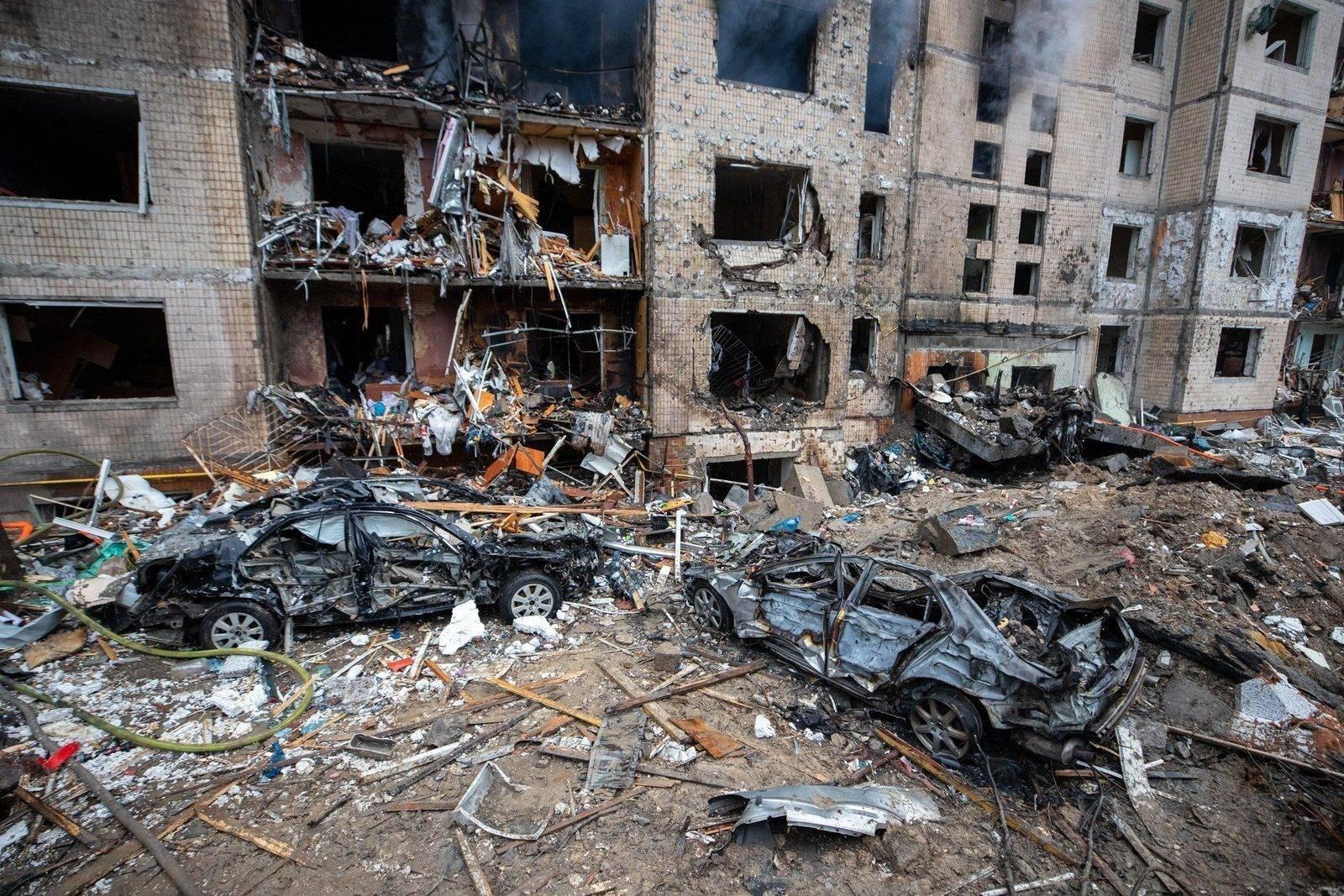
The sirens stayed silent. Just before 10:40 p.m. on Tuesday, Russian ballistic missiles slammed into Kyiv, hitting a key thermal power plant and setting a block of flats ablaze — the second night in a row that Ukraine says it received no warning from its partners. The war's energy front has reached the capital.
The sirens stayed silent. Just before 10:40 p.m. on Tuesday, Russian ballistic missiles slammed into Kyiv. One of the main targets was thermal power plant No. 4, known as CHPP-4, one of the capital's key energy facilities. A nine-storey block of flats was also hit, apartments caught fire, and residents were evacuated into the night. Mayor Vitali Klitschko said at least one person was killed in the strike on the building.
It was the second night in a row that Ukraine says it received no warning from its partners. On Monday evening, five ballistic missiles hit civilian infrastructure in Kyiv, President Volodymyr Zelensky said, again without the early warning that has previously given air defences and civilians precious minutes. Zelensky said Ukrainian systems detected the missiles only when they were already virtually on approach to Kyiv. He added that Ukrainian intelligence believes Russia is preparing further ballistic launches.
Two nights, no warning, and the missiles found the power plant.
The human toll spread far beyond the capital. Ukrainian officials said at least four people were killed and 41 injured in Russian strikes across the country on Tuesday. In Kharkiv, Ukraine's second city, four people were killed when a residential building was destroyed. In Rivne, in the north-west, a drone struck an educational institution and injured 14 people. In the Kyiv region's Fastiv district, one person was killed and at least two were hurt. A woman was wounded in a strike on a private home in Kyiv's Darnytskyi district, and a Russian drone hit a residential building near Lviv. The strikes formed part of a wider barrage in which, Zelensky said, Russia used more than 100 weapons overnight, including jet-powered drones, loitering munitions and ballistic missiles.
Early warning of a ballistic launch depends on satellites that spot the heat of a rocket motor seconds after liftoff, plus radar tracking that turns that flash into a warning with minutes to act. Ukraine has long relied on American systems for that first alert. Fabian Hoffmann, a missile expert at the Norwegian Institute for Defence Studies, said Ukraine's European allies had very limited ability to replace American early-warning intelligence. Ukraine relies on the American Space-Based Infrared System, he said, a network he described as second to none.
The silence landed in the middle of a row over intelligence. Reuters and other outlets have reported that American officials threatened to cut off intelligence sharing and weapons sales unless Ukraine stops attacking Russian refineries. Kyiv depends heavily on American intelligence for early warnings of missile strikes, officials and experts say. Asked about the reports on Tuesday, Trump said Washington was still sharing intelligence. “We are helping them, and we are sharing intel,” he told reporters. Zelensky stopped short of linking the missing warnings to any American threat.
Behind the pressure sits fuel. Trump has struck an arrangement with Moscow to bring Russian diesel to world markets, describing tranches of more than 300,000 tonnes at once, 500,000 tonnes in November and a further one million tonnes shortly afterwards, according to CNBC. The aim, as presented in Washington, is to ease fuel prices before America's midterm elections. A bipartisan group of six American senators, including four Republicans, urged the administration to reverse course, arguing the United States should not hand Moscow a financial lifeline while Russia kills Ukrainian civilians.
On Sunday, October 11, Trump announced on social media that an energy ceasefire between Russia and Ukraine was effective immediately, writing that both parties had agreed. Neither side had publicly confirmed any agreement. Zelensky said the announcement was news to him. He said Ukraine supports an energy ceasefire and would halt strikes on Russian energy sites if Russia reciprocated, but that Kyiv was still awaiting details from Washington. In Moscow, Kremlin spokesman Dmitry Peskov said only that contacts on the matter continue. Foreign Minister Sergey Lavrov dismissed the idea, and Peskov later said the Kremlin does not want a ceasefire but long-term peace.
The facts on the ground did not wait for the diplomacy. Zelensky said Russia struck six Ukrainian energy facilities within hours of the announcement, and that 19 regions came under attack over two days. He said Ukraine had not hit Russian oil refineries or other energy sites in the two days since the announcement — a claim that could not be independently verified. Russia's Defence Ministry, for its part, said its air defences intercepted 151 Ukrainian drones overnight, a figure that also could not be independently verified. A significant proportion of the incoming weapons were shot down, but not all of them, Zelensky said.
Europe answered with sanctions and scepticism. On Monday, European Union foreign ministers approved 1,569 new names for their sanctions list, described as the largest single package since Russia's full-scale invasion in 2022. German Chancellor Friedrich Merz said Russia would only negotiate seriously under pressure. EU foreign policy chief Kaja Kallas said she had not yet seen Russia stick to any energy halt, and that she would prefer a wider ceasefire that includes people not being killed.
Zelensky arrives in London on Wednesday, October 14, to meet Prime Minister Andy Burnham at Downing Street. Burnham has pledged £45 million — about $59.6 million — of surface-to-air missiles to target jet-powered Russian drones, with £10 million of that package fast-tracked for urgent need. Britain will also speed up deliveries of lightweight multirole missiles, which have proved effective against those drones. Burnham has asked officials to draw up further sanctions, military aid and fiscal support, and his foreign and finance ministers have been lobbying allies to follow Britain in banning maritime services that support Russian liquefied natural gas exports.
The visit follows a bruising few days. Trump said at the weekend that Zelensky should be replaced as Ukraine's leader, days after the diesel arrangement with Moscow. Britain has said it does not support the diesel deal and has called for allies to keep economic pressure on Moscow. Burnham telephoned Zelensky on Saturday to express what London called complete solidarity. Foreign Secretary Ed Miliband described a very difficult few days in relations with Washington. Chancellor John Healey used IMF meetings in Bangkok to press allies for a ban on Russian liquefied natural gas.
Winter gives the London talks their urgency. Russia began its latest strike campaign against Ukraine's grid about two weeks ago, already causing daily, hours-long power cuts in Kyiv, straining the capital's water and sewage systems and twice bringing its underground trains to an abrupt halt. Thermal plants like CHPP-4 are the backbone of city heating as temperatures fall. Zelensky said his government is working to replenish air defences with anti-ballistic missiles, and that resilience plans for cities and regions are further advanced than in earlier winters, even in border and frontline regions.
What to watch now is whether the warnings come back. If early-warning intelligence resumes, Kyiv's air defences regain the minutes that save lives; if not, every ballistic launch becomes a test of whether Europe can fill a gap its own experts describe as very hard to fill. Watch, too, what London actually delivers beyond the missile package, whether Washington's pressure on refinery strikes hardens into a real cutoff, and whether the so-called energy ceasefire acquires terms, a start time, or a monitor — or stays a post.
For now, Kyiv counts two nights of missiles, two nights of silence, and a war entering another winter with its power plants on the front line. Zelensky carries that arithmetic into Downing Street. The question is whether Britain, Europe and the United States can turn pledges into protection before the cold does what the missiles started. The stakes reach beyond Ukraine, into the wider contest over Russia's war and the credibility of the energy ceasefire Washington announced.
From Western capitals, the two silent nights read as a stress test of the alliance itself. The missing warnings raise a blunt question: whether Washington's intelligence pipeline to Kyiv is still unconditional, or whether it has become leverage in a dispute over refinery strikes and diesel prices. London's answer, delivered before Zelensky even lands, is to move faster — missiles, sanctions, fiscal support — and to rally others to squeeze Russian liquefied natural gas.
The Western reading also treats the energy ceasefire as a lesson in how not to announce peace. A post without terms, monitors or signatures left Kyiv exposed and Moscow uncommitted, and the strikes that followed hardened the European view that pressure, not declarations, is what changes Russian behaviour.
From Moscow's vantage, the week looks different. The Kremlin has said it does not want a ceasefire but long-term peace, and its officials argue that short pauses let Ukraine rearm — the same reasoning Foreign Minister Lavrov offered when dismissing the energy halt. In this reading, Kyiv's refinery strikes, not Russian missiles, are the escalation that forced Washington to apply pressure, and the diesel arrangement is pragmatic commerce in a tight fuel market.
The Russian reading also notes what Kyiv's account leaves out: Moscow says its air defences intercepted scores of Ukrainian drones, and it treats Ukrainian claims about warning gaps as a dispute between Kyiv and its partners, not as evidence about Russian operations.
From much of the Global South, the week's defining image is not a missile but a transaction: diesel for restraint, announced over the heads of the people living under the strikes. Governments that buy fuel on world markets watch the Russian diesel arrangement for what it does to prices at home, and many read the energy-ceasefire episode as a reminder that great-power deals are struck first and explained later — if at all.
The Southern reading also keeps score on civilians. Power cuts, water strain and apartment blocks on fire are the costs that fall on ordinary Ukrainians, and they land in countries already juggling food prices, fuel bills and their own winters. For them, the test of any ceasefire is simple: the lights stay on, or they do not.
Ukraine says its partners gave no early warning before ballistic strikes on two consecutive nights, although such warnings had previously been routine. Kyiv has not named the partner it expected the warning from, and Trump says Washington is still sharing intelligence. Experts note Ukraine relies on American satellite detection, which European allies cannot readily replace.
On Sunday, October 11, Trump announced that Russia and Ukraine had agreed to stop striking each other's energy infrastructure, effective immediately. Neither Moscow nor Kyiv had publicly confirmed an agreement. Zelensky said the announcement was news to him, and that Ukraine would comply if Russia did. Russia said contacts on the matter continue.
In London, Zelensky is seeking faster weapons, more sanctions and fiscal support. Britain has pledged £45 million of surface-to-air missiles against jet-powered drones, with £10 million fast-tracked, plus faster deliveries of lightweight multirole missiles. London is also lobbying allies to ban maritime services supporting Russian liquefied natural gas exports.
Not yet, but the pressure is mounting. Russia's latest grid campaign has already caused daily hours-long power cuts in Kyiv, strained water and sewage systems, and twice halted the metro. Thermal plants such as CHPP-4 are central to city heating. Zelensky says resilience plans are further advanced than in past winters, and air defences are being replenished.
