Al Jazeera footage shows a residential building in Gaza City’s Al-Rimal neighbourhood reduced to rubble on the ceasefire’s first anniversary — capping a 48-hour wave of evacuation orders and night strikes that killed at least seven Palestinians.
Published 11 October 2026 · 00:06 GMT
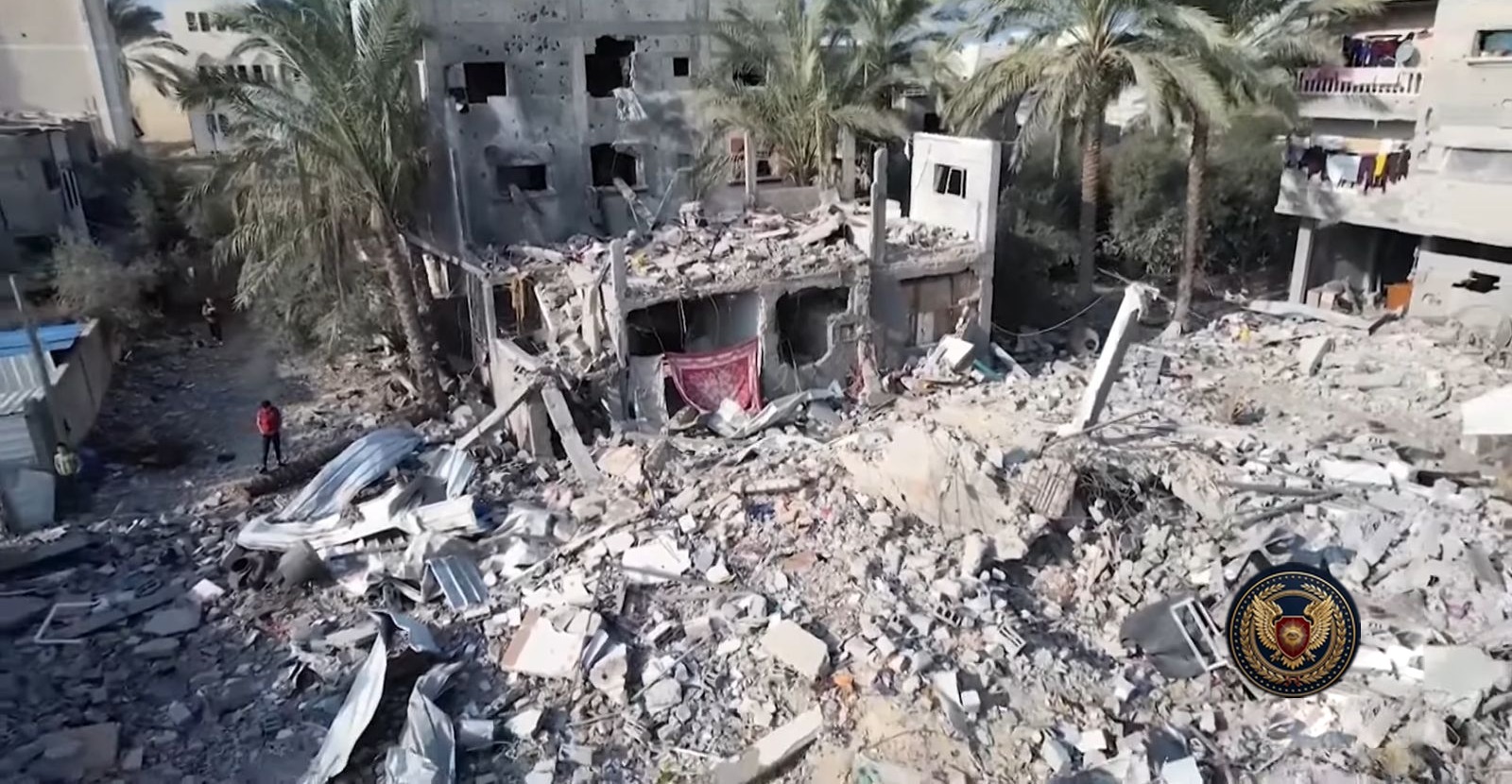
One year to the day after a US-brokered ceasefire was supposed to silence Gaza’s guns, an Israeli strike flattened a residential building in Gaza City — and footage published by Al Jazeera on October 10, 2026, shows the Al-Rimal neighbourhood block reduced to a cratered pile of concrete and rebar. It was not an isolated event. On the night of October 8–9, the Israeli military ordered residents of several blocks in Gaza City and Khan Younis to evacuate in the dark, then bombed the buildings they had fled.
The cost was immediate. A displaced child and a woman of the Abu Asr family, who had fled earlier fighting in Shujaiya, were killed while trying to get out; at least seven people were wounded, including a journalist helping residents leave. In Khan Younis, warplanes hit homes in the Katiba area twice shortly before midnight on Thursday, destroying or badly damaging several houses and sending hundreds into the streets. On Saturday, Reuters reported at least five more Palestinians killed in two strikes: four near Panda Mall in Gaza City, one in the Tuffah neighbourhood.
Israel’s stated reason for the anniversary-eve strikes is familiar: the military said it was destroying four weapons storage facilities belonging to Hamas and Islamic Jihad — the same explanation offered for similar strikes throughout the ceasefire year. Palestinian factions deny the claim and accuse Israel of deliberately destroying standing residential buildings. For the Saturday strikes, the military said only that it had “targeted militants,” without detail.
The ceasefire year’s casualty ledger is grimly specific. The Gaza Health Ministry and the government media office count at least 1,478 Palestinians killed and more than 5,000 wounded since October 10, 2025; Reuters and Human Rights Watch put the toll at more than 1,400 killed and 4,881 wounded. Israel says four of its soldiers were killed by militants in the same period; the Associated Press says five.
The territorial picture shifted under the ceasefire’s cover. Israel now controls more than 63 percent of Gaza after expanding within the so-called Yellow Line — the October 2025 deal’s demarcation line — over twelve months. Gaza’s government media office says Israel committed 5,223 on-the-ground violations of the agreement: bombing, gunfire, demolitions, incursions. UN monitors recorded 196 Palestinians killed near the Yellow Line between the ceasefire’s start and early April 2026, and estimate access-restricted areas now cover roughly 65 percent of the Strip.
The exact time of the strike is not confirmed, and no casualty figure specific to that building has been reported — the five deaths Reuters documented on Saturday were at Panda Mall and in Tuffah, different locations. There is also a genuine location puzzle: Al Jazeera’s footage places the destroyed building in Al-Rimal, while the most detailed written account of the anniversary-eve wave puts the two destroyed Gaza City buildings in Sabra and the Old City. Whether these are different strikes in the same wave or a reporting mismatch is unclear.
Nor can the central military claim be independently verified: whether the buildings destroyed on October 8–9 actually contained weapons storage, as Israel says, or were simply homes, as Palestinian factions say. And the most consequential unknown is human — where the hundreds displaced by this week’s evacuation orders and demolitions are supposed to go, in a territory where reconstruction has not begun and most land sits behind a military line.
The timing is the story. A ceasefire’s first anniversary is the moment the world checks the ledger — and this week’s ledger is devastating. Twelve months after the October 2025 deal, the Trump-chaired Board of Peace counts prisoner exchanges and donor pledges as achievements, while more than 1,400 people have died and the agreement’s core provisions — a stabilisation force, a functioning Palestinian administration, reconstruction — exist only on paper. Our assessment of the Board’s first year is here: the Gaza ‘ceasefire’ that never stopped the killing.
UN Secretary-General António Guterres appealed ahead of the date: “It is time for the ceasefire to become permanent. It is time to allow humanitarian assistance at scale. And it is time to respect international law.” Human Rights Watch’s Sarah Sanbar warned that “the outside world may be under a dangerous illusion that life in Gaza is returning to normal, but reality tells a very different story. There is nothing normal about living in a tent under bombardment, without enough food or drinking water for your family.”
The strikes also test the deal’s enforcement machinery at its weakest point. UN Security Council Resolution 2803 authorised the Board of Peace to assess compliance — but the Board has no troops deployed to point to. The stabilisation force announced in February was never established, Indonesia suspended its 8,000-troop pledge last spring, Hamas formally dissolved its government in July while keeping the civil service, and Israel barred the new Palestinian administration from entering through Egypt. A compliance assessment with no enforcement behind it is a verdict without a court.
Step back and a pattern emerges larger than any single strike. The October 8–9 operation followed a tactic routine in the ceasefire year: evacuation orders issued at night, then demolition of the emptied buildings. Humanitarian organisations have long argued that ordering civilians out before destroying their homes still destroys their homes — the displacement is the point, whatever the stated target. With hundreds newly displaced this week and no reconstruction begun, each such operation permanently shrinks Gaza’s liveable map.
Then there is the Yellow Line. A demarcation line is supposed to freeze positions; this one has moved. Israeli control of more than 63 percent of the territory, with roughly 65 percent under access restrictions, means the ceasefire year has been territorial consolidation disguised as truce — while Hamas remains dominant in the roughly 40 percent outside Israeli control. A partition hardening under the label of peace.
And the numbers deserve a cold reading. Between 1,400 and 1,478 Palestinians killed during a ‘ceasefire’ year is not a truce frayed at the edges; it is a low-intensity war inside a diplomatic fiction. The fiction matters because it shapes what the world does next: donors pledge to a peace, the Board of Peace assesses compliance with an agreement never implemented. Anniversaries force the fiction into the open. This one did.
The first ripple is diplomatic. Egypt and Qatar, mediators of the October 2025 deal, staked credibility on an arrangement visibly failing; eight Arab and Muslim nations already condemned Israeli actions as ‘repeated violations’ months ago. If the anniversary week ends with rubble in Al-Rimal rather than renewed commitment, the mediators’ leverage — spent once already — shrinks further.
The second ripple is institutional. The Board of Peace’s compliance assessment under Resolution 2803 was designed as the deal’s accountability mechanism. But an assessment that finds systematic violations, with no stabilisation force to deploy and no lever to pull, risks becoming a document that proves the institution’s irrelevance. The suspended Indonesian pledge and the stillborn February force are the precedents; a paper verdict would be the confirmation.
The third ripple is humanitarian and compounding. More than 74,000 Palestinians have been killed since October 2023, including over 21,000 children, per the Gaza Health Ministry via Human Rights Watch. Each new displacement wave — hundreds more this week — lands on a population with no reconstruction and shrinking liveable space, winter approaching. The ‘ceasefire’ label does not merely misdescribe this reality; it diverts the urgency a recognised war would command.
The immediate watch is the rest of the anniversary weekend: whether the strikes of October 8–9 and 10 were the wave or its beginning. The military’s language — “targeted militants,” weapons storage — leaves room for further operations, and past anniversary-adjacent escalations have rarely been single nights.
The political watch is the Board of Peace’s compliance assessment. Resolution 2803 gave the Board the job of judging whether the ceasefire is honoured; the anniversary supplied the evidence — 5,223 recorded violations, a moving Yellow Line, hundreds dead per quarter. What the Board does with it, and whether Washington backs enforcement or files the report, decides whether the ‘ceasefire’’s second year differs from the first.
And the human watch is the displaced — hundreds ordered from their homes this week, the Abu Asr family burying a child and a mother killed mid-evacuation, joining the Strip’s vast displaced population with nothing rebuilt to return to. Until reconstruction begins, every destroyed building is a permanent subtraction. That is the anniversary’s arithmetic.
The Western framing, led by Reuters, treats the strikes as a security operation inside a fragile but real diplomatic framework: Israel says it targeted militants and weapons stores, accuses Hamas of rearming in violation of the October deal, and the story is filed as counterterrorism with civilian costs. The anniversary becomes a test of whether the Trump-brokered arrangement survives its first year — with casualty figures reported inside a narrative of mutual violations. The earlier pattern of Israeli warnings fits the same frame: Israel’s warnings that Gazans “will pay heavily”.
The Eastern framing, carried by Al Jazeera, presents the anniversary strikes as proof that the ‘ceasefire’ has covered a continued war by other means: night evacuation orders, then demolition; a violations ledger of 5,223 incidents; a Yellow Line drifting westward while the world watches anniversary speeches. The central fact here is not the military’s stated target but the destroyed homes and the displaced — and the question of what a ceasefire means when more than a thousand die under it. The running toll is tracked here: Israeli attacks across Gaza.
The Global South framing, visible in Bangladeshi and regional coverage, reads Gaza as a case study in imposed trusteeship: a Board of Peace chaired from Washington, a stabilisation force announced and never deployed, a Palestinian administration blocked at the Egyptian border, reconstruction funds pledged but unspent. In this reading the anniversary marks a year in which the machinery of peace was built everywhere except where it was needed, while the machinery of war never stopped. The question is blunt: who, exactly, is the ceasefire for?
The US-brokered ceasefire that took effect on October 10, 2025, under a 20-point plan championed by President Donald Trump. It was supposed to end the fighting, open the way for reconstruction and install a transitional administration overseen by a Trump-chaired Board of Peace. One year later, the shooting never fully stopped: more than 1,400 Palestinians have been killed since the deal began, and its main provisions remain unimplemented.
Al Jazeera’s footage places the destroyed residential building in Gaza City’s Al-Rimal neighbourhood, but detailed reporting on the same anniversary-eve wave locates the two destroyed Gaza City buildings in Sabra and the Old City instead. The mismatch matters because it determines whether this was one strike or several across the city that night — and it must not be confused with a separate October 3 strike on the al-Asala building in Rimal, which killed five people.
The Gaza Health Ministry and the government media office count at least 1,478 Palestinians killed and more than 5,000 wounded since October 10, 2025. Reuters and Human Rights Watch report more than 1,400 killed and 4,881 wounded. Israel says four of its soldiers were killed by militants in the same period, though the Associated Press puts the figure at five. The ranges reflect different counting cutoffs, not a dispute that the dying continued.
Watch three things. First, whether the anniversary weekend brings more strikes or a pause. Second, the Board of Peace’s compliance assessment under UN Security Council Resolution 2803 — the formal verdict on whether the deal is being honoured. Third, the missing pieces of the agreement itself: the international stabilisation force announced in February was never established, Indonesia’s 8,000-troop pledge was suspended, and reconstruction has not begun.
