Kimberly Guilfoyle was asked to resign as ambassador to Greece after reports she sought $100,000 from a donor for access to Trump officials. She denies it all; the texts tell the rest.
Published 14 October 2026 · 18:00 GMT
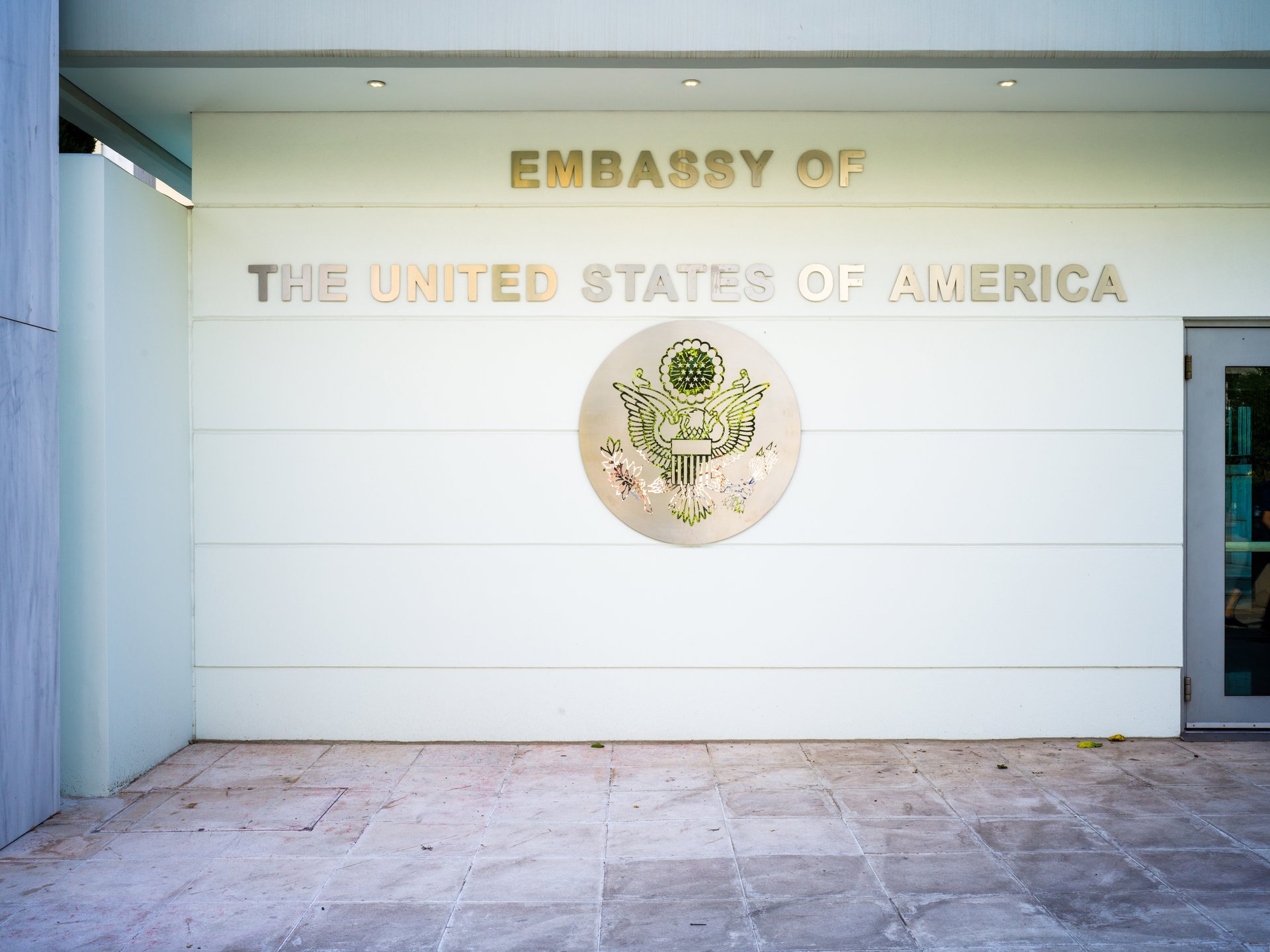
Two hours. That is how long Kimberly Guilfoyle's fall took on Tuesday: the White House announced she had been asked to resign, and the ambassador to Greece confirmed it herself on X — denying every allegation as she went, and pledging loyalty to the president whose eldest son she was once engaged to.
On Tuesday afternoon the White House press room delivered the line everyone had been expecting: Ambassador Kimberly Guilfoyle had been asked to resign. New press secretary Katie Zacharia, at her first briefing, paired the news with a soft landing — Guilfoyle, she said, had been a wonderful asset to the team. Within two hours Guilfoyle confirmed it herself in a post on X, denying every allegation and pledging to "vigorously defend" her name, her reputation and her integrity.
The president's own verdict came minutes later, as he left for Alaska. Asked about the woman who had been engaged to his eldest son for a reported four years, Trump drew a bright line: "She wasn't a member of my family. She, I guess, dated my son a long time ago." Then came the epitaph of the whole affair: "She was doing a good job, but we didn't like what we were reading." He added that he had not spoken with her personally — but "she will not be there."
"She was doing a good job, but we didn't like what we were reading." — Donald Trump
What they were reading was the Wall Street Journal. The paper's second investigation into Guilfoyle, published in early October, reproduced text messages in which the ambassador allegedly asked Trump donor Eric Deters — a Kentucky lawyer and former congressional candidate — to wire $100,000 directly to her American Express account, days before her Senate confirmation hearing. The messages, reviewed by the Journal, reportedly urged Deters to pay American Express directly so the transaction would not leave a paper trail, while promising help in winning access to senior administration officials. Deters said he never paid. Guilfoyle's lawyer, Jesse Binnall, disputed the messages' authenticity and said the sums discussed were unpaid fees for speaking engagements and travel completed before her nomination.
The Journal reported that Guilfoyle, fighting for the post over the weekend, told White House officials the texts were AI fabrications — a claim the officials did not believe, according to people familiar with the matter. Journal reporters said they had verified the authenticity of the donor's messages. Deters, in a television interview, called the arrangement "absolutely" a quid pro quo.
That was the second act. The Journal's first series, beginning in September, described a registered lobbyist for the Greek construction and energy group Aktor — Christos Marafatsos — accompanying Guilfoyle to private diplomatic meetings; audio recordings of the ambassador boasting of ties to wealthy Greek businessmen as she sought an invitation to a Davos dinner honoring Eric Trump; and claims she had threatened to use American influence to undermine the Greek government.
A parallel thread came from London: the Daily Mail reported that the State Department's internal watchdog was examining staff complaints about inappropriate behavior at the Athens embassy, and NBC News separately confirmed an investigation of the ambassador. Guilfoyle's lawyers have said her travel followed State Department guidance and that she complied with federal gift and reporting rules.
Whatever the verdict on the allegations — none has been proven, and a request to resign is not a court ruling — her eleven months in Athens were the loudest of any recent American envoy. She arrived on November 4, 2025, on a private jet owned by a Greek-American businessman, appeared on the cover of Vogue Greece, and threw herself into energy diplomacy: offshore drilling permissions for ExxonMobil in her first week, a deal delivering American liquefied natural gas to Ukraine signed with Volodymyr Zelensky in Athens on November 16, and the Vertical Corridor project carrying American gas into Eastern Europe. The United States had rarely had so visible an ambassador in Athens — or so noisy a departure.
She also made enemies. In her first local-media interview she said China should sell its 67 percent stake in the port of Piraeus, a cornerstone of Beijing's Belt and Road Initiative. China's ambassador to Greece, Fang Qiu, shot back, accusing Washington of "an outdated and a harmful mentality" and "a hegemonic mindset." Days before the resignation, Secretary of State Marco Rubio was in Athens launching new counterterrorism information-sharing between the two countries' law enforcement agencies — and publicly calling Guilfoyle "a strong ambassador."
The president said on Monday he was "looking at it" and "not happy"; by Tuesday the decision was made. Reporting points to a pile-up: the Journal's second investigation, the watchdog probe, Democratic lawmakers demanding ethics reviews, and a calendar — the November midterm elections are weeks away, and the row was landing alongside other administration flashpoints, from the president's attacks on the Nobel committee to the Ilhan Omar home-search controversy. Over the weekend Guilfoyle had been reluctant to go, rallying allies inside the administration, while officials discussed flying her back from Athens for a conversation with Rubio meant to nudge her out. In the end the move came by press briefing, not by phone.
The Journal's reporting on her final days found the dealbook wobbling. In a few months Guilfoyle had shepherded half a dozen countries — from Albania to Romania and Ukraine — toward memorandums signaling intent to buy American gas, often routed through Aktor and its joint venture with a Greek state-backed energy firm. Albania's energy ministry now says it is not fully convinced the arrangement is economically viable and awaits a complete feasibility study; Ukraine's Naftogaz told the Journal it had discontinued negotiations; Romania's Transgaz said its memorandum of understanding had expired. Aktor's lawyers call a 20-year supply agreement with Albania binding and subject to international arbitration. The verdict on the corridor will outlast the ambassador who branded it.
Kathimerini's English edition reports that Josh Huck, a career diplomat serving as deputy chief of mission, is expected to take temporary charge. No successor has been named; any nominee would need Senate confirmation, the same process Guilfoyle went through after her nomination in 2025. For Athens the questions are now Greek ones: the opposition PASOK party is demanding the government explain what it knew. Its foreign-affairs spokesman, Dimitris Mantzos, asked whether officials would demand an explanation or "content themselves with watching the country serve as a 'theatre'" for outside interests. Former deputy foreign minister Sia Anagnostopoulou called the affair "an issue of national dignity" in parliament. Foreign Minister Giorgos Gerapetritis has said Guilfoyle was "treated the same way as every other ambassador" and rejected calls to summon her; the government itself has not commented on the allegations.
Strip away the personalities and this is a story about price tags. A sitting ambassador allegedly offered introductions to the administration's senior ranks in exchange for a six-figure credit-card payment; the Journal documented a lobbyist inside the room at diplomatic meetings; the denials say it was all legitimate speaking fees and fabricated messages. Washington has seen ambassadorial ethics rows before — Gordon Sondland was recalled in 2020, Marie Yovanovitch in 2019 — but rarely with the alleged merchandise stated so plainly: access itself, itemized at $100,000, in the same capital where Washington's access-and-secrets rows keep surfacing, from the declassified Epstein network files onward. When money is the story, the honest frame is money: influence, packaged and priced, inside a diplomatic mission that had real strategic work to do — NATO's eastern Mediterranean anchor, the Red Sea maritime mission Greece leads, the counterterrorism channels Rubio had just opened.
What to watch now: whether the inspector general's inquiry becomes a formal investigation; whom Trump nominates next and how the Senate treats the pick; and whether Athens' parliament forces the Mitsotakis government to say what it knew, and when. The White House has said its piece. The paper trail — real or, as Guilfoyle's team insists, fabricated — has not.
For the Western press this is an accountability story that worked: a newspaper documented the messages, lawmakers raised the alarm, an inspector general opened an inquiry, and a president read the coverage and acted. The system — adversarial, public, messy — produced an outcome within days.
It is also a warning about the political-ambassador model itself. A large share of American ambassadorships goes to political appointees, and when the appointee's currency is personal proximity to the president, the line between diplomacy and influence-peddling thins to transparency.
Read from Beijing, the episode confirms a familiar critique: American diplomacy as transactional theater. The same envoy who demanded China sell its 67 percent stake in Piraeus was, by the Journal's account, privately pricing access to Washington at $100,000 — a contrast Chinese commentary will not waste.
The deeper Eastern reading is about the corridor. Guilfoyle's liquefied-gas push was aimed squarely at reshaping Southeast Europe's energy mix in America's favor. Her exit leaves the Vertical Corridor's American branding intact, but its dealbook — Albania wavering, Ukraine out, Romania's memorandum expired — visibly thinner.
From Athens, the story lands as a question of dignity. The opposition is not defending Guilfoyle; it is asking what its own government knew, and whether energy agreements signed on her watch were negotiated state-to-state or person-to-person. "National dignity," as one former minister put it, is the phrase of the week.
For smaller states courted by great powers, the lesson is structural: when an ambassador doubles as a dealmaker with private interests in the room, the host country becomes the stage rather than the partner. PASOK's "theatre" line will travel well beyond Greece.
The Wall Street Journal reported two strands of allegations. Before her Senate confirmation, she allegedly asked Trump donor Eric Deters to wire $100,000 to her American Express account while offering access to senior administration officials. As ambassador, she allegedly brought a lobbyist for Greece's Aktor energy group into private diplomatic meetings and threatened to use U.S. influence against the Greek government. Guilfoyle denies all of it, and her lawyer disputes the messages' authenticity.
Formally, she resigned. The White House asked her to step down at a Tuesday press briefing, and she submitted her resignation the same day, confirming it on X within two hours. But the request came after President Trump said publicly he was considering firing her, so the resignation was the White House's chosen form for a dismissal. Nothing about the timing was voluntary.
Not that has been announced. Britain's Daily Mail reported that the State Department's internal watchdog was examining staff complaints about behavior at the Athens embassy, and NBC News separately confirmed an inquiry into the ambassador. No charges have been filed and no official finding of wrongdoing exists. A watchdog review can become a formal investigation, but that step has not been reported.
Kathimerini's English edition reports that Josh Huck, a career diplomat serving as deputy chief of mission, is expected to take temporary charge of the embassy. President Trump has not named a successor. Any nominee would need Senate confirmation, the same process Guilfoyle went through after her nomination in 2025. The post could stay in caretaker hands for months.
