More than 400 Sudanese a day are crossing into Chad — twenty times the recent rate — while US funding cuts strip health, water and protection from nearly half a million people.
Published 3 October 2026 · 18:00 GMT
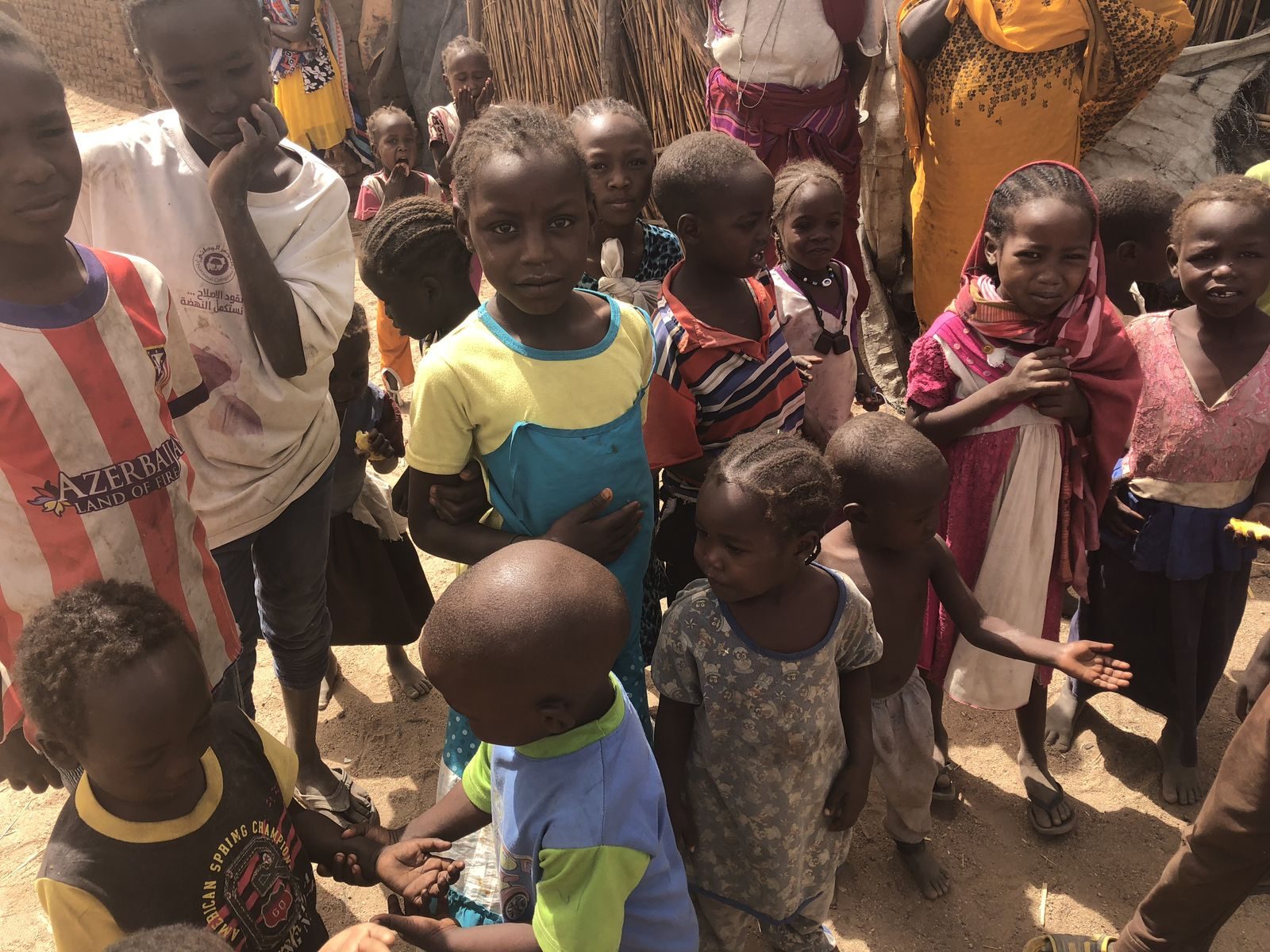
At Adré and Tiné, the dust never settles anymore. More than four hundred people a day are now crossing from Sudan into eastern Chad — around twenty times the daily rate of recent months — fleeing a war that has already displaced 11.3 million souls, the largest displacement crisis on earth. They arrive telling the same three stories: the conflict, the aerial bombardments, the drone attacks. And the country receiving them, one of the poorest on the planet, is being asked to do it with 18 percent of the money it needs.
The road into Adré ends in dust and waiting. On the Chadian side of the Sudanese border, the transit center at Tiné now holds more than 4,300 people — families who walked out of Darfur, Kordofan and Blue Nile with whatever they could carry, arriving at a rate the aid workers have stopped pretending is normal: more than 400 people a day this past week, crossing at Adré and Tiné, around twenty times the daily rate of recent months. Ask them why they came and the answers arrive in the same order, every time. UN Regional Refugee Coordinator Mamadou Dian Balde has heard it so often he can recite the litany: people “who tell us that they flee the conflict, they flee the aerial bombardments, they flee the drone attacks.” Three reasons, in that order — the ground war, the sky war, and the newest war, the one fought by machines no one on the ground can see coming. Behind them, the arithmetic of catastrophe keeps compounding: more than 55,000 Sudanese refugees have fled to eastern Chad so far in 2026, and nearly a million since the guns started in April 2023. A million people. That is a city the size of Marseille, relocated on foot into one of the poorest countries on earth. The twenty-fold figure deserves a pause: twenty times the recent daily rate does not mean twenty times the suffering — suffering was already maximal — it means the war has found a new gear, and the border is where gears become visible. Every one of those 400 daily crossings is a household that calculated, in the end, that the road was safer than home.
And this is where the numbers turn from staggering to obscene. More than 190,000 refugees are stuck in difficult conditions along the border. Around 31,000 families — do the household math and that is well over a hundred thousand people — lack adequate shelter. Most receive less than half the minimum daily water ration, which means the humanitarian standard itself has become a fiction everyone politely maintains: the minimum is a number on a spreadsheet in Geneva, and the reality is a jerrycan shared between too many hands in the Sahelian heat. Only 18 percent of UNHCR’s $1.6 billion funding requirement has been received — less than a fifth of what the agency says it needs, which means four-fifths of the plan exists only on paper. The agency’s warning is blunt and deserves to be quoted plainly: when needs go unmet at the border, many keep walking — onward, eventually, toward Europe. That sentence is doing diplomatic work, of course; it is addressed to European capitals in the only language that reliably moves them. But it is also simply true. Desperation is a logistics system. It routes around every obstacle, including indifference. The water figure is the one that stays with you: less than half the minimum daily ration, in the Sahel, for families that walked for days to get there. A minimum is a promise the world made to itself; half a minimum is the world breaking it quietly, in a place with no cameras. Meanwhile, the funding math sits beside the human math and refuses to balance: 18 percent of $1.6 billion is not a shortfall, it is a verdict — and the verdict is being read aloud, daily, in jerrycans.
The world’s largest displacement crisis is getting larger — and the money meant to meet it is getting smaller.
Meanwhile, inside Sudan, the floor is falling out from under the people who stayed. On October 1, the International Rescue Committee reported from Nairobi that almost half a million people have just lost life-saving health, water and protection services — not because the war reached them, but because the money ran out. American funding ended in July; the bridge funding that kept clinics open through the gap has now run out too. Read that again slowly: half a million people did not lose their clinic to a bomb. They lost it to a budget line. In Darfur, 14 facilities and mobile clinics that serve an average of 16,900 patients and 6,381 young children every month are watching that care disappear — the vaccinations, the malnutrition treatment, the clean water, the protection casework for the most vulnerable, all of it evaporating not with a bang but with an accounting decision made an ocean away. IRC Director Mohammed Mahdi’s verdict on three years of this should be carved into the wall of every donor conference: “We have spent over 3 years watching what happens when the world looks away from Sudan.” The world did not even have the decency to look away dramatically. It looked away via spreadsheet. The Darfur clinic numbers make the abstraction concrete: 16,900 patients a month, 6,381 of them young children — vaccinations, rehydration salts, the small unglamorous acts that keep children alive. When the bridge funding ran out, none of that was bombed. It was simply switched off, like a light in an empty room, except the room was full.
The war itself, for its part, is not pausing to let the humanitarians catch up — it is widening. In August, the UN humanitarian office reported that the Rapid Support Forces had encircled El Obeid, the capital of North Kordofan, threatening a full-scale ground assault on a major city — the kind of siege that turns markets into front lines and hospitals into targets. In Sirba, in West Darfur, fighting displaced around 18,000 people from more than 20 villages in a single week, most of them fleeing across the border into Chad — which is where the 400-a-day at Adré and Tiné comes from; the surge has an address. In Central Darfur, three health facilities closed, cutting off around 75,000 displaced people from care in one stroke — a number to set beside the IRC’s half-million and feel the full weight of the subtraction. And beneath all of it, the oldest enemies are back: drought and below-average rainfall are damaging livelihoods across the region, and the approaching rainy season threatens flooding in Darfur — water, too much and too little, arriving on schedule while the aid does not. Sudan’s $3 billion humanitarian appeal is 40 percent funded. Forty percent. The war is fully funded by its combatants. The response to it is not. Set the two funding figures side by side and read them as a single sentence: the war is fully funded by its combatants; the appeal to keep its victims alive is funded at 40 percent. That is not a funding gap. It is a statement of priorities, signed by everyone and no one. For now, the war’s accountants keep two sets of books: one for the combatants, settled in full, and one for the civilians, settled at forty cents on the dollar.
Step back far enough and the map reveals the layer the headlines usually bury: this is no longer, if it ever was, a purely Sudanese war. A July 2026 assessment by the British government, reported on October 2, found that the RSF benefited from support networks involving the United Arab Emirates and neighboring countries, while the Sudanese Armed Forces received backing from Egypt, Iran, Pakistan and Turkey. The UAE denies arming the RSF — the denial is on the record and must be carried alongside the allegation, because that is how the proxy game is played: everything deniable, nothing accidental. What the assessment describes, stripped of diplomatic padding, is a regional proxy battle increasingly centered on Sudan’s Red Sea coastline — its ports, its military access, its position on one of the world’s great shipping chokepoints. Ports are the prize; the paramilitaries and the armies are the instruments; the 11.3 million displaced are the externality. It is worth sitting with that word — externality — because it is the precise economic term for what happens when the costs of someone else’s strategy land on people who never signed the contract. A port concession in Port Sudan; a jerrycan shared in Tiné. The distance between those two facts is the whole story of the modern proxy war. The British assessment matters less for what it proves — every player denies, every allegation is contested — than for what it maps: a coastline, a set of ports, a shipping lane. Wars are fought over maps long before they are fought on the ground, and Sudan’s map has been on other people’s tables for years.
Geopolitics. The proxy map is the story now, and it runs through the Red Sea. When the SAF’s backers include Egypt, Iran, Pakistan and Turkey, and the RSF’s networks run through the UAE and neighboring states, Sudan stops being a civil war and becomes a regional board — with the coastline as the square everyone is playing for. Ports mean naval access; naval access on the Red Sea means leverage over the shipping lane that carries a meaningful share of world trade; leverage over that lane is the kind of asset states go to great lengths to secure. The denials — the UAE’s especially — are part of the structure, not a flaw in it: proxy warfare’s whole point is influence without fingerprints. Macroeconomics. Now follow the money in the other direction — the money that is not arriving. UNHCR at 18 percent of $1.6 billion. The Sudan appeal at 40 percent of $3 billion. Half a million people losing clinics to a funding cliff. The global humanitarian system is running a deficit measured not in dollars but in untreated children — 6,381 young ones a month in Darfur alone — and in cholera, which is spreading through the gaps the money left behind. The war economy, meanwhile, wants for nothing: the guns are funded, the drones are funded, the sieges are funded. Only the survival of civilians turns out to be optional. Cholera spreading through the gaps is the final auditor here: disease does not read donor strategies or proxy denials. It reads only the absence — of clean water, of clinics, of the half-million people the spreadsheets deleted — and it bills accordingly.
Demographics. Eleven point three million forcibly displaced since April 2023 — 6.4 million of them inside Sudan, more than 3.5 million as refugees and asylum-seekers across the region, with UN estimates running as high as 14 million. Read those numbers as what they are: the largest displacement crisis on the planet, and still growing, with the 20-fold surge at the Chadian border as its latest proof of acceleration. A displaced population of that size does not “return” when the shooting stops; it resettles, it urbanizes, it becomes a permanent demographic fact in Chad, in Egypt, in South Sudan — and, per UNHCR’s warning, eventually in Europe. Historical patterns. Darfur has been here before — the name itself is a byword for the world watching and failing to act — and Mahdi’s “three years watching” lands precisely because the pattern is a repeat with better cameras. The encirclement of El Obeid replays the siege playbook; the closed clinics of Central Darfur replay the weaponization of aid access; the drought replaying underneath it all is the oldest pattern in the Sahel. History is not repeating as farce here. It is repeating as policy. The cruelest historical echo is the demographic one: Darfur’s displaced once filled the camps the world photographed and then forgot. Today’s 11.3 million are walking the same roads toward the same forgetting, only faster, and this time the world cannot even claim it did not see the numbers — they are published, weekly, in Geneva. Beneath the surface, the demographic arithmetic keeps compounding: every month of war mints new displaced who will never go home, and every unmourned convoy of the forgotten makes the next forgetting easier.
Structural trends. The deepest structure in this story is the drone — the same machine haunting Kyiv’s bridges and Vilnius’s radar screens is driving Sudanese families across the Chadian border. Balde’s litany puts “the drone attacks” third, after the conflict and the bombardments, which tells you how fast the technology has normalized: in three years, remote killing has gone from novelty to expected cause of flight, from Sudan to Ukraine to the Baltic. The second structure is the funding model of mercy itself — a system in which half a million people’s survival depends on a single donor government’s budget line surviving an election cycle, and in which “bridge funding” is the literal name for the plank between one appropriation and the next. When the plank runs out, the clinic closes; when the clinic closes, cholera spreads; when cholera spreads, the displacement accelerates; when displacement accelerates, 400 people a day cross at Adré. That is not a chain of accidents. It is a machine with an input — indifference, priced in dollars — and an output measured in footprints in the dust. The dust at Adré, the briefing notes, never settles anymore. Neither, it seems, does the world’s attention — it simply moves on, leaving the displaced to do the walking. And so the machine runs: indifference in, footprints out. The only variable that has ever interrupted it — in Sudan, in Darfur before, in every forgotten war — is attention sustained past the news cycle. The dust at Adré will settle one day. The question is whether anyone will still be watching when it does. On paper, the system worked — the alerts were issued, the appeals published, the numbers logged. In practice, the dust never settled, because settling would have required someone to stay.
The West reads Sudan through the ledger — and the ledger is damning. Half a million people losing clinics because American funding ended in July is, in Western capitals, Exhibit A of what happens when humanitarian leadership is treated as a discretionary line item; the 18 percent funding figure for UNHCR is read not as African failure but as donor failure, and the names on that failure are Western. The proxy assessment lands differently here: a British government paper naming the UAE’s networks behind the RSF and Egypt, Iran, Pakistan and Turkey behind the SAF turns Sudan into a file Western foreign ministries can act on — sanctions designations, arms-embargo pressure, Red Sea diplomacy. The West’s Sudan story is ultimately about responsibility: who armed whom, who paid for what, and who looked away. The ledger, in the end, is not only about Sudan — it is about what Western humanitarian leadership is actually worth when the cameras move on.
But the Western reading has a mirror it prefers not to face. The funding cliff the IRC describes was dug in Washington, not Khartoum — the “bridge funding” ran out because the American bridge was withdrawn, which means the West is both the coroner and, in part, the cause. And the proxy outrage sits uneasily beside the record: Western states have their own long history of arming partners of convenience, and the Red Sea coastline everyone now covets is coveted partly because Western navies have spent decades treating it as their lake. Beneath the surface, the hardest Western question is the one Mahdi asked outright — what happens when the world looks away — because the answer, delivered at 400 people a day at Adré, is that the world does not get to look away cleanly. UNHCR said it plainly: unmet needs push people onward, toward Europe. The ledger always comes due.
From the East, Sudan reads as a Western-authored crisis wearing local clothes. The American funding cutoff — clinics closed by spreadsheet in July — is exhibited as proof that Western humanitarianism was never more than a policy instrument, extended and withdrawn with the electoral cycle; the sermon about responsibility rings hollow, in this telling, when the preacher defunded the clinic. The British assessment naming backers on both sides is read with open skepticism: London’s paper arrives from a capital with its own Red Sea interests and its own history of picking winners in other people’s wars, and the UAE’s denial is given equal billing with the allegation — as it should be, the East insists, until evidence meets the standard Ozerov demanded in Chișinău on another file the same week. The proxy framing itself is the objection: call it a “regional proxy battle” and you have already assigned the roles, with outside powers as authors and Sudanese as instruments.
And yet the Eastern reading, pressed, concedes the ground truth it cannot explain away: 11.3 million displaced is not a narrative, it is a census of suffering, and no denunciation of Western hypocrisy feeds a child in Tiné. The East’s own partners sit inside the same proxy map — Iran and the networks around the Gulf are not spectators — which means the “outside powers as authors” objection cuts both ways, and the East knows it. The honest Eastern analysts will admit, behind closed doors, what the public line cannot: that the Red Sea coastline is coveted by every compass point, that deniability is the currency of all the players, and that Sudan’s agony is overdetermined — everyone’s fault, which in practice means no one’s responsibility. That is the bleakest reading of Saturday’s files, and it may also be the most accurate.
The Global South reads Sudan first as a mirror — and the reflection is uncomfortable. Chad, one of the poorest countries on earth, is absorbing nearly a million Sudanese while the funding covers 18 percent of the need; the South knows exactly what that ratio feels like, because the South lives it in every crisis from the Sahel to the Levant. The border at Adré is the South’s daily reality: the wealthy world’s wars and the wealthy world’s budget cycles arriving together, on foot, at the gates of countries that were never consulted. Balde’s litany — the conflict, the bombardments, the drones — is the South’s vocabulary now, spoken in languages from Arabic to French to Hausa. And Mahdi’s line about watching what happens when the world looks away lands hardest here, because the South has spent decades being looked away from; Sudan is not an exception to the rule. It is the rule, with cameras.
The second Southern reading is colder, and it concerns the proxy map. The British assessment — UAE networks here, Egypt, Iran, Pakistan, Turkey there, ports on the Red Sea as the prize — is read in Southern capitals as confirmation of the oldest suspicion: that African wars are rarely only African, and that the continent’s coastlines and corridors are still priced by outsiders. But the South also reads its own agency in this file: Chad keeping its border open, the African Union’s diplomacy, the regional states hosting 3.5 million refugees with a fraction of the resources Europe mobilized for Ukraine. The comparison is not made with bitterness, exactly — it is made with bookkeeping. The South’s question about Sudan is the same one it asked about every forgotten war: if 11.3 million displaced Europeans commanded the world’s attention and treasury, what does 11.3 million displaced Sudanese command? The answer, at 400 people a day in the dust of Adré, is the scandal the numbers are trying to tell.
Beijing just wrote the biggest liquidity check of the year — and changed nothing else.
The People's Bank of China will offer banks up to one trillion yuan a day — about $149 billion — in overnight funds from September 28 through October 8, covering the Golden Week holiday. It is the largest such cap since the tool's introduction in June 2026, up from 600 billion yuan in mid-September.
The calendar explains the timing. Golden Week sends hundreds of millions of Chinese traveling and spending; banks need cash the way airports need runways. The central bank is making sure the plumbing holds.
The scale, though, is the story. One trillion yuan a day is not holiday housekeeping. It is a backstop — a signal that whatever the holiday throws at the financial system, the PBoC has already covered.
And then, the other hand: nothing. Chinese banks left the one-year and five-year loan prime rates unchanged at 3.00% and 3.50% — the 16th consecutive month without a move.
Sixteen months of stillness in the price of credit, alongside the largest liquidity flood of the year. Beijing is watering the garden and refusing to lower the fence — liquidity yes, cheaper credit no.
Governor Pan Gongsheng gave the doctrine a name: slower loan growth is becoming "the new normal." Property and local-government borrowing are shrinking faster than emerging industries can borrow. The credit engine is being rebuilt mid-flight.
Liquidity is Beijing's answer to everything except the one question markets keep asking: where is the growth?
The PBoC is not idle elsewhere. It stepped up support with a net 200-billion-yuan injection through medium-term lending facility operations, reiterated its "moderately loose" stance, and kept its grip on the yuan.
The yuan, for its part, cooperated — rebounding after briefly dipping below 6.70 per dollar as US Treasury yields rose and the PBoC's grip eased.
The diplomacy helped. A US–China summit extended the trade truce to January — without new tariff cuts, but without new tariffs either. A truce, not a peace; markets will take it.
Step back and the contrast is the story. In Washington, yields cross 5% and traders bet on another hike. In Beijing, the central bank floods the system with cash and leaves rates untouched for a 16th month. Two central banks, two planets.
The logic is not mysterious. China's problem is not hot demand — it is cold credit. Pumping liquidity keeps the system liquid; cutting rates into weak demand would be pushing on the proverbial string.
The risk is the one Beijing knows best: banks awash in cash, with nowhere productive to lend it. Liquidity without lending becomes asset froth — the 2015 lesson, still fresh in institutional memory.
For the region, the signal matters more than the mechanics. A stable yuan and a liquid Chinese banking system through Golden Week is the foundation under Asia's supply chains. When Beijing sneezes, the region's exporters reach for tissues.
Watch what happens after October 8. If the trillion-yuan window closes quietly, it was holiday plumbing. If support lingers, it was something else — a central bank telling you, without saying it, that the economy needs the help.
Western coverage — Reuters and the financial wires — emphasizes the restraint: Beijing holding rates while flooding liquidity, a central bank running out of its favorite tools.
In this telling, 16 months of unchanged loan prime rates is the real headline — evidence of a policymaker boxed in by a hawkish world, a weak property sector, and the fear that rate cuts would only weaken the yuan. Liquidity is what you do when you've decided rates can't move.
Pan's "new normal" gets a skeptical hearing: an elegant phrase for a credit engine that no longer transmits. The question in Western commentary is whether "moderately loose" is a stance or a shrug.
Eastern coverage — Xinhua and Chinese outlets — emphasizes the calibration: targeted, seasonal, and exactly as doctrine prescribes.
In this telling, the trillion-yuan facility is textbook PBoC: precise, time-bound, and aimed at a known seasonal need. The unchanged rates are not paralysis but prudence — "moderately loose" means loose where it counts, steady where it matters, with the yuan's stability as the binding constraint.
The summit's truce extension gets equal billing: diplomacy buying the central bank room to maneuver, and the maneuver working — the yuan's rebound presented as policy competence, not luck.
Global South coverage — Malaysia's business press among it — emphasizes the neighborhood: what Beijing's plumbing means for everyone downstream.
The read from Kuala Lumpur: a liquid China through Golden Week is good news for ASEAN exporters, supply chains, and the region's own central banks. Yuan stability is a public good in Asia, and the PBoC just underwrote another week of it.
The caution in this coverage is borrowed from experience: when the region's biggest economy needs record liquidity to get through a holiday, the "new normal" of slower credit is everyone's normal too.
To read Beijing's move properly, you need the toolkit. Start with the overnight reverse repo — the instrument at the center of the trillion-yuan headline. In a reverse repo operation, the central bank lends cash to commercial banks overnight, taking bonds as collateral; the banks get the liquidity they need, the central bank gets the bonds back the next morning plus a sliver of interest. It is plumbing, not policy: the money created exists for a day, maybe rolled over, and its purpose is to keep the interbank market — the market where banks lend to each other — from seizing. The cap is the message. A trillion yuan a day says: whatever the holiday throws at the system, the PBoC has already covered.
The tool itself is young — introduced only in June 2026 — which makes the record cap more interesting. A new instrument's ceiling is normally discovered cautiously; jumping from 600 billion yuan in mid-September to a full trillion two weeks later is not calibration but declaration. It tells the banks, and through them the market, that the central bank will not be outbid by seasonal stress. The facility runs September 28 to October 8, covering Golden Week exactly. Time-bound, enormous, and explicitly temporary: the PBoC is writing a check it intends to tear up on the 9th. The question the article ends on — what happens after October 8 — is the only one that matters, because a backstop that lingers stops being a backstop and starts being a subsidy.
Then the medium-term lending facility — the MLF — through which the PBoC added a net 200 billion yuan. If reverse repos are the overnight overdraft, the MLF is the term loan: banks borrow for months, not hours, pledging collateral, at a rate the central bank sets. The MLF rate is the PBoC's quiet policy lever — it guides the loan prime rates without the drama of changing them. And the loan prime rates, the LPRs, are the number the article keeps returning to: 3.00 percent for one year, 3.50 percent for five, unchanged for the sixteenth consecutive month. The LPR is the benchmark for most new lending in China; holding it still while flooding the system with cash is the whole doctrine in one gesture. Liquidity yes. Cheaper credit no.
The sixteen months of stillness deserve their own reading, because stillness is also a decision — sixteen times over. In a world where Washington is hiking and yields cross 5 percent, cutting Chinese rates would narrow the already thin cushion against capital outflow and yuan depreciation; every basis point of easing is a basis point of incentive for money to leave. The PBoC's box, as the Western lens describes it, is real: a property sector that no longer transmits stimulus, local governments deleveraging rather than borrowing, and a currency whose stability is the binding constraint on everything else. Holding the LPR is not paralysis. It is the recognition that the price of credit is no longer the economy's binding constraint — and that moving it would cost more in currency stress than it buys in growth.
The calendar explains the timing, as the article says — but the calendar deserves its scale stated plainly. Golden Week is the largest annual human migration on earth compressed into seven days: hundreds of millions of Chinese traveling, spending, withdrawing cash, settling bills. The banking system's cash demand does not rise. It detonates. ATMs must be stocked, merchants' settlement accounts funded, the interbank market supplied with enough reserves to clear a week's worth of the world's second-largest economy changing hands. In normal years, the PBoC manages this with routine open-market operations. This year it wrote the biggest check in the tool's short history.
The scale, though, is the story — the article's line, and worth pressing. One trillion yuan a day is not holiday housekeeping; it is a backstop sized for something the PBoC sees and the market does not yet. Seasonal demand explains the facility's existence. It does not fully explain its size. Either the central bank is being theatrically cautious — signaling strength by oversupplying safety — or its internal read on holiday-season financial stress is darker than the public data. Both readings are consistent with "moderately loose." Only one of them is reassuring. The banks will take the cash either way; the signal is in the surplus.
There is also the consumption angle, which is where the liquidity meets the real economy. Golden Week is China's great annual test of consumer confidence: the week when households vote with their wallets on whether the economy feels safe. A banking system visibly backstopped — cash available, payments clearing, no friction — is the precondition for the spending the state wants to see. The PBoC cannot make households spend; it can only ensure that nothing in the plumbing stops them. In an economy where the consumer has been the missing piece and property wealth no longer does the spending's work, the holiday's cash registers matter more than the interbank rate. The trillion yuan is, among other things, a bet on the tills.
And the regional read — the Global South lens from Kuala Lumpur — captures what the holiday means beyond China's borders. A liquid China through Golden Week is the foundation under Asia's supply chains: exporters paid, importers funded, the region's own central banks spared the volatility of a yuan under holiday stress. Yuan stability, as the article notes, is a public good in Asia, and the PBoC just underwrote another week of it. When the region's biggest economy needs record liquidity to get through a holiday, the "new normal" of slower credit becomes everyone's normal — but a stable holiday is still a stable holiday, and Asia's exporters will take it.
Central bankers choose their phrases the way diplomats choose communiqués — every word weighed, every ambiguity intentional. When Governor Pan Gongsheng said slower loan growth is becoming "the new normal," he was not describing a statistic. He was retiring an expectation. For two decades, China's credit engine ran on a simple formula: property developers borrowed, local governments borrowed against land, and the resulting construction carried GDP. That engine is being dismantled mid-flight — property deleveraging, local-government debt discipline — faster than emerging industries can borrow to replace it. "New normal" is the doctrine that says: stop waiting for the old credit cycle to return. It is not returning.
The doctrine has a logic, and it is worth steelmanning before doubting. Credit-fueled growth bought China two decades of expansion and left it with the property crisis, the local-government debt pile, and the demographic headwinds now arriving together. Pumping cheap credit into that structure — the old playbook — would reflate the very imbalances the state is trying to defuse. Slower, cleaner credit growth, directed at manufacturing upgrades and strategic industries rather than concrete, is the quality-over-quantity bet. The PBoC is not refusing to stimulate. It is refusing to stimulate the old economy. The distinction is the entire policy.
The risk, as the article notes, is the one Beijing knows best: banks awash in cash with nowhere productive to lend it. Liquidity without lending becomes asset froth — the 2015 lesson, still fresh in institutional memory, when stimulus leaked into equity speculation rather than productive investment. The trillion-yuan facility, the 200-billion MLF injection, the "moderately loose" stance — all of it presupposes transmission channels that the "new normal" itself describes as weakened. Watering the garden, to use the article's image, works only if the soil still absorbs water. If property and local governments no longer drink, and emerging industries cannot drink fast enough, the water pools. Pooled liquidity has a history in China. It is called a bubble.
Step back and the contrast the article closes on — two central banks, two planets — is the frame that will define the autumn. Washington hikes into data it may not have, fighting inflation with the South's interest bills. Beijing floods with cash it cannot lend, defending a currency it cannot afford to let slip, waiting for a credit engine it is rebuilding mid-flight. Neither has a clean instrument. Both are improvising inside doctrines — data-dependence, the new normal — that describe the world they wish they governed. Watch October 8: if the trillion-yuan window closes quietly, it was holiday plumbing, and the doctrine holds. If support lingers, the PBoC will have told you, without saying it, that the new normal needs more help than the old vocabulary admits.
Monetary policy does not happen in a diplomatic vacuum, and the PBoC's autumn maneuver owes more to the summit than the communiqués admit. The US–China meeting extended the trade truce to January — no new tariff cuts, but no new tariffs either — and that pause is worth more to Beijing's central bank than any single instrument in its toolkit. Tariff escalation would have meant a weaker yuan, imported inflation, and capital flight arriving together; the truce removes the worst tail from the PBoC's planning. "A truce, not a peace; markets will take it," as the article says. So will central bankers.
The yuan's rebound — recovering after briefly dipping below 6.70 per dollar — is the truce's signature in the currency market. With US Treasury yields rising and the PBoC's grip easing, the currency found its footing not through intervention but through the removal of a threat. That distinction matters: a yuan steadied by diplomacy is cheaper to defend than a yuan steadied by reserves. Every week the truce holds is a week the PBoC does not have to choose between growth and the exchange rate — the choice that has boxed in Chinese policy for the better part of a decade.
But truces expire, and January is closer than it looks. The extension without tariff cuts is a freeze, not a thaw: the existing duties remain, the structural disputes untouched, the next escalation one headline away. The PBoC is therefore managing a window, not a settlement — using the diplomatic calm to get through Golden Week, to steady the currency, to buy the "new normal" time to prove itself. If January brings escalation, the trillion-yuan plumbing will look like the prelude to a harder season. Diplomacy bought the central bank room to maneuver, as the Eastern lens notes. Room is not resolution. It is rented, monthly, and the rent comes due in January.
