Riyadh is mobilizing for a ground offensive to retake the Red Sea corridor — as fire burns near an Aramco facility and Europe admits its naval mission falls short.
Published 3 October 2026 · 18:00 GMT
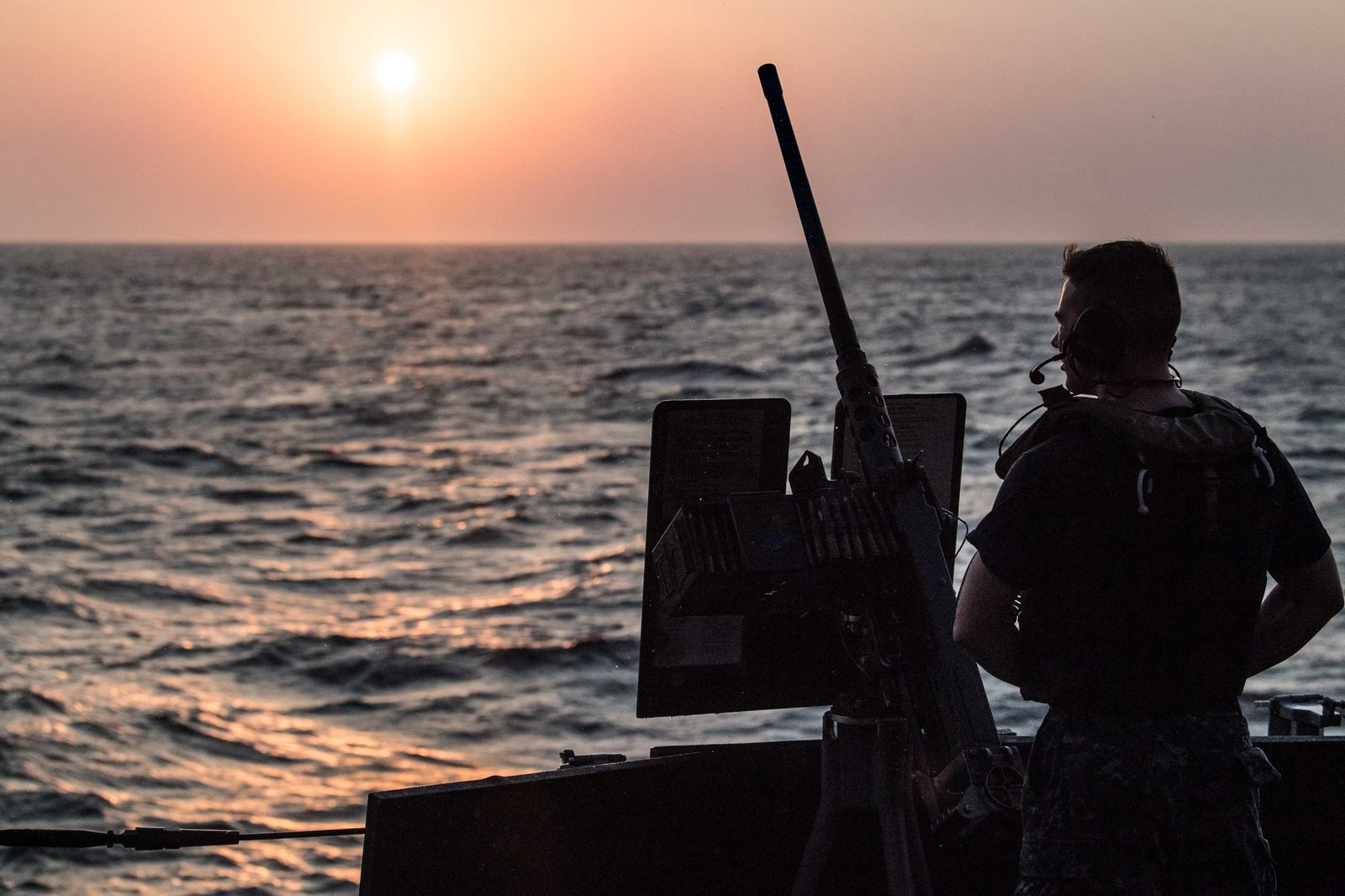
A column of smoke rose over Riyadh on Saturday morning, and a witness watched it climb near an Aramco facility. Nobody claimed it. Nobody confirmed it. And yet it fit the pattern of a week in which the Red Sea — the corridor that carries roughly twelve percent of the world's goods — became, once again, the most dangerous waterway on earth.
Start with the smoke, because the smoke is the story in miniature. On Saturday morning, a witness watched a large plume of smoke and fire rise near an Aramco facility in Riyadh and told Reuters what he had seen. That was the whole of it: Saudi authorities had not confirmed any fire, Aramco did not respond to requests for comment, and no one — not the Houthis, not anyone — had claimed responsibility. In a normal week, an unconfirmed fire near an oil facility in a Gulf capital would be a footnote. This is not a normal week. Only days earlier, the Houthis said they had attacked Aramco facilities in Yanbu with missiles and drones; Saudi Arabia said it had intercepted six ballistic missiles fired toward Taif and the Yanbu area, while reporting no damage to Aramco facilities. And back in August, after the Houthis declared a maritime embargo on the kingdom and claimed attacks on Yanbu and the Jazan refinery, Saudi Arabia confronted open risk to its Red Sea oil exports. So the smoke over Riyadh arrives already loaded with meaning, whether or not it turns out to mean anything at all. That is the condition of the Red Sea corridor in October 2026: every plume is read as a signal and every signal as a threat, because the threat is real and everyone in the region knows it. The witness may have seen an accident. The region saw a warning. And warnings, in the Gulf, have a way of becoming policy: every unclaimed fire near an Aramco facility is read in Riyadh as a rehearsal for the claimed one, and every claimed one as a promise of the next.
The corridor at the center of it all is one the world forgot it depends on. About twelve percent of the world's goods typically move through the Bab el-Mandeb strait, the narrow gate between the Red Sea and the Gulf of Aden — and for the past month, the Houthis have been tightening their grip on it. In September they captured the island of Mayun at the Red Sea entrance, a prize with a very specific value: it commands a key alternative route for Saudi oil exports at a moment when the Strait of Hormuz is constrained by the US-Israel-Iran war. Houthi spokesman Yahya Saree put the new order of the waterway in a single sentence: "maritime navigation is safe for all companies except for Saudi vessels." Consider what that sentence does. It does not close the strait; it taxes it, selectively, turning the world's shipping lane into an instrument of pressure against one country. The numbers tell their own story. Saudi crude accounted for about ninety percent of the record 2.17 million barrels per day loaded at Egypt's Sidi Kerir terminal — the Mediterranean outlet that has absorbed the diverted flows — while recent crude loadings at Yanbu were conducted without continuous vessel-tracking signals, the maritime equivalent of traveling with the lights off. Opacity, in this market, is not an accident. It is a strategy. For the world's shippers, the lesson is equally stark: the cheapest route on the map is only cheap until someone with missiles decides otherwise — and the Red Sea has now decided twice, first with the embargo, then with Mayun.
Saudi Arabia is preparing the largest ground operation of the Yemen war's new chapter — while Europe's naval mission sails with six warships where it needs more than ten.
Riyadh's answer, meanwhile, is taking shape in the one currency the region understands: force. According to six regional and Western officials with knowledge of the preparations, Saudi Arabia is planning an offensive against the Houthis in Yemen, expected in the coming weeks. Two options are on the table. The first is a narrow coastal push to secure the Red Sea shipping route — a limited operation with a single objective: break the chokehold. The second is far larger: a broader, synchronized multi-front assault on Al-Bayda, Marib, Taiz, and Al-Jawf, designed to roll back Houthi power across the board. The scale under discussion is formidable either way: more than 100,000 Yemeni troops could be mobilized, led by Yemeni forces overseen by Riyadh and supported by Saudi airstrikes, with the United States providing intelligence while Saudi allies are not expected to play a direct combat role. The objective is explicit — to reverse the rapid Houthi gains of last month, when the Houthis advanced down the coast and seized control of the Bab el-Mandeb strait itself. The timing matters. An offensive measured in weeks, not months, means the planning is done and the question is no longer whether, but how wide. Behind closed doors, the debate in Riyadh is said to turn on that single variable: a coastal operation promises a quicker, cleaner result, while the multi-front assault promises something closer to a verdict on Houthi power itself — at a far higher price.
The background here is a war that never quite ended. Saudi Arabia entered Yemen's civil war in 2015 at the head of an Arab coalition supporting the internationally recognized government — an intervention meant to be swift that became, instead, one of the region's grinding stalemates. A truce in 2022 largely held, and for a time the Red Sea was a backwater of the conflict rather than its front line. That changed this year, when the Houthis launched missile and drone attacks on Saudi shipping and oil infrastructure in a spillover from the Iran war, which began in February 2026. The escalation has been methodical: in August, the Houthis declared a maritime embargo on the kingdom and claimed attacks on Yanbu and the Jazan refinery, putting Saudi Arabia's Red Sea oil exports openly at risk. Then came the coastal advance of last month and the seizure of the Bab el-Mandeb strait — the moment, in retrospect, when the spillover became a siege. For Riyadh, the logic of a ground offensive is therefore defensive in its own telling: the strait is not a foreign adventure but the kingdom's economic jugular, and the Houthis have their hand on it. For the Houthis, the logic is the mirror image: the strait is leverage, and leverage is survival. Neither telling is false, which is why the standoff has lasted this long: each side's defensive war is the other's war of aggression, and the strait sits exactly on the line between the two stories.
The Houthis' playbook, meanwhile, deserves a close read, because it has been working. In September, Houthi forces seized a United Nations compound in Mokha, and UN staff fled — an episode that reads as a small, deliberate humiliation of the international order and a large, deliberate demonstration of who controls the coast. It sits inside a pattern: declare an embargo, claim a missile strike, seize a position, and let the world's insurers do the rest. The movement has spent a decade absorbing airstrikes and emerging intact, and its leadership understands something its adversaries keep underestimating — that in a war over a shipping lane, you do not need to win battles; you need to make the lane uninsurable. Mayun island is the proof of concept: a single rock at the Red Sea entrance that now functions as a toll booth on Saudi Arabia's alternative export route, captured while the world's attention was fixed on the Hormuz confrontation. Behind closed doors, the region's security planners have a phrase for this kind of actor, and it is not a flattering one; in practice, though, the Houthis have achieved what years of Saudi airpower could not undo — a permanent seat at the table of Red Sea power, paid for in other people's shipping costs. It is, by any honest accounting, a remarkable return on a small investment: a few missiles, one island, and a sentence from a spokesman — set against the full weight of a kingdom's navy and air force.
And what of Europe, whose goods sail those waters? The honest answer arrived this week in Rome, where Italian Defense Minister Guido Crosetto met EU foreign policy chief Kaja Kallas and said out loud what diplomats had been whispering: contributions to the EU naval mission Aspides remain insufficient. Italy pressed its allies to do more and said it was ready to deploy its own ships — the kind of offer that reads as leadership and lands as an indictment. Kallas put a number on the gap: Aspides would need more than ten warships to be effective. Diplomats say six are currently deployed. Aspides was launched in 2024 to protect commercial shipping from Houthi attacks, and two years on, the mission that was supposed to secure Europe's trade artery is sailing at barely half strength. The contrast with Riyadh's planning could not be sharper. On paper, the European Union has a Red Sea strategy; in practice, it has six hulls and a press conference. The kingdom, meanwhile, is assembling more than 100,000 troops. Nobody in Brussels will say it plainly, but the implication hangs over the Rome meeting like the smoke over Riyadh: if the strait is to be held, it will not be Europe holding it. For now, Aspides sails on, under-crewed and over-tasked — the naval equivalent of a press release — while the real decisions about the Red Sea are being made in Riyadh, in Sanaa, and in the insurance offices of London.
Geopolitics. Step back and the Red Sea looks like the place where three wars intersect. The Yemen war, which Riyadh thought it had frozen in 2022, has thawed into a Houthi offensive. The Iran war, which began in February 2026, constrains the Strait of Hormuz and makes the Red Sea the indispensable alternative — which is precisely why the Houthis seized Mayun island when they did. And the undeclared war over the world's chokepoints, waged by every power with a navy and a grievance, has found its newest theater. Saudi Arabia's planned offensive is therefore not a local operation; it is a bid to reset the geometry of all three wars at once, with Yemeni troops in the lead, Saudi airpower overhead, and American intelligence in the background. The coalition arithmetic is delicate — allies are not expected in direct combat — and the signal to Tehran is unmistakable. Macroeconomics. The numbers tell their own story. Twelve percent of the world's goods through a single strait; ninety percent of a record 2.17 million barrels a day at Sidi Kerir flowing from Saudi fields; Yanbu loadings conducted dark, without tracking signals, because visibility has become vulnerability. Every barrel rerouted, every tanker sailing dark, every insurance premium repriced is a tax the Houthis levy without firing a shot — and a reminder that the global economy's just-in-time machinery has a single point of failure at Bab el-Mandeb. Riyadh's offensive, if it comes, will be priced in barrels before it is priced in territory: the kingdom is not fighting for coastline, it is fighting for the margin on every shipment. That is why the coming offensive, whatever its shape, will be judged first in Riyadh not by flags planted but by tankers moving — the only metric that matters to an economy built on the uninterrupted flow of crude.
Demographics. Behind the troop figures — 100,000 mobilized, a number that rolls off the tongue — lies a country that has been at war, in one form or another, for over a decade. Yemen's population has endured the airstrikes, the blockade years, the truce, and now the return of open escalation; the UN staff who fled the Mokha compound are only the most visible of the civilians caught between the Houthis' advance and Riyadh's answer. Wars of this kind are fought by the young men of the front lines and paid for by everyone else — the port workers of Hodeidah, the fishermen of the coast, the families for whom the strait's closure is measured in bread prices. Historical patterns. There is a lineage here that Riyadh knows intimately. The 2015 intervention was supposed to be short; it became the kingdom's longest war. The 2022 truce was supposed to hold; it held until the region's larger war gave the Houthis their opening. Every Saudi escalation in Yemen has followed the same arc — decisive in announcement, grinding in execution — and the Houthis have outlasted every one of them. Structural trends. The deepest current is structural: the world's chokepoints have become weapons, and non-state actors have learned to wield them. The Houthis did not invent this — but Mayun island, the selective embargo, the dark loadings at Yanbu are its newest expression. Even if Riyadh's offensive retakes the coast, the lesson will survive the battle: in the 21st century, a movement with missiles and a strait can tax the global economy. The smoke over Riyadh, confirmed or not, was the invoice arriving early. Whether the kingdom pays it in airstrikes or in insurance premiums is the choice now before Riyadh; either way, the era of the free strait — the assumption that the world's great chokepoints simply stay open — is over.
Read from the West, the story is a test of collective security — and Europe is failing it in public. Six warships where more than ten are needed: Kallas's number turned the Rome meeting into an audit, and Crosetto's offer to deploy Italian ships read less as generosity than as frustration with allies who sign communiqués and send nothing. In this reading, Aspides is the parable of European power — launched in 2024 with a clear mandate to protect commercial shipping, still sailing at half strength two years into the Houthi campaign. Washington's posture draws a different, equally noted line: intelligence yes, combat no — the United States will help Riyadh see the battlefield but will not fight on it. The Western lens also counts the commercial damage in the only terms markets understand: a strait that carries twelve percent of the world's goods, tankers sailing dark off Yanbu, a record 2.17 million barrels a day rerouted through Sidi Kerir. The smoke over Riyadh, confirmed or not, is priced in before it is explained.
And yet the West also reads Riyadh's offensive plan with a familiar unease. More than 100,000 troops, a multi-front assault across Al-Bayda, Marib, Taiz, and Al-Jawf — the scale recalls 2015, when a short intervention became a decade-long war. Western capitals will quietly hope the narrow coastal option wins the argument in Riyadh: secure the lane, avoid the quagmire. The Houthis' seizure of the UN compound in Mokha, meanwhile, is filed as evidence of a movement that respects no rules — which, in the Western telling, is precisely why the rules-based order needs its warships. The trouble, as Rome made plain, is that the warships are not there. It is the oldest story in alliance politics: everyone agrees the mission matters, no one wants to pay for the hulls, and the press releases multiply while the fleet stays home. Rome was supposed to change that arithmetic; instead, it merely published it. The audit is now public.
Read from the East, the story is about escalation dressed as defense. A Saudi ground offensive — 100,000 troops, multi-front, with American intelligence overhead — reads in Moscow and Beijing not as corridor security but as the return of the 2015 playbook, this time with a US-Israel-Iran war as its backdrop. In this reading, the Houthis are the resilient actor of the piece: a movement that absorbed years of Saudi airpower, seized Mayun island at the decisive moment, and now taxes the kingdom's exports with a single sentence — "safe for all companies except for Saudi vessels." The seizure of the UN compound in Mokha is noted without the Western moralizing; what matters, in the Eastern telling, is control of the coast, and the Houthis have it. The Iran-war spillover framing is taken at face value: this is what happens when a regional war, begun in February 2026, redraws every calculation around it.
The Eastern lens is also skeptical that force resolves anything. Riyadh tried the maximalist route in 2015 and got a decade of stalemate; the Houthis' writ over Bab el-Mandeb survived every bombing campaign. Europe's Aspides shortfall — six hulls where ten are needed — is read as confirmation that the Western security architecture cannot even crew its own missions, let alone stabilize the Red Sea. Expect, in this reading, the offensive to begin, the coast to change hands at a price, and the Houthis to remain exactly where they are: astride the strait, patient, and taxing. The smoke over Riyadh, claimed by no one, is filed under the normal fog of a war the kingdom chose to re-enter. In this telling, the coming weeks will follow a script the region knows by heart: bombs will fall, the coast will be contested, communiqués will claim victory — and the strait will remain, as it has through every campaign, in the hands of those patient enough to wait.
Read from the South, the story is about a corridor the world forgot — until it closed. Twelve percent of the world's goods is not a Saudi statistic or a European one; it is everyone's: the grain, the fuel, the manufactured goods on which developing economies run. In this reading, the Red Sea is the South's artery, and every actor fighting over it — Riyadh with its 100,000 troops, the Houthis with their selective embargo, Europe with its six warships — is gambling with someone else's livelihood. The Egyptian angle sharpens the point: Sidi Kerir's record 2.17 million barrels a day, ninety percent of it Saudi crude, is the South absorbing the North's rerouted risk, terminal by terminal. The Southern lens notes, too, the symbolism of Mokha: a UN compound seized, UN staff fleeing — the international order's flag hauled down on the very coast the order was supposed to protect.
What the South wants is de-escalation, and what it expects is the opposite. The Houthis' sentence — "safe for all companies except for Saudi vessels" — is read neither as heroism nor as piracy but as leverage, the weapon of the weak in a war of the strong. Riyadh's offensive is read the same way in reverse: the weapon of the strong, with a 2015 precedent that ended in stalemate. Neither, in the Southern telling, will reopen the strait for long; both will keep taxing it. The smoke over Riyadh is therefore the South's emblem of the whole affair: unconfirmed, unclaimed, and already priced into everyone's fuel bill. That is the South's quiet indictment of the whole affair: the powerful fight over the artery, the weak tax it, and the bill — as always — is sent to those who were never consulted. De-escalation would be cheaper for everyone; it is simply not on offer.
Beijing just wrote the biggest liquidity check of the year — and changed nothing else.
The People's Bank of China will offer banks up to one trillion yuan a day — about $149 billion — in overnight funds from September 28 through October 8, covering the Golden Week holiday. It is the largest such cap since the tool's introduction in June 2026, up from 600 billion yuan in mid-September.
The calendar explains the timing. Golden Week sends hundreds of millions of Chinese traveling and spending; banks need cash the way airports need runways. The central bank is making sure the plumbing holds.
The scale, though, is the story. One trillion yuan a day is not holiday housekeeping. It is a backstop — a signal that whatever the holiday throws at the financial system, the PBoC has already covered.
And then, the other hand: nothing. Chinese banks left the one-year and five-year loan prime rates unchanged at 3.00% and 3.50% — the 16th consecutive month without a move.
Sixteen months of stillness in the price of credit, alongside the largest liquidity flood of the year. Beijing is watering the garden and refusing to lower the fence — liquidity yes, cheaper credit no.
Governor Pan Gongsheng gave the doctrine a name: slower loan growth is becoming "the new normal." Property and local-government borrowing are shrinking faster than emerging industries can borrow. The credit engine is being rebuilt mid-flight.
Liquidity is Beijing's answer to everything except the one question markets keep asking: where is the growth?
The PBoC is not idle elsewhere. It stepped up support with a net 200-billion-yuan injection through medium-term lending facility operations, reiterated its "moderately loose" stance, and kept its grip on the yuan.
The yuan, for its part, cooperated — rebounding after briefly dipping below 6.70 per dollar as US Treasury yields rose and the PBoC's grip eased.
The diplomacy helped. A US–China summit extended the trade truce to January — without new tariff cuts, but without new tariffs either. A truce, not a peace; markets will take it.
Step back and the contrast is the story. In Washington, yields cross 5% and traders bet on another hike. In Beijing, the central bank floods the system with cash and leaves rates untouched for a 16th month. Two central banks, two planets.
The logic is not mysterious. China's problem is not hot demand — it is cold credit. Pumping liquidity keeps the system liquid; cutting rates into weak demand would be pushing on the proverbial string.
The risk is the one Beijing knows best: banks awash in cash, with nowhere productive to lend it. Liquidity without lending becomes asset froth — the 2015 lesson, still fresh in institutional memory.
For the region, the signal matters more than the mechanics. A stable yuan and a liquid Chinese banking system through Golden Week is the foundation under Asia's supply chains. When Beijing sneezes, the region's exporters reach for tissues.
Watch what happens after October 8. If the trillion-yuan window closes quietly, it was holiday plumbing. If support lingers, it was something else — a central bank telling you, without saying it, that the economy needs the help.
Western coverage — Reuters and the financial wires — emphasizes the restraint: Beijing holding rates while flooding liquidity, a central bank running out of its favorite tools.
In this telling, 16 months of unchanged loan prime rates is the real headline — evidence of a policymaker boxed in by a hawkish world, a weak property sector, and the fear that rate cuts would only weaken the yuan. Liquidity is what you do when you've decided rates can't move.
Pan's "new normal" gets a skeptical hearing: an elegant phrase for a credit engine that no longer transmits. The question in Western commentary is whether "moderately loose" is a stance or a shrug.
Eastern coverage — Xinhua and Chinese outlets — emphasizes the calibration: targeted, seasonal, and exactly as doctrine prescribes.
In this telling, the trillion-yuan facility is textbook PBoC: precise, time-bound, and aimed at a known seasonal need. The unchanged rates are not paralysis but prudence — "moderately loose" means loose where it counts, steady where it matters, with the yuan's stability as the binding constraint.
The summit's truce extension gets equal billing: diplomacy buying the central bank room to maneuver, and the maneuver working — the yuan's rebound presented as policy competence, not luck.
Global South coverage — Malaysia's business press among it — emphasizes the neighborhood: what Beijing's plumbing means for everyone downstream.
The read from Kuala Lumpur: a liquid China through Golden Week is good news for ASEAN exporters, supply chains, and the region's own central banks. Yuan stability is a public good in Asia, and the PBoC just underwrote another week of it.
The caution in this coverage is borrowed from experience: when the region's biggest economy needs record liquidity to get through a holiday, the "new normal" of slower credit is everyone's normal too.
To read Beijing's move properly, you need the toolkit. Start with the overnight reverse repo — the instrument at the center of the trillion-yuan headline. In a reverse repo operation, the central bank lends cash to commercial banks overnight, taking bonds as collateral; the banks get the liquidity they need, the central bank gets the bonds back the next morning plus a sliver of interest. It is plumbing, not policy: the money created exists for a day, maybe rolled over, and its purpose is to keep the interbank market — the market where banks lend to each other — from seizing. The cap is the message. A trillion yuan a day says: whatever the holiday throws at the system, the PBoC has already covered.
The tool itself is young — introduced only in June 2026 — which makes the record cap more interesting. A new instrument's ceiling is normally discovered cautiously; jumping from 600 billion yuan in mid-September to a full trillion two weeks later is not calibration but declaration. It tells the banks, and through them the market, that the central bank will not be outbid by seasonal stress. The facility runs September 28 to October 8, covering Golden Week exactly. Time-bound, enormous, and explicitly temporary: the PBoC is writing a check it intends to tear up on the 9th. The question the article ends on — what happens after October 8 — is the only one that matters, because a backstop that lingers stops being a backstop and starts being a subsidy.
Then the medium-term lending facility — the MLF — through which the PBoC added a net 200 billion yuan. If reverse repos are the overnight overdraft, the MLF is the term loan: banks borrow for months, not hours, pledging collateral, at a rate the central bank sets. The MLF rate is the PBoC's quiet policy lever — it guides the loan prime rates without the drama of changing them. And the loan prime rates, the LPRs, are the number the article keeps returning to: 3.00 percent for one year, 3.50 percent for five, unchanged for the sixteenth consecutive month. The LPR is the benchmark for most new lending in China; holding it still while flooding the system with cash is the whole doctrine in one gesture. Liquidity yes. Cheaper credit no.
The sixteen months of stillness deserve their own reading, because stillness is also a decision — sixteen times over. In a world where Washington is hiking and yields cross 5 percent, cutting Chinese rates would narrow the already thin cushion against capital outflow and yuan depreciation; every basis point of easing is a basis point of incentive for money to leave. The PBoC's box, as the Western lens describes it, is real: a property sector that no longer transmits stimulus, local governments deleveraging rather than borrowing, and a currency whose stability is the binding constraint on everything else. Holding the LPR is not paralysis. It is the recognition that the price of credit is no longer the economy's binding constraint — and that moving it would cost more in currency stress than it buys in growth.
The calendar explains the timing, as the article says — but the calendar deserves its scale stated plainly. Golden Week is the largest annual human migration on earth compressed into seven days: hundreds of millions of Chinese traveling, spending, withdrawing cash, settling bills. The banking system's cash demand does not rise. It detonates. ATMs must be stocked, merchants' settlement accounts funded, the interbank market supplied with enough reserves to clear a week's worth of the world's second-largest economy changing hands. In normal years, the PBoC manages this with routine open-market operations. This year it wrote the biggest check in the tool's short history.
The scale, though, is the story — the article's line, and worth pressing. One trillion yuan a day is not holiday housekeeping; it is a backstop sized for something the PBoC sees and the market does not yet. Seasonal demand explains the facility's existence. It does not fully explain its size. Either the central bank is being theatrically cautious — signaling strength by oversupplying safety — or its internal read on holiday-season financial stress is darker than the public data. Both readings are consistent with "moderately loose." Only one of them is reassuring. The banks will take the cash either way; the signal is in the surplus.
There is also the consumption angle, which is where the liquidity meets the real economy. Golden Week is China's great annual test of consumer confidence: the week when households vote with their wallets on whether the economy feels safe. A banking system visibly backstopped — cash available, payments clearing, no friction — is the precondition for the spending the state wants to see. The PBoC cannot make households spend; it can only ensure that nothing in the plumbing stops them. In an economy where the consumer has been the missing piece and property wealth no longer does the spending's work, the holiday's cash registers matter more than the interbank rate. The trillion yuan is, among other things, a bet on the tills.
And the regional read — the Global South lens from Kuala Lumpur — captures what the holiday means beyond China's borders. A liquid China through Golden Week is the foundation under Asia's supply chains: exporters paid, importers funded, the region's own central banks spared the volatility of a yuan under holiday stress. Yuan stability, as the article notes, is a public good in Asia, and the PBoC just underwrote another week of it. When the region's biggest economy needs record liquidity to get through a holiday, the "new normal" of slower credit becomes everyone's normal — but a stable holiday is still a stable holiday, and Asia's exporters will take it.
Central bankers choose their phrases the way diplomats choose communiqués — every word weighed, every ambiguity intentional. When Governor Pan Gongsheng said slower loan growth is becoming "the new normal," he was not describing a statistic. He was retiring an expectation. For two decades, China's credit engine ran on a simple formula: property developers borrowed, local governments borrowed against land, and the resulting construction carried GDP. That engine is being dismantled mid-flight — property deleveraging, local-government debt discipline — faster than emerging industries can borrow to replace it. "New normal" is the doctrine that says: stop waiting for the old credit cycle to return. It is not returning.
The doctrine has a logic, and it is worth steelmanning before doubting. Credit-fueled growth bought China two decades of expansion and left it with the property crisis, the local-government debt pile, and the demographic headwinds now arriving together. Pumping cheap credit into that structure — the old playbook — would reflate the very imbalances the state is trying to defuse. Slower, cleaner credit growth, directed at manufacturing upgrades and strategic industries rather than concrete, is the quality-over-quantity bet. The PBoC is not refusing to stimulate. It is refusing to stimulate the old economy. The distinction is the entire policy.
The risk, as the article notes, is the one Beijing knows best: banks awash in cash with nowhere productive to lend it. Liquidity without lending becomes asset froth — the 2015 lesson, still fresh in institutional memory, when stimulus leaked into equity speculation rather than productive investment. The trillion-yuan facility, the 200-billion MLF injection, the "moderately loose" stance — all of it presupposes transmission channels that the "new normal" itself describes as weakened. Watering the garden, to use the article's image, works only if the soil still absorbs water. If property and local governments no longer drink, and emerging industries cannot drink fast enough, the water pools. Pooled liquidity has a history in China. It is called a bubble.
Step back and the contrast the article closes on — two central banks, two planets — is the frame that will define the autumn. Washington hikes into data it may not have, fighting inflation with the South's interest bills. Beijing floods with cash it cannot lend, defending a currency it cannot afford to let slip, waiting for a credit engine it is rebuilding mid-flight. Neither has a clean instrument. Both are improvising inside doctrines — data-dependence, the new normal — that describe the world they wish they governed. Watch October 8: if the trillion-yuan window closes quietly, it was holiday plumbing, and the doctrine holds. If support lingers, the PBoC will have told you, without saying it, that the new normal needs more help than the old vocabulary admits.
Monetary policy does not happen in a diplomatic vacuum, and the PBoC's autumn maneuver owes more to the summit than the communiqués admit. The US–China meeting extended the trade truce to January — no new tariff cuts, but no new tariffs either — and that pause is worth more to Beijing's central bank than any single instrument in its toolkit. Tariff escalation would have meant a weaker yuan, imported inflation, and capital flight arriving together; the truce removes the worst tail from the PBoC's planning. "A truce, not a peace; markets will take it," as the article says. So will central bankers.
The yuan's rebound — recovering after briefly dipping below 6.70 per dollar — is the truce's signature in the currency market. With US Treasury yields rising and the PBoC's grip easing, the currency found its footing not through intervention but through the removal of a threat. That distinction matters: a yuan steadied by diplomacy is cheaper to defend than a yuan steadied by reserves. Every week the truce holds is a week the PBoC does not have to choose between growth and the exchange rate — the choice that has boxed in Chinese policy for the better part of a decade.
But truces expire, and January is closer than it looks. The extension without tariff cuts is a freeze, not a thaw: the existing duties remain, the structural disputes untouched, the next escalation one headline away. The PBoC is therefore managing a window, not a settlement — using the diplomatic calm to get through Golden Week, to steady the currency, to buy the "new normal" time to prove itself. If January brings escalation, the trillion-yuan plumbing will look like the prelude to a harder season. Diplomacy bought the central bank room to maneuver, as the Eastern lens notes. Room is not resolution. It is rented, monthly, and the rent comes due in January.
