Russia has hit Kyiv's Southern Bridge two days running; Ukraine has answered at a Volgograd refinery. The trenches are quiet. The infrastructure is the front.
Published 2 October 2026 · 06:00 GMT
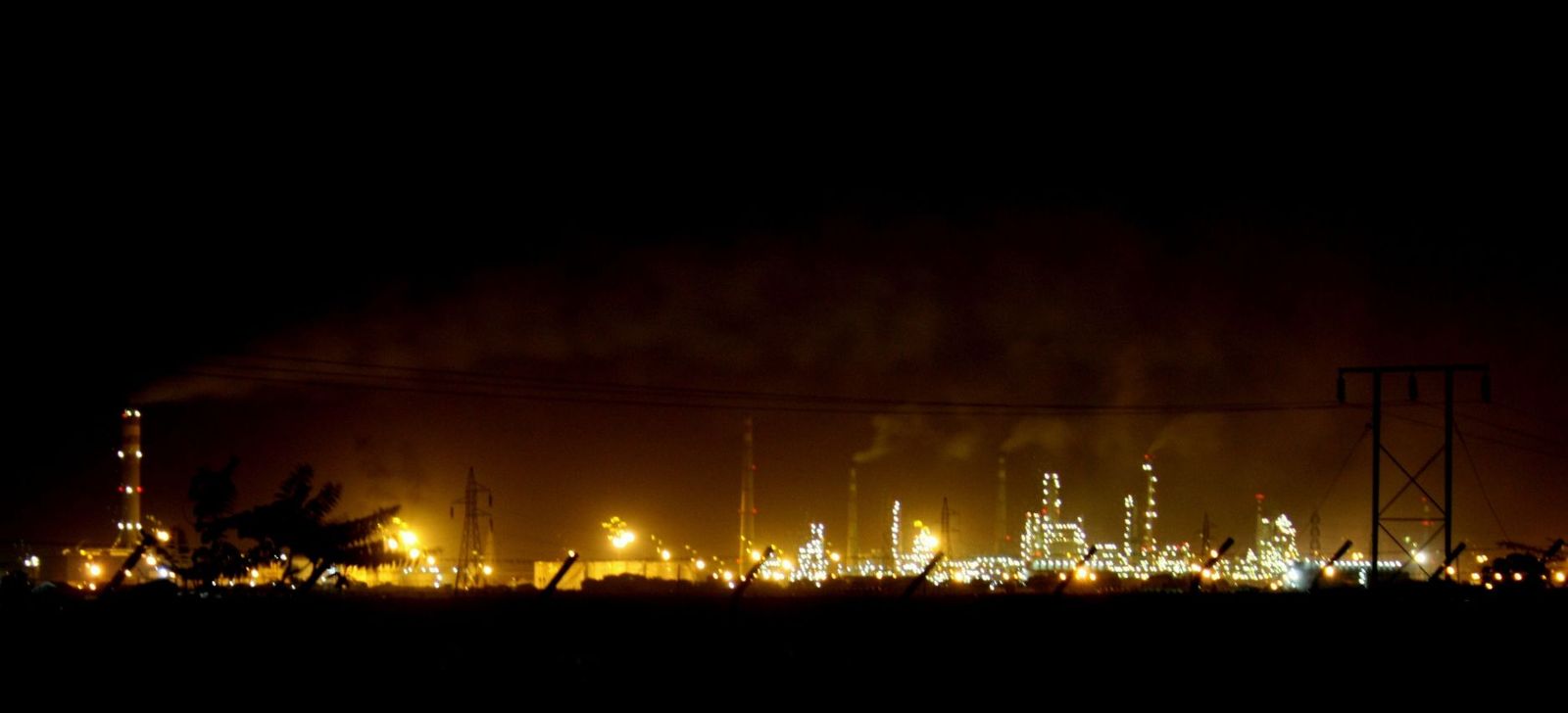
Two bridges closed, a school in ashes, a refinery burning — and the war's new address is infrastructure. Russia is smashing Kyiv's river crossings while Ukraine torches Moscow's fuel machine, and both capitals are discovering that concrete and crude bleed harder than trenches.
It began, as these things now do, on Telegram. At midday on Thursday, Kyiv mayor Vitali Klitschko wrote that two Russian drones had slammed into the Southern Bridge — the cable-stayed artery that carries road traffic and the metro across the Dnipro — and by evening a second strike had damaged a support, chewed up part of the road surface, and wrecked the protective structures around the metro crossing. Unofficial channels posted footage of the roadway ablaze and a column of thick black smoke climbing over the river. That same Thursday morning, a Russian drone had smashed into the third floor of a Kyiv school; the children were already in the shelter — more than a hundred of them — and nobody was injured, though the building's windows were shattered and the staff picked through debris while President Volodymyr Zelensky arrived to inspect the wreckage. 'They [Russians] spare no one,' said the school's director, Valentyna Chorna. 'Children are our future, the future of our nation. In order to destroy a nation, of course, they need to destroy children.' Then, on Friday, Klitschko was back on Telegram with the word nobody in Kyiv wanted to read: the bridge had been hit again. Traffic across the Southern Bridge and the Paton Bridge was closed in both directions, with partial restrictions on the Metro Bridge, as authorities rerouted three million residents across alternative crossings. A fire broke out on the top floors of an apartment building. By Friday's count, the strikes had killed one person and injured two in the capital.
While Kyiv's firefighters worked the bridge, the war answered from the other end of the range. Early Friday, the governor of Russia's Volgograd region, Andrei Bocharov, wrote on Telegram that Ukrainian drones had attacked industrial facilities in the city — home to one of Russia's largest oil refineries — and that a fire had broken out in an apartment building, injuring one person, before being extinguished. Bocharov did not name the industrial facilities. Unofficial Telegram channels were less discreet: they reported explosions and a blaze at the Lukoil-Volgogradneftepererabotka refinery, and Russia's defence ministry said 34 Ukrainian drones had been shot down over the region overnight while aviation authorities imposed temporary restrictions at Volgograd airport. Regional officials have not confirmed that the refinery itself was struck — a gap worth noting, because the pattern of the last two months has been denial first and admission later. What is on the record is harder to dodge: industry sources previously told Reuters that the Lukoil Volgograd plant accounts for around 5 percent of Russia's entire oil-refining capacity, and it has already been forced to suspend processing this year after a Ukrainian drone attack sparked a fire. Volgograd, in other words, is not a symbolic target. It is one of the fuel taps of the Russian state — and Kyiv has been turning them off, one drone wave at a time.
The attacker needs one drone to get through; the defender needs to stop them all. That is the losing arithmetic of the infrastructure war.
Vladimir Putin said so himself, which is why this story is not just another overnight exchange of drones. Speaking on Thursday at the Valdai discussion forum in Moscow, the Russian president acknowledged that Ukraine's strikes on Russian oil refineries had 'partially achieved [their] objectives' — his phrase — and that the damage had cost Russia around 1 percent of its gross domestic product, by the Kremlin's own preliminary estimates. For a leader who has spent years insisting the war economy was invulnerable, it was a remarkable admission. It was also a warning. Putin declared that Russia was now 'responding in kind' and rejected calls to halt strikes on economic targets on both sides; he added that Russia would not supply diesel to global markets until sanctions against Moscow are lifted. The market heard him: Russia this week extended its ban on diesel exports for fuel producers until the end of October, squeezing a global diesel market already rattled by war. In the United States, diesel prices have shot to records above $6.50 a gallon, a political hazard for Donald Trump ahead of the midterm elections; the American president said last month that Ukrainian attacks on Russian fuel facilities were causing a global diesel shortage and urged Kyiv to stop. Meanwhile, ordinary Russians are forming long lines at petrol stations as refinery damage ripples through domestic supply. France's Le Monde reported last month that Kyiv's campaign had cut Russia's oil-processing capacity by 20 to 30 percent — the first such reduction since the invasion began in 2022. One percent of GDP, a fifth of refining capacity, queues at the pump: this is what an infrastructure war looks like Consider the asymmetry: Ukraine's entire refinery campaign is run on drones that cost a fraction of a cruise missile, while Russia's answer requires jet-powered attack drones and ballistic missiles against cities — an exchange in which the defender's economics get worse every month. The longer it runs, the more both economies look like war economies wearing civilian clothes.
The bridge was always coming. The front line in eastern and southern Ukraine has barely moved in a year, and the war has been migrating steadily away from trenches and toward the things armies and economies stand on. Russia intensified its drone campaign against Kyiv through the summer: Ukraine's air force counted 2,850 Russian drone attacks in August and 3,177 in September through the 29th, increasingly with fast jet-powered models that Ukraine's interceptors struggle to catch. On Wednesday, Russia said it had struck Ukraine's energy infrastructure — Kyiv read it as the opening salvo of the cold-weather campaign to cut power and heating before winter. The week's ledger is grim: on Monday a Russian drone smashed into Ukraine's National Academy of Sciences in central Kyiv, killing one person and wounding several; late Wednesday a drone hit Kyiv's Institute of Nuclear Research, which reported radiation levels normal; Thursday brought the school and the bridge; Friday the bridge again. Russia's defence ministry said its drones had also hit a power station in the Kyiv region, the Izmail port near Odesa and a cargo vessel — all claimed, without evidence, as military targets. Political analyst Vadym Denysenko captured why the bridge strikes landed so heavily: such structures had been treated as a 'red line,' he wrote, and crossing it is an escalation in its own right. The omen had been posted days earlier by Sergiy 'Flash' Beskrestnov, an adviser to Zelensky, who warned that Russia had begun fielding a jet-powered drone designed specifically to cut electricity pylons and steel bridge structures. The bridge-cutter has arrived.
Start with geopolitics, because that is where the escalation ladder lives. Moscow's message with the Southern Bridge is twofold: Kyiv's refinery campaign will be answered on Ukrainian infrastructure, and the 'red lines' around strategic crossings are now rhetorical furniture. Putin said it plainly at Valdai — Russia is responding in kind, and he will not be talked out of it. From Kyiv's side, the refinery strikes are the one asymmetric tool that has visibly moved the Russian president's own numbers, and Zelensky's government has every incentive to keep it: Thursday's counter-strikes included a Ukrainian hit on a drone storage and launch site in Russia's Oryol region, proof the campaign is widening beyond refineries to the machinery that launches the attacks on Ukraine. The macroeconomics are where Putin's admission does its real damage. One percent of GDP is not a rounding error in a sanctions-warped economy; a 20-to-30 percent cut in refining capacity is a direct tax on everything Russia moves by road, rail and air — including the military — and the diesel export ban until the end of October turns a domestic wound into a global price signal. Watch the queues: Andrei Klepach, the chief economist of Russia's state development bank, was dismissed in mid-August after warning that war pressure could trigger a 'social crisis' that would 'break out when no one particularly expects it.' Fuel lines are exactly the kind of everyday humiliation that makes such warnings real. The demographic dimension is quieter but uglier. Three million people in Kyiv now live under round-the-clock attack alerts; a school director counts the hundred children who survived because the shelter drill worked; families reroute their mornings around closed bridges. In Russia, the petrol queue becomes the war's most democratic institution — it reaches everyone, regardless of politics. Historically, none of this is new. The oil campaign of the Second World War taught that refineries are the soft underbelly of any mechanized military, and every air campaign since has rediscovered it. Bridges, too: the Kerch crossing has been hit before, and the lesson Kyiv is applying to Volgograd is the oldest in strategic bombing — you do not have to defeat the army if you can starve its engine. The structural trend underneath it all is the drone. Cheap, long-range, increasingly jet-fast, the drone has made infrastructure defense a losing arithmetic: the attacker needs one to get through, the defender needs to stop them all. Ukraine's air force is begging for interceptor missiles; Zelensky said Thursday it was 'important that we have additional missiles in October.' The side that solves the drone-defense equation first wins the infrastructure war — and neither side is close. The winter dimension sharpens everything. Russia's Wednesday strikes on Ukraine's energy infrastructure were read in Kyiv as the rehearsal for a cold-weather campaign against heat and power, and a city that spends January in the dark negotiates from a different position than a city with working radiators. Ukraine's refinery campaign is, in part, an answer to that arithmetic: if Moscow plans to freeze Kyiv, Kyiv plans to bankrupt the freezer. The Turkish dimension — the one watched from these straits — is that the Black Sea is the pressure valve for both campaigns at once: it carries the grain, it carries the oil products, and it carries the insurance premiums that price every drone wave. Every attack on a port, a refinery or a cargo vessel travels straight into freight rates and food prices, which is why Erdoğan's 'inexplicable' comment was aimed at both capitals with equal force.
From Istanbul, this looks less like a war of trenches and more like a war over the Black Sea's throat — and Turkey holds the throat. President Recep Tayyip Erdoğan told Zelensky last week that attacks by Russia and Ukraine on commercial vessels in the Black Sea were 'inexplicable' and that both sides must act responsibly; Ankara says some of those attacks have struck Turkish-owned vessels and killed Turkish citizens, and it is still waiting for Moscow's and Kyiv's responses to its offers to stop the strikes. At the UN General Assembly, Erdoğan declared that 'the Black Sea is not, should never be, a front of this war,' and his foreign minister has called the spread of fighting in the basin 'not an acceptable situation.' The mediation is not theatre: Turkey and the UN are brokering new talks on a Black Sea truce, and a document seen by Bloomberg describes a 'narrowly defined and reciprocal arrangement' covering free commercial navigation and — crucially — the protection of ports and energy infrastructure. That last phrase is doing heavy work: Putin said on Friday that Ukraine's proposals to halt attacks, including in the Black Sea, remain on the table, while insisting they were prompted by Moscow's retaliatory strikes and that Russia would decide based on its own interests. Foreign Minister Lavrov, meanwhile, called any return to the 2022 grain deal 'completely unacceptable and unrealistic.' So the corridor that once fed the world — the 2022 grain initiative Turkey and the UN brokered before Russia walked away in 2023 — stays shut, wheat prices stay high, and the importers of Asia, the Middle East and Africa keep paying the premium. Turkey's leverage is real — it controls the Bosporus and the Dardanelles, it talks to both presidents, it sits inside NATO — but leverage is not a solution, and every burned bridge and burning refinery makes the truce document look more like archaeology than diplomacy.
The immediate question is structural: how much damage did two days of drone strikes actually do to the Southern Bridge, and how long do three million people reroute their lives? Klitschko's crews are inspecting; metro and road closures are the honest answer for now. The second question is ammunition. Zelensky held a conference call Thursday with the officials in charge of protecting infrastructure, ordered a review of partner agreements on air-defense missiles and F-16 deliveries within 24 hours, and said flatly that 'it is important that we have additional missiles in October.' If the interceptors do not arrive, the jet-powered drones will keep arriving instead. The third question is the refinery campaign's staying power: Russia is patching plants and ringing them with air defenses, and Ukraine keeps hitting them — the Volgograd strike, confirmed or not at the refinery gate, shows Kyiv is not pausing for Putin's admission. The fourth is winter. Wednesday's strikes on the power grid were Kyiv's read as the opening of the cold-weather campaign; a city that loses heat in January does not negotiate from strength. The fifth is the diplomatic track: Turkey and the UN's narrow arrangement on navigation and infrastructure protection is the only proposal on any table that addresses the war both sides are actually fighting now. And the sixth is the diesel market — the export ban runs to the end of October, American prices are at records, and fuel politics has a way of traveling from the pump to the ballot box. None of these threads resolves the others. That is the point of an infrastructure war: it multiplies. A seventh thread runs underneath them all: repair speed. Refineries can be patched and bridges can be shored, but the race between repair crews and drone waves is the war's true tempo — and the side whose engineers lose that race first will feel it in the dark, at the pump, and at the negotiating table.
Wars end when the cost of continuing exceeds the cost of stopping, and infrastructure wars are designed to make that arithmetic visible — in queues, in detours, in the price of a liter of diesel. Putin has now priced his own damage at one percent of GDP. Kyiv has priced its at two bridges and a school. Both ledgers are still open, both sides are still adding lines, and the Black Sea — Turkey's sea, the world's breadbasket route — sits between them, waiting to see whether the next document signed in the region is a truce or an insurance claim. The insurers, the shipowners and the grain traders will keep their own ledger regardless: risk premiums on Black Sea routes have already priced in a war that both capitals insist is under control. It is not under control. It is expanding, one bridge and one refinery at a time — and the expansion has a direction: toward everything that keeps a modern state warm, fed and moving.
From the Western vantage, the bridge strikes confirm what the last month has made plain: Moscow is systematically crossing lines it once treated as untouchable, and it is doing so against a capital's civilian fabric — a school, an apartment block, the metro millions ride to work. The 'red line' around the Dnipro bridges was not a Western invention; a Ukrainian analyst named it, and Russia erased it anyway, two days running. Putin's talk of 'responding in kind' is a false equivalence dressed as doctrine. Ukraine's refinery campaign targets the fuel that feeds a war machine; Russia's answer targets the crossings, schools and power grid that feed a civilian population heading into winter. One is economic pressure on a war economy. The other is terror against a city.
The West's honest read of Putin's 1-percent admission is that the pressure is working — and that this is precisely why the air defenses must arrive now. Kyiv's drone surge numbers (3,177 Russian attacks in September) and Zelensky's demand for 'additional missiles in October' describe a defense running on fumes while jet-powered drones do the bridge-cutting work. The diesel export ban to the end of October, the $6.50 American gallon, the queues at Russian pumps: all of it is the predictable cost of an aggressor's economy meeting a victim's reach. Turkey's mediation is welcome in Western capitals, but nobody there mistakes it for a substitute for interceptors. The bridge will be repaired; the question is whether Kyiv gets the missiles before winter does the rest of Russia's work.
From Moscow's vantage, the sequence runs the other way: Ukraine openly declared economic warfare — its own leaders said the goal was to damage the Russian economy — and then spent the summer torching refineries from Volgograd to Siberia with long-range drones. One percent of GDP is real damage, and Putin's candor about it at Valdai was a statement of confidence, not weakness: the economy absorbs it, the plants get repaired, the air defenses go up. The Southern Bridge, in this telling, is not a civilian target but a military artery over the Dnipro, in a city the Russian defence ministry describes as a logistics hub; the ministry's claim that the bridge, the power station, the Izmail port and the cargo vessel all served military purposes is the legal frame Moscow will keep repeating. 'Responding in kind' is not escalation to the Kremlin — it is symmetry.
The Eastern read is also deeply skeptical of the mediation theatre around it. Lavrov's dismissal of any return to the 2022 grain deal as 'completely unacceptable' rests on the Russian conviction that Kyiv abused that arrangement for military ends; from Moscow, the new Black Sea truce proposals look like Kyiv asking for a timeout because the retaliation is biting — Putin said as much on Friday. The diesel export ban is, in this frame, a sovereign right, not a market crime: if sanctions bar Russian fuel from world markets, Moscow will manage its own supply first. And 1 percent of GDP, while unwelcome, is 'not critical' — the phrase Putin has used before. The refinery war, Moscow insists, has not changed the strategic picture; it has only changed the price of heating oil in Ohio.
From the Global South, the arithmetic of this war is measured in prices, not principles. When Russia extends its diesel export ban to the end of October, it is truckers in Lagos, farmers in Punjab and fishermen in Mombasa who pay the difference at the pump; when the 2022 grain corridor stays shut and wheat prices stay high, it is the importers of Asia, the Middle East and Africa who absorb the premium. One percent of Russian GDP and two closed Kyiv bridges are headlines in the North; in the South they arrive as inflation. The fuel queues forming at Russian petrol stations are newsworthy, but the queues that matter most to the South are the ones at the grain terminals that never reopened. Neither Moscow nor Kyiv asked the developing world whether it consented to an infrastructure war — it simply got billed for one.
This is why the South's ear is tuned to Ankara rather than to either capital. Erdoğan's insistence that the Black Sea 'should never be a front of this war,' the Turkish-UN talks on a narrow arrangement for navigation and infrastructure protection, the still-waiting offers to stop the vessel attacks — these are the only proposals on any table that speak to the South's interest, which is not who wins but what ships. The skepticism is mutual: developing countries have watched red lines drawn and erased, grain deals signed and abandoned, and diesel promises made and withdrawn, all by powers that lecture about rules. The South's verdict on the bridge-and-refinery war is unsentimental. End the strikes on the things that feed people — the fuel, the grain, the ports — or admit that the rest of the world is simply the battlefield's wallet.
Beijing just wrote the biggest liquidity check of the year — and changed nothing else.
The People's Bank of China will offer banks up to one trillion yuan a day — about $149 billion — in overnight funds from September 28 through October 8, covering the Golden Week holiday. It is the largest such cap since the tool's introduction in June 2026, up from 600 billion yuan in mid-September.
The calendar explains the timing. Golden Week sends hundreds of millions of Chinese traveling and spending; banks need cash the way airports need runways. The central bank is making sure the plumbing holds.
The scale, though, is the story. One trillion yuan a day is not holiday housekeeping. It is a backstop — a signal that whatever the holiday throws at the financial system, the PBoC has already covered.
And then, the other hand: nothing. Chinese banks left the one-year and five-year loan prime rates unchanged at 3.00% and 3.50% — the 16th consecutive month without a move.
Sixteen months of stillness in the price of credit, alongside the largest liquidity flood of the year. Beijing is watering the garden and refusing to lower the fence — liquidity yes, cheaper credit no.
Governor Pan Gongsheng gave the doctrine a name: slower loan growth is becoming "the new normal." Property and local-government borrowing are shrinking faster than emerging industries can borrow. The credit engine is being rebuilt mid-flight.
Liquidity is Beijing's answer to everything except the one question markets keep asking: where is the growth?
The PBoC is not idle elsewhere. It stepped up support with a net 200-billion-yuan injection through medium-term lending facility operations, reiterated its "moderately loose" stance, and kept its grip on the yuan.
The yuan, for its part, cooperated — rebounding after briefly dipping below 6.70 per dollar as US Treasury yields rose and the PBoC's grip eased.
The diplomacy helped. A US–China summit extended the trade truce to January — without new tariff cuts, but without new tariffs either. A truce, not a peace; markets will take it.
Step back and the contrast is the story. In Washington, yields cross 5% and traders bet on another hike. In Beijing, the central bank floods the system with cash and leaves rates untouched for a 16th month. Two central banks, two planets.
The logic is not mysterious. China's problem is not hot demand — it is cold credit. Pumping liquidity keeps the system liquid; cutting rates into weak demand would be pushing on the proverbial string.
The risk is the one Beijing knows best: banks awash in cash, with nowhere productive to lend it. Liquidity without lending becomes asset froth — the 2015 lesson, still fresh in institutional memory.
For the region, the signal matters more than the mechanics. A stable yuan and a liquid Chinese banking system through Golden Week is the foundation under Asia's supply chains. When Beijing sneezes, the region's exporters reach for tissues.
Watch what happens after October 8. If the trillion-yuan window closes quietly, it was holiday plumbing. If support lingers, it was something else — a central bank telling you, without saying it, that the economy needs the help.
Western coverage — Reuters and the financial wires — emphasizes the restraint: Beijing holding rates while flooding liquidity, a central bank running out of its favorite tools.
In this telling, 16 months of unchanged loan prime rates is the real headline — evidence of a policymaker boxed in by a hawkish world, a weak property sector, and the fear that rate cuts would only weaken the yuan. Liquidity is what you do when you've decided rates can't move.
Pan's "new normal" gets a skeptical hearing: an elegant phrase for a credit engine that no longer transmits. The question in Western commentary is whether "moderately loose" is a stance or a shrug.
Eastern coverage — Xinhua and Chinese outlets — emphasizes the calibration: targeted, seasonal, and exactly as doctrine prescribes.
In this telling, the trillion-yuan facility is textbook PBoC: precise, time-bound, and aimed at a known seasonal need. The unchanged rates are not paralysis but prudence — "moderately loose" means loose where it counts, steady where it matters, with the yuan's stability as the binding constraint.
The summit's truce extension gets equal billing: diplomacy buying the central bank room to maneuver, and the maneuver working — the yuan's rebound presented as policy competence, not luck.
Global South coverage — Malaysia's business press among it — emphasizes the neighborhood: what Beijing's plumbing means for everyone downstream.
The read from Kuala Lumpur: a liquid China through Golden Week is good news for ASEAN exporters, supply chains, and the region's own central banks. Yuan stability is a public good in Asia, and the PBoC just underwrote another week of it.
The caution in this coverage is borrowed from experience: when the region's biggest economy needs record liquidity to get through a holiday, the "new normal" of slower credit is everyone's normal too.
To read Beijing's move properly, you need the toolkit. Start with the overnight reverse repo — the instrument at the center of the trillion-yuan headline. In a reverse repo operation, the central bank lends cash to commercial banks overnight, taking bonds as collateral; the banks get the liquidity they need, the central bank gets the bonds back the next morning plus a sliver of interest. It is plumbing, not policy: the money created exists for a day, maybe rolled over, and its purpose is to keep the interbank market — the market where banks lend to each other — from seizing. The cap is the message. A trillion yuan a day says: whatever the holiday throws at the system, the PBoC has already covered.
The tool itself is young — introduced only in June 2026 — which makes the record cap more interesting. A new instrument's ceiling is normally discovered cautiously; jumping from 600 billion yuan in mid-September to a full trillion two weeks later is not calibration but declaration. It tells the banks, and through them the market, that the central bank will not be outbid by seasonal stress. The facility runs September 28 to October 8, covering Golden Week exactly. Time-bound, enormous, and explicitly temporary: the PBoC is writing a check it intends to tear up on the 9th. The question the article ends on — what happens after October 8 — is the only one that matters, because a backstop that lingers stops being a backstop and starts being a subsidy.
Then the medium-term lending facility — the MLF — through which the PBoC added a net 200 billion yuan. If reverse repos are the overnight overdraft, the MLF is the term loan: banks borrow for months, not hours, pledging collateral, at a rate the central bank sets. The MLF rate is the PBoC's quiet policy lever — it guides the loan prime rates without the drama of changing them. And the loan prime rates, the LPRs, are the number the article keeps returning to: 3.00 percent for one year, 3.50 percent for five, unchanged for the sixteenth consecutive month. The LPR is the benchmark for most new lending in China; holding it still while flooding the system with cash is the whole doctrine in one gesture. Liquidity yes. Cheaper credit no.
The sixteen months of stillness deserve their own reading, because stillness is also a decision — sixteen times over. In a world where Washington is hiking and yields cross 5 percent, cutting Chinese rates would narrow the already thin cushion against capital outflow and yuan depreciation; every basis point of easing is a basis point of incentive for money to leave. The PBoC's box, as the Western lens describes it, is real: a property sector that no longer transmits stimulus, local governments deleveraging rather than borrowing, and a currency whose stability is the binding constraint on everything else. Holding the LPR is not paralysis. It is the recognition that the price of credit is no longer the economy's binding constraint — and that moving it would cost more in currency stress than it buys in growth.
The calendar explains the timing, as the article says — but the calendar deserves its scale stated plainly. Golden Week is the largest annual human migration on earth compressed into seven days: hundreds of millions of Chinese traveling, spending, withdrawing cash, settling bills. The banking system's cash demand does not rise. It detonates. ATMs must be stocked, merchants' settlement accounts funded, the interbank market supplied with enough reserves to clear a week's worth of the world's second-largest economy changing hands. In normal years, the PBoC manages this with routine open-market operations. This year it wrote the biggest check in the tool's short history.
The scale, though, is the story — the article's line, and worth pressing. One trillion yuan a day is not holiday housekeeping; it is a backstop sized for something the PBoC sees and the market does not yet. Seasonal demand explains the facility's existence. It does not fully explain its size. Either the central bank is being theatrically cautious — signaling strength by oversupplying safety — or its internal read on holiday-season financial stress is darker than the public data. Both readings are consistent with "moderately loose." Only one of them is reassuring. The banks will take the cash either way; the signal is in the surplus.
There is also the consumption angle, which is where the liquidity meets the real economy. Golden Week is China's great annual test of consumer confidence: the week when households vote with their wallets on whether the economy feels safe. A banking system visibly backstopped — cash available, payments clearing, no friction — is the precondition for the spending the state wants to see. The PBoC cannot make households spend; it can only ensure that nothing in the plumbing stops them. In an economy where the consumer has been the missing piece and property wealth no longer does the spending's work, the holiday's cash registers matter more than the interbank rate. The trillion yuan is, among other things, a bet on the tills.
And the regional read — the Global South lens from Kuala Lumpur — captures what the holiday means beyond China's borders. A liquid China through Golden Week is the foundation under Asia's supply chains: exporters paid, importers funded, the region's own central banks spared the volatility of a yuan under holiday stress. Yuan stability, as the article notes, is a public good in Asia, and the PBoC just underwrote another week of it. When the region's biggest economy needs record liquidity to get through a holiday, the "new normal" of slower credit becomes everyone's normal — but a stable holiday is still a stable holiday, and Asia's exporters will take it.
Central bankers choose their phrases the way diplomats choose communiqués — every word weighed, every ambiguity intentional. When Governor Pan Gongsheng said slower loan growth is becoming "the new normal," he was not describing a statistic. He was retiring an expectation. For two decades, China's credit engine ran on a simple formula: property developers borrowed, local governments borrowed against land, and the resulting construction carried GDP. That engine is being dismantled mid-flight — property deleveraging, local-government debt discipline — faster than emerging industries can borrow to replace it. "New normal" is the doctrine that says: stop waiting for the old credit cycle to return. It is not returning.
The doctrine has a logic, and it is worth steelmanning before doubting. Credit-fueled growth bought China two decades of expansion and left it with the property crisis, the local-government debt pile, and the demographic headwinds now arriving together. Pumping cheap credit into that structure — the old playbook — would reflate the very imbalances the state is trying to defuse. Slower, cleaner credit growth, directed at manufacturing upgrades and strategic industries rather than concrete, is the quality-over-quantity bet. The PBoC is not refusing to stimulate. It is refusing to stimulate the old economy. The distinction is the entire policy.
The risk, as the article notes, is the one Beijing knows best: banks awash in cash with nowhere productive to lend it. Liquidity without lending becomes asset froth — the 2015 lesson, still fresh in institutional memory, when stimulus leaked into equity speculation rather than productive investment. The trillion-yuan facility, the 200-billion MLF injection, the "moderately loose" stance — all of it presupposes transmission channels that the "new normal" itself describes as weakened. Watering the garden, to use the article's image, works only if the soil still absorbs water. If property and local governments no longer drink, and emerging industries cannot drink fast enough, the water pools. Pooled liquidity has a history in China. It is called a bubble.
Step back and the contrast the article closes on — two central banks, two planets — is the frame that will define the autumn. Washington hikes into data it may not have, fighting inflation with the South's interest bills. Beijing floods with cash it cannot lend, defending a currency it cannot afford to let slip, waiting for a credit engine it is rebuilding mid-flight. Neither has a clean instrument. Both are improvising inside doctrines — data-dependence, the new normal — that describe the world they wish they governed. Watch October 8: if the trillion-yuan window closes quietly, it was holiday plumbing, and the doctrine holds. If support lingers, the PBoC will have told you, without saying it, that the new normal needs more help than the old vocabulary admits.
Monetary policy does not happen in a diplomatic vacuum, and the PBoC's autumn maneuver owes more to the summit than the communiqués admit. The US–China meeting extended the trade truce to January — no new tariff cuts, but no new tariffs either — and that pause is worth more to Beijing's central bank than any single instrument in its toolkit. Tariff escalation would have meant a weaker yuan, imported inflation, and capital flight arriving together; the truce removes the worst tail from the PBoC's planning. "A truce, not a peace; markets will take it," as the article says. So will central bankers.
The yuan's rebound — recovering after briefly dipping below 6.70 per dollar — is the truce's signature in the currency market. With US Treasury yields rising and the PBoC's grip easing, the currency found its footing not through intervention but through the removal of a threat. That distinction matters: a yuan steadied by diplomacy is cheaper to defend than a yuan steadied by reserves. Every week the truce holds is a week the PBoC does not have to choose between growth and the exchange rate — the choice that has boxed in Chinese policy for the better part of a decade.
But truces expire, and January is closer than it looks. The extension without tariff cuts is a freeze, not a thaw: the existing duties remain, the structural disputes untouched, the next escalation one headline away. The PBoC is therefore managing a window, not a settlement — using the diplomatic calm to get through Golden Week, to steady the currency, to buy the "new normal" time to prove itself. If January brings escalation, the trillion-yuan plumbing will look like the prelude to a harder season. Diplomacy bought the central bank room to maneuver, as the Eastern lens notes. Room is not resolution. It is rented, monthly, and the rent comes due in January.
