Russia's Kosmos 2612 military satellite spent days manoeuvring within hundreds of metres of ICEYE-X36, a commercial radar spacecraft whose imagery supports Ukraine's war effort. Trackers call it the first non-consensual close approach of two active satellites in low-Earth orbit — and Moscow is saying nothing about why.
Published 20 October 2026 · 16:13 GMT
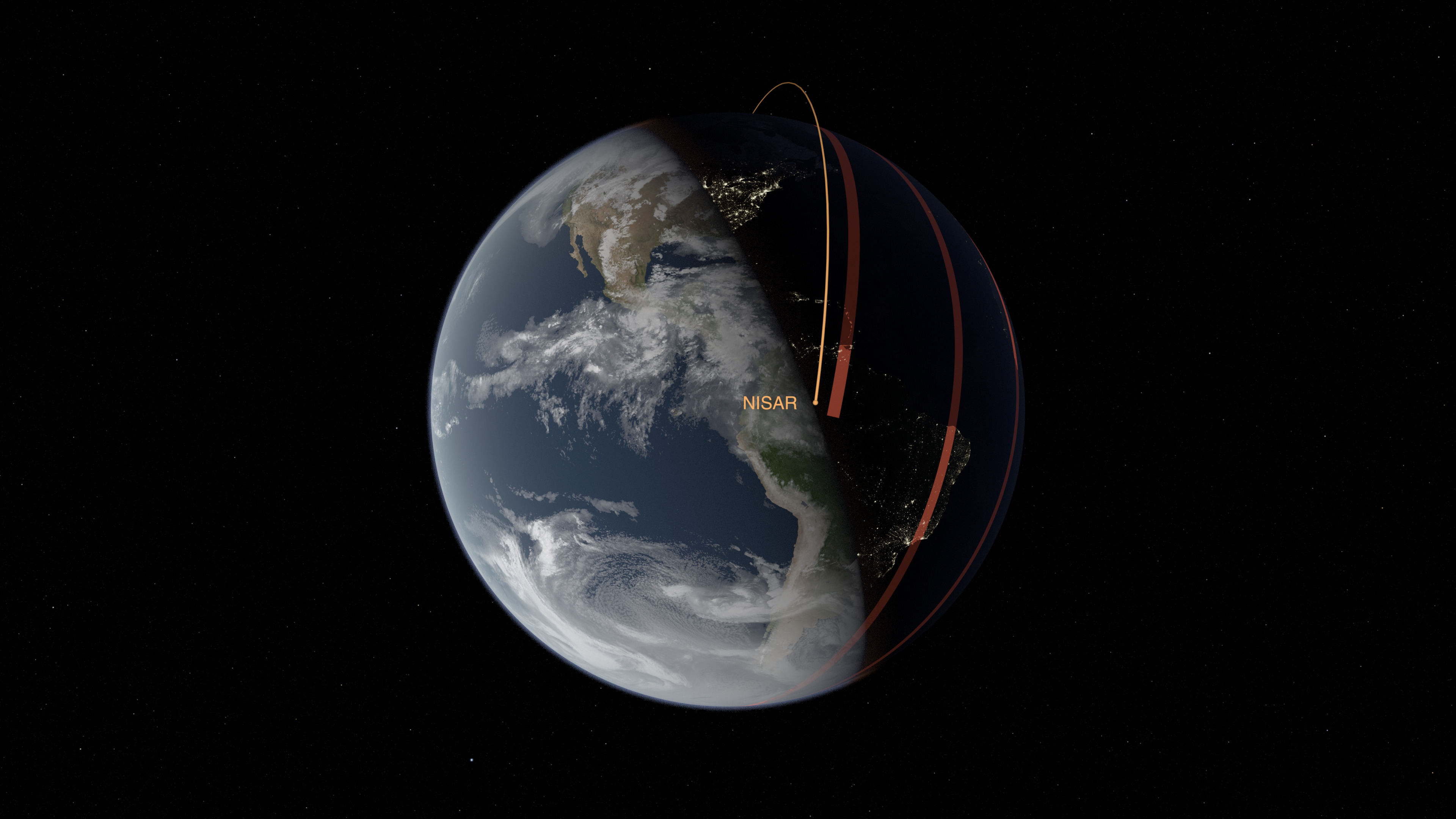
Between Thursday, October 15 and Monday, October 19, 2026, a Russian military satellite called Kosmos 2612 carried out a deliberate series of orbital manoeuvres that brought it to within hundreds of metres of ICEYE-X36, a commercial radar-imaging satellite whose data supports Ukraine's armed forces, according to the US space-tracking firm LeoLabs.
LeoLabs, which operates a global network of ground-based radars, said Kosmos 2612 closed a gap of more than 320 kilometres on October 15, drew to within about 4.8 kilometres by the early hours of October 16, and then spent the weekend shifting between positions ahead of and behind the ICEYE spacecraft — at times coming within roughly 500 metres.
By Monday, LeoLabs reported, the Russian satellite had begun to move away, and the close-proximity phase was over.
Kosmos 2612 is one of six military satellites Russia launched on April 17, 2026, from the Plesetsk cosmodrome. In May, four of them moved close to ICEYE spacecraft, and a June report by the UK's Royal United Services Institute flagged intimidation and communications jamming as possible objectives.
The stalking turned serious in the autumn. The space analyst Marco Langbroek wrote that Kosmos 2612 began its "worrisome" stalking mission on September 30. Then, on October 15, came the rapid final approach: from about 350 kilometres out to less than 5 kilometres by the early morning of October 16, according to LeoLabs.
What followed was not a flyby. LeoLabs described a controlled sequence: a deliberate approach, changes in relative position, sustained close-proximity loitering, repeated small manoeuvres to hold station, and finally a controlled departure. At times the two spacecraft flew so close that LeoLabs' radars struggled to distinguish them.
ICEYE is a Finnish company that operates through a US subsidiary; ICEYE-X36 is registered in the United States. Its synthetic aperture radar (SAR) satellites can image the Earth's surface at night and through cloud cover — a capability militaries prize. ICEYE has supplied radar imagery to Ukraine since 2022, and a January 2026 release detailed an expanded agreement giving the Ukrainian armed forces "persistent situational awareness on tactical timelines."
A Ukrainian official told the news site Axios that Ukraine's military works with ICEYE and uses its capabilities, but said it was unclear whether ICEYE-X36 itself is tasked for Ukraine. ICEYE's chief executive told Reuters the company had moved its own satellite in May.
ICEYE itself has said little. A company spokesperson told reporters the firm is "aware of the situation and tracking it closely," adding that "our constellation architecture is designed for continuity and resilience." For background on how commercial space assets have become entangled in the war, see the Bureau's earlier reporting on Ukraine's reliance on commercial satellite services and Ukraine in the Factbook.
Russia's purpose. No Russian official statement has explained what Kosmos 2612 was doing next to a Western commercial satellite. CNN said it had reached out to the Russian Ministry of Defence, the Aerospace Forces and the space agency Roscosmos for comment. The silence is itself part of the story: as Scientific American noted, no explanatory or corroborating statements have emerged from Russian or US defence officials or from ICEYE.
Exactly how close the two satellites came. LeoLabs puts the minimum at roughly 500 metres, with explicit uncertainty. Some tracking services estimated far closer passes — one widely repeated figure was about 26 metres — but independent reconstructions caution that such numbers are predictions, not measurements: public orbital data cannot support a miss distance that small, and the in-track uncertainty for Kosmos 2612 is on the order of two kilometres.
Whether ICEYE-X36 itself serves Ukraine. The company's constellation supports Ukraine's military; whether this particular spacecraft is part of that tasking is unconfirmed.
What the demonstrated capability will be used for next. LeoLabs says the observed tactics could support inspection, shadowing, interference, or preparation for future counterspace operations — a menu of possibilities, not a verdict. See also Russia in the Factbook.
This is the moment commercial space crossed a line it cannot uncross. Until now, Russia's close-approach games targeted government satellites. Kosmos 2612 is the first documented case of an uncooperative rendezvous and proximity operation against a commercial spacecraft.
Adam Marsh, LeoLabs' vice president of technical solutions, called it "the most advanced and potentially dangerous uncooperative RPO we've observed." Victoria Samson of the Secure World Foundation agreed, noting that earlier cases involved US government satellites being approached — never a commercial one, and never this close without coordination.
The danger is physical as well as political. Two objects converging at orbital speed with no coordination is, in Langbroek's image, like placing a car on a motorway within centimetres of another at full speed: a collision would scatter debris through one of the most crowded lanes of low-Earth orbit. And the legal vacuum is total — the 1967 Outer Space Treaty demands "due regard" for others' activities but sets no minimum separation. For the wider pattern of Russian grey-zone pressure on the West, see Poland scrambling jets as Russia strikes and NATO's top commander warns Russia.
Strip the coverage to what the evidence actually supports, and the picture is narrower — and more consequential — than any single lens admits. What is established: a Russian military satellite spent weeks aligning its orbit with a commercial radar spacecraft, closed deliberately from hundreds of kilometres to hundreds of metres, loitered with repeated station-keeping manoeuvres, and then departed in a controlled fashion.
What is not established: hostile intent. The menu of purposes runs from the menacing (a dry run for a future attack, an inspection rehearsal). The honest ranking puts signalling first — it is the cheapest explanation that fits all the facts — with rehearsal as the possibility that should worry planners most.
Note the information asymmetry, which may itself be the tactic. One side operates entirely in the open: a commercial tracking firm publishes its radar plots, analysts post their reconstructions, journalists quote everyone. The other side says nothing at all. In that vacuum, every Western newsroom fills the silence with its own threat model — which is precisely what a grey-zone operation is designed to produce.
If close approaches of this kind become routine, the second-order effects compound fast. Commercial operators will re-run their threat models: insurers will reprice orbital risk, constellation designers will weigh the cost of evasive manoeuvres against the fuel budgets that determine a satellite's working life.
The norms debate will sharpen. There are no binding keep-out zones in orbit, no agreed minimum separation, no traffic police — only the Outer Space Treaty's 1967 language of "due regard." Every unanswered close approach is a precedent, and precedents accumulate into custom.
For Ukraine, the immediate lesson is redundancy: no single sensor, no single provider, no single orbit can be assumed safe. For the rest of the world, the lesson is that the war's front line now passes through low-Earth orbit — roughly 550 kilometres overhead, moving at seven kilometres per second, and visible to anyone with a radar.
The tracking continues. Public orbital data will show whether Kosmos 2612 — or one of its five siblings from the April launch — lines up on another Western spacecraft.
Three questions will decide what this incident becomes. First, does Moscow ever explain itself — or does the silence harden into doctrine? Third, do the world's spacefaring states use this moment to start writing the rules of the road for close approaches, or does the vacuum persist until debris forces the issue?
The answers will arrive in that order: in the radars first, in the ministries later, and in the treaties last — if at all.
The Western lens: escalation and grey-zone warfare Western coverage frames the encounter as an escalation — the orbital equivalent of the drone incursions and airspace violations that have rattled NATO's eastern flank. The emphasis falls on intent and precedent: the Center for Strategic and International Studies warned in an October 15 report that it should be assumed Kosmos 2612 could take actions threatening the commercial satellite, and placed the episode in the context of Moscow's "aggressive grey-zone policies" toward US and European interests. The Western question is blunt: if Russia will shadow a commercial satellite this brazenly, what stops it from interfering with one — or with the constellations, like Starlink, on which Ukraine's communications depend?
The Eastern lens: capabilities, measured in metres per second South Korean coverage — notably a detailed technical account by JKN — treats the story as an engineering event first and a geopolitical one second. The reporting dwells on specifics: the Soyuz-2.1b launch vehicle, the 27.9-metre-per-second velocity change of October 12, the 541-to-555-kilometre operating band, the conflicting distance estimates. Asia's space powers watch such incidents the way artillery officers watch a ranging shot: their own constellations fly the same orbits.
The Global South lens: whose infrastructure is this? Al Jazeera's October 20 explainer put the plain question to a global audience — is Russia stalking the satellites that help Ukraine? — and answered it the way the South tends to: through precedent and consequence rather than alignment. The pattern, in this telling, is hybrid warfare: the same logic as a drone over Polish airspace or a low pass at a NATO warship.
Kosmos 2612 is a Russian military satellite launched on April 17, 2026, as one of six spacecraft carried into orbit by a Soyuz-2.1b rocket from the Plesetsk cosmodrome. Within weeks of launch, at least four of the six began adjusting their orbits toward ICEYE satellites. Kosmos 2612 is the specific spacecraft that closed on ICEYE-X36 between October 15 and 19, 2026.
According to the tracking firm LeoLabs, Kosmos 2612 closed from more than 320 kilometres away to under 5 kilometres by the morning of October 16, then spent the weekend within roughly 500 metres of ICEYE-X36 — though the firm stresses the exact figure is uncertain. Some trackers claimed passes as close as 26 metres, but analysts say public data cannot confirm that. By October 19–20, the Russian satellite was moving away.
ICEYE's constellation has supplied synthetic aperture radar imagery to Ukraine's military since 2022, under an agreement expanded in January 2026 to provide persistent situational awareness. However, a Ukrainian official told Axios that while the military works with ICEYE, it is unclear whether this specific satellite, ICEYE-X36, is tasked for Ukraine. That distinction remains unconfirmed.
Yes — against government satellites. In early 2020, two Russian satellites moved close to USA 245, an American spy satellite. In September 2025, Germany's defence minister said Russian Luch-Olymp satellites were tracking Intelsat spacecraft used by the German military. What is new here is the target: a commercially owned satellite, approached this closely without its operator's consent.
It is the first documented non-consensual close approach to a commercial satellite in low-Earth orbit, and commercial spacecraft now carry much of the West's orbital sensing and communications. Analysts warn of collision risk and debris, and of a norms vacuum: the Outer Space Treaty requires ‘due regard’ but sets no minimum separation. How states respond will shape the rules of orbital behaviour for years.
