At Quantico, the US defense secretary ordered a four-star Autonomous Warfare Command, cut the generals by 20 percent, and handed Elon Musk, Palmer Luckey and Newt Gingrich a seat at the war-planning table.
Published 2 October 2026 · 18:00 GMT
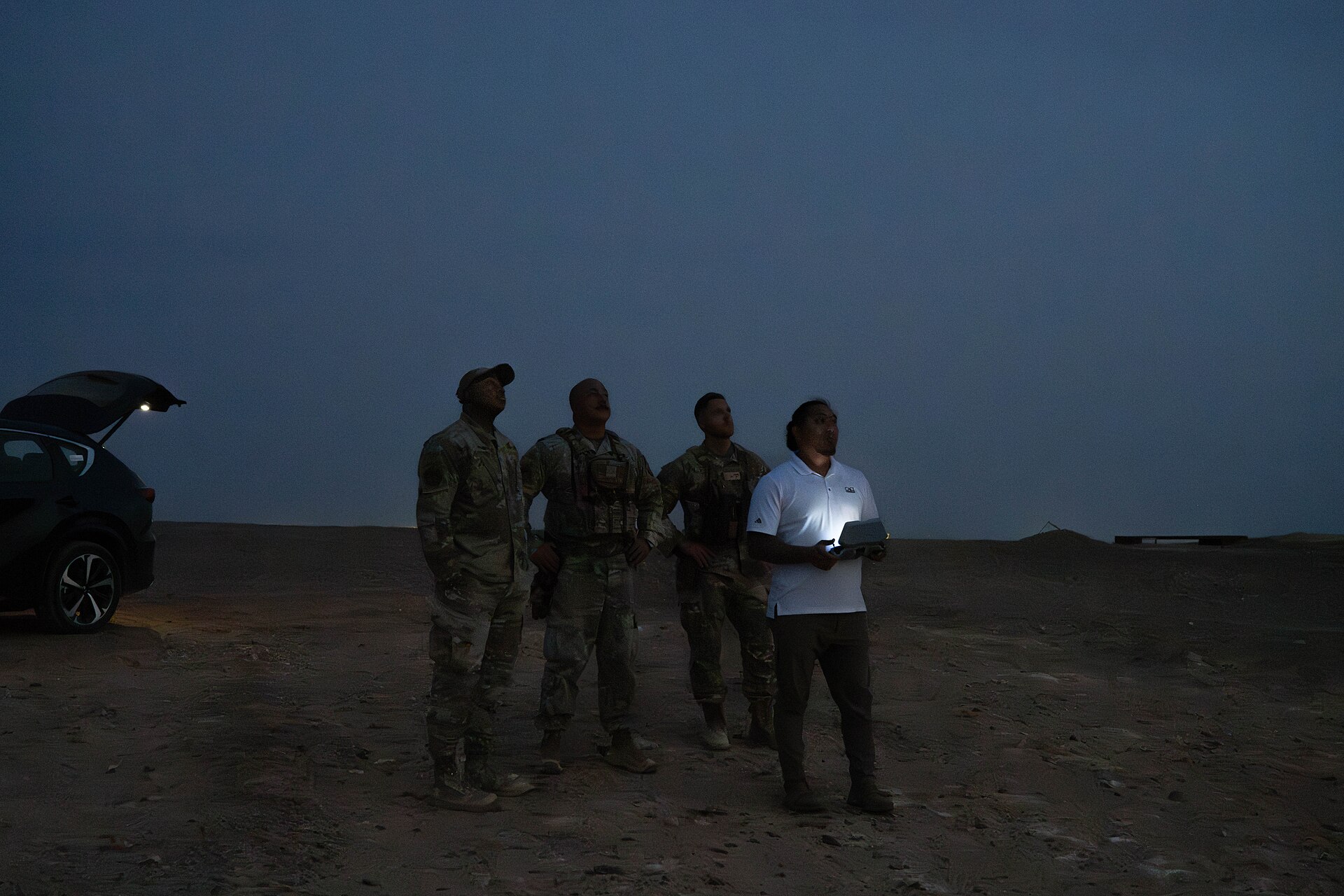
The most important weapon announced at Quantico on Wednesday was not a missile or a jet. It was an org chart. A new four-star command, its own budget and its own manpower, built to put robots and artificial intelligence at the center of American warfighting by October 2027.
QUANTICO, Virginia — The room was the message. Last year, Defense Secretary Pete Hegseth gathered roughly 800 generals and admirals to lecture them on standards. This year, on September 30, he filled a room at Marine Corps Base Quantico with about 600 O-3 officers and E-6 noncommissioned officers — junior leaders, the people who actually fly the drones, carry the radios and take the hill — and addressed them as the future of the force. Above them, Air Force Gen. Dan Caine, the chairman of the Joint Chiefs, stood beside the secretary, a kind of institutional bodyguard for the revolution being announced. Six initiatives poured out of the speech, billed as the second annual “State of the Force” address. But one swallowed the rest: the creation of the Autonomous Warfare Command, nicknamed AutoWarCom — a four-star functional combatant command, with service-like authorities, its own budget and its own manpower, whose mission is to build and field autonomous and robotic capabilities across the entire joint force. Target date: October 1, 2027. “The pace of war is changing faster than the process to support it,” Hegseth told the room, and the whole enterprise of the speech was an attempt to prove the sentence true in a single afternoon. “Today, with … Autowarcom, we institutionalize — and we supercharge — the era of super intelligence, robotics and autonomous systems, all in order to win.”
Why should anyone care about another headquarters with a four-star flag and a budget line? Because in the American military system, headquarters are where change goes to die — unless the headquarters owns the money. The Pentagon's own recent history is a graveyard of offices, task forces and “innovation cells” that could recommend anything and buy nothing. AutoWarCom is designed to break that pattern. A functional combatant command with service-like authorities is not an advisory body; it is an institution that can set requirements, run acquisition, hire people into entirely new military occupational specialties, and field systems to troops. The memo Hegseth signed the same day as the speech directs his staff to go to Congress for the legislation the command needs, and the army's own account of the address stresses that new career fields for drone operators and autonomy specialists will be created in each military department. That detail matters more than the stars: a command can be abolished, but career fields and budget lines develop constituencies — contractors, officers, congressional districts — and constituencies survive secretaries. The last time Washington created a combatant command, in 2019, it was the Space Force's parent: Space Command, now widely seen as the institutional anchor that turned orbital warfare from a talking point into a program of record. AutoWarCom aspires to do for drones and algorithms what that command did for satellites. The United States currently has 11 combatant commands; AutoWarCom would be the twelfth, and the first built around machines rather than geography or domains of human presence. Strip away the ceremony and the logic is ruthless arithmetic: a $40 million aircraft can be destroyed by a $40,000 drone, and a military built around the former cannot survive a war defined by the latter. “Cheap compute, superintelligence, and advanced commercial manufacturing have enabled the proliferation of low-cost, high-precision strike,” Hegseth said — the single most honest sentence in the speech, because it describes a reality that arrived whether or not the Pentagon was ready.
“The pace of war is changing faster than the process to support it — so the Pentagon is building a new process, with four stars and its own checkbook.”
The classroom where the Pentagon learned this lesson is burning on the other side of the world. In Ukraine, a war that began with tanks, artillery and massed armor has mutated into something the old manuals cannot describe: an airspace so saturated with unmanned systems that soldiers speak of surviving the sky. Drones are now estimated to account for roughly 70 percent of Russian casualties, according to reporting by Reuters — a figure the defense secretary himself cited to make the case that cheap, remote, expendable machines have displaced the expensive manned platforms around which Western militaries were built. The lesson, as Hegseth framed it, is not that one type of drone wins wars: “Ukraine's lesson is not that one type of drone wins wars, but rather the need for a purpose-built system that maximizes the ability to adapt,” he said, in remarks carried by the Associated Press. Washington has been improvising its answer for years. The Pentagon's $1 billion Drone Dominance Program, running from 2025 to 2027, has pushed “thousands” of robotic systems to forces in the Middle East, according to the department — a region where, as The Insight International noted in its coverage of the Quantico speech, the United States remains at war with Iran, and where cheap one-way attack drones have already rewritten the cost-exchange math of air defense. A separate counter-drone outfit, Joint Interagency Task Force 401, was stood up to handle the defensive side of the equation. What AutoWarCom represents is the offensive institutionalization of all of it: not another pilot program, but a permanent buyer with a flag. And the speech paired the hardware revolution with a personnel one. Hegseth confirmed he has doubled the planned cut to general and flag officer billets to 20 percent — up from the 10 percent reduction he ordered in a May 2025 memo — aiming to finish by early 2027, with the deadline set for January 1, 2027. “Less generals, more GIs,” is his slogan for it; to critics, quoted in American press coverage, it reads as a purge — “The media calls that a purge. I call it accountability,” he answered in advance. CNN has reported that more than two dozen senior officers have been fired during his tenure, often without detailed public explanation. Read together, the two moves — a new command for machines, fewer stars for humans — sketch a single theory of the future force: flatter, cheaper, more expendable at the edge, with decisions pushed downward and machines pushed outward.
Between the announcement and the target date stretches a year, and Hegseth named the bridge: Project Agincourt. The name is deliberate theater. In 1415, outnumbered English longbowmen at Agincourt annihilated a vastly larger French army of armored knights — the cheap, fast, mass-produced weapon defeating the expensive, prestigious, slow one. Every general in the room understood the analogy without footnotes: the drone is the longbow, the $40 million jet is the knight, and the Pentagon has been fielding knights. The interim effort will be led by the Pentagon's unmanned-systems portfolio manager, with Defense Innovation Unit director Owen West — a Marine veteran — as its chief executive and Navy SEAL Senior Chief Max Strasiser as chief operating officer, according to the department's own memorandum. Its mandate is the part the Pentagon has failed at for two decades: acquisition. Hegseth calls the model “warfighting acquisition, not just acquisition that happens at the Pentagon,” and the design pushes “decisions and dollars closer to frontline units,” fusing operators with the engineers and entrepreneurs who build the systems, in tight adaptation cycles measured in weeks rather than procurement generations. The project builds directly on the Drone Dominance Program's pipeline of small drones and, if it works, it will hand the new command a running start: doctrine drafted by the people who will fight with the machines, contracts already flowing, and a cadre of operators in the new career fields the secretary promised. The honest caveat sits in the memo itself. A combatant command needs an act of Congress, and the interim team is a wager that a year's worth of momentum — prototypes fielded, money moved, jobs created — will make the authorization politically harder to refuse. Washington is littered with interim efforts that were meant to become permanent and instead became reports. Agincourt's advantage is that it is being asked to produce weapons, not paper: if by next summer American units are flying systems the command bought, the congressional debate will be about codifying a fact rather than authorizing a dream. If it is not, the speech will be remembered as the day the Pentagon named a command after a battle and lost its own.
The most politically charged of the six announcements was not the command but the council: Project Meridian, a 120-day study of the future of warfare, commissioned by the Pentagon's chief technology officer and co-directed by three men who were in the room at Quantico — Elon Musk, Anduril founder Palmer Luckey, and former House Speaker Newt Gingrich. “We should have the humility to recognize that the best forecasters of future conflict do not solely reside inside the Pentagon,” Hegseth said, and the first session of the study group was to convene immediately after the speech. On paper, the logic is impeccable: the two men who built the most consequential military-adjacent technology companies of the decade, plus the most prolific institutional imagination in recent Republican politics, sketching the domains America must conquer and the capabilities it must master “for decades to come.” In practice, it puts the war-planning table inside the boardroom. Musk's companies sell the Pentagon launch capacity, satellite communications and — increasingly — the frontier AI models the speech kept invoking; Luckey's Anduril is among the largest beneficiaries of the Pentagon's drone and autonomous-systems spending, the very budget lines the new command will control. This is not a conflict-of-interest allegation so much as a description of the design: Hegseth is betting that proximity between the people who write requirements and the people who sell the answers produces speed, and that speed matters more than the old church-and-state separation between buyer and vendor. The criticism writes itself, and the most serious version comes from inside the uniform. The sharpest line in the American defense press this week argued that the men planning the next war have never fought one — that Silicon Valley can manufacture everything except the combat experience of a staff sergeant who spent months dodging drones, a Navy chief who kept a ship running after something important broke, an infantry lieutenant who learned that the $100,000 gadget headquarters loved was too heavy to carry up a mountain. The Pentagon's answer, built into the Agincourt design, is to fuse the two: engineer meets operator, venture capital meets mud, theory meets incoming fire. Whether the fusion produces better weapons or merely better-connected vendors will be decided not by the study group's white papers but by whose systems are still flying in eighteen months — the entrepreneurs' or the sergeants'.
The remaining initiatives revealed the rest of the theory: that the future war begins at home, with the power grid. FORTRESS America — the clunky acronym unpacks to Federal Operations for Resilience, Troop Resources, Energy, Supply, and Survivability — would require every American military installation to eventually generate its own power, hardening bases against attacks on public grids that defense planners now treat as a live threat in an age of sophisticated cyberattacks and hybrid warfare. A two-star program office is to be stood up within 30 days, according to Stars and Stripes' account of the address. Alongside it, Hegseth invited governors from every state to compete to host a “Next Great American Base” — a new installation for 15,000 to 20,000 troops, built around autonomous systems and its own power supply, with governors and adjutant generals invited to the Pentagon to pitch their states. The base-building announcement is equal parts strategy and pork: a new installation means a decade of construction contracts, and the competition format guarantees every state legislature gets to audition. America's Corps of Cadets extends the pipeline logic to officer production: five universities — Hillsdale College, Louisiana State University, Liberty University, Mississippi State University, and Tuskegee University — will host expanded full-time cadet programs with priority in commissioning. The list is a political Rorschach test: three culturally conservative institutions, two flagship state schools, and Tuskegee, the historically Black university whose airmen are legend — a portfolio that reads as both ideological project and demographic hedge. Finally, the creation of an Office of Religious Affairs reporting directly to the secretary — tasked with giving chaplains better access to senior leadership — folded the culture war into the hardware program in a single speech. America United for Separation of Church and State promptly criticized it. But note the coherence: the address treated the military's problems as simultaneously technological (too slow to buy drones), physical (too dependent on the civilian grid), human (too many generals, too few cadets), and spiritual (chaplains too far from power). Whether you find that sweep visionary or messianic is a political judgment; what is not in doubt is that the speech was a theory of the whole force, not a press release about procurement.
Read through the five dimensions and the announcement looks less like a speech than a confession. Geopolitically, AutoWarCom is an admission that the United States no longer assumes technological supremacy as a birthright. The Reuters account of the address led its analysis with the warning that the US and China — “the two major drivers of cutting-edge AI development and its global adoption” — are at loggerheads over AI policy while experts on both sides call for guardrails around military applications, explicitly including systems connected to nuclear weapons. A command whose portfolio includes AI-enabled targeting and command-and-control sits uncomfortably close to that red line, and every rival general staff now has a template: whatever AutoWarCom fields, Beijing and Moscow will mirror, because institutionalizing autonomy is a signal no competitor can afford to ignore. Macroeconomically, the numbers tell the story the speech only summarized. The Pentagon has proposed tripling its autonomous-warfare spending and asked for $74 billion for drone and counter-drone technology in its budget request, according to the Wall Street Journal — a figure that reframes the whole announcement as the organizational superstructure for money already moving. “Today we need both quality and quantity,” Hegseth said, and the sentence is the budget doctrine in miniature: the old model bought small numbers of exquisite systems; the new one must buy both the exquisite and the expendable, at scale. Demographically, the personnel math is the quietest radicalism in the speech. A force that cuts a fifth of its generals while creating new career fields for autonomy operators is not just getting leaner — it is changing what a military career looks like, shifting prestige from command of formations to mastery of machines, and betting that a generation raised on interfaces will outfight a generation raised on staff colleges. Historically, the pattern is the interwar one: the institutions that recognized the tank, the aircraft carrier and the long-range bomber early dominated the next war; the ones that built one more battleship did not. Agincourt's name is the tell — Hegseth wants this remembered as the longbow moment, the cheap weapon that humiliated the armored elite. Structurally, the reform theory is that the Pentagon's disease is not lack of ideas but distance: between the operator and the engineer, between the requirement and the dollar, between the laboratory and the battlefield. Every failed acquisition reform since the 1980s promised to shorten those distances; this one tries to do it by building an entirely new chain of command whose only customer is the warfighter and whose only product is the machine. It is either the most honest diagnosis of Pentagon dysfunction ever delivered from a podium, or the most expensive way to learn that bureaucracies reproduce themselves — four stars at a time.
Strip out the partisan noise and three substantive objections remain. The first is the one the speech never quite answered: who decides when a machine kills. AutoWarCom's brief covers AI-enabled targeting and command-and-control, and the experts Reuters quoted warn of “unchecked AI development and technology rivalries that could further heighten risks across the global security environment.” The Pentagon's formal position has long been that a human remains in the loop for lethal decisions; the institutional logic of a command built to “scale autonomous and robotic capabilities” at “the fastest peacetime shift in modern history” pushes relentlessly toward shorter loops, faster cycles, and machines that act before a human can meaningfully intervene. A command can institutionalize safeguards or it can institutionalize momentum — it cannot do both by accident, and the speech offered no doctrine of restraint to match its doctrine of speed. The second objection is congressional and constitutional. The memo signed September 30 sets the target and directs the staff to seek legislation, but a combatant command created by executive energy and ratified by legislative exhaustion is a weaker institution than one Congress actually debated. Lawmakers have floated similar autonomy commands in draft defense bills, which suggests the votes may exist — but draft bills are where Pentagon dreams go to be amended into oblivion, and the history of base-closure politics suggests that once a new command's headquarters site is chosen, the authorization fight becomes a jobs fight, which is not the same as a strategy fight. The third objection is the oldest one in the book: that this is procurement reform wearing a uniform. The Pentagon has announced a new acquisition model roughly every eighteen months for forty years — “warfighting acquisition” is the latest entry in a genre that includes acquisition reform, acquisition excellence, and better buying power. The difference this time is that the reform comes with a flag officer, a budget line and a congressional constituency, which is either proof it will survive or proof it will become exactly the bureaucracy it was created to destroy. All three objections share a structure: the announcement is a promise about the future, and promises are cheap. What is not cheap is the $74 billion request, the 20 percent of generals already being cut, and the career fields already being stood up. The speech spent institutional capital that cannot be unspent — which is either the definition of seriousness or the definition of a trap.
The calendar now does the talking. First, Congress: the authorization legislation Hegseth's memo demands must move through the armed services committees, and the fight will reveal whether AutoWarCom is a bipartisan modernization consensus or a partisan vehicle — watch which senators attach headquarters-location amendments, because that is where strategy debates go to become pork debates. Second, the commander: no four-star has been named, and the choice will signal the command's real weight — a sitting service chief's rival, or a caretaker. Third, the money: the $74 billion drone and counter-drone request must survive appropriations in a Congress that has never met a defense dollar it could not reallocate, and the tripling of autonomous-warfare spending will be measured against the actual delivery of systems, not the announcement of commands. Fourth, Project Agincourt's first twelve months: by next summer there will either be American units flying machines this effort bought — which makes the October 2027 target a coronation — or a pile of briefings, which makes it an obituary. Fifth, Project Meridian's 120-day report, due roughly in January 2027, will land within weeks of the January 1 deadline for the 20 percent generals cut — a collision of the future-war study and the present-war purge that will make for either a coherent doctrine or a very awkward press conference. Sixth, the allies: Israel, Britain, Australia and the Gulf states are all building their own drone architectures, and the question is whether AutoWarCom becomes the hub of a coalition autonomy standard or another American system nobody else can plug into — interoperability is where American technological leadership has historically been won or lost. Seventh, the adversaries: whatever Moscow and Beijing announce in response over the next year will tell you whether they read Quantico as a bluff, a threat, or an invitation to accelerate. And finally, the loop question — the one nobody at Quantico asked aloud: the first time an American autonomous system makes a targeting decision that a human would not have made, the debate will move from budgets and org charts to the only question that has ever mattered about new weapons. Not whether they work. Whether we should have built them. The longbow won at Agincourt. It also made war cheaper, faster, and crueler — and nobody at the English court in 1415 spent much time on that part. Six hundred years later, the Pentagon has named its drone program after the battle. It might consider reading the rest of the history.
The Western reading is institutional and cautiously optimistic: this is what serious adaptation looks like. The Ukraine war gave the Pentagon a laboratory it never paid for — 70 percent of Russian casualties from drones — and AutoWarCom is the organizational answer to a lesson most Western militaries have drawn but few have acted on. The service-like authorities matter enormously in this reading: for decades, Western defense establishments watched good ideas die in the valley between the services that fight and the offices that buy. A command that owns its budget, its people and its requirements collapses that valley. The congressional authorization is a feature, not a bug — it forces a public debate about autonomy in warfare and gives the institution democratic legitimacy that an executive fiat never could. And the Musk-Luckey-Gingrich study group, whatever its conflicts, represents something Western strategists have demanded for years: a Pentagon willing to admit the frontier of military technology now lives in the private sector.
The Western worry is quieter but real: speed without doctrine. The speech promised the “fastest peacetime shift in modern history” but offered no theory of restraint to match the theory of velocity — no public doctrine on human control of lethal decisions, no answer to the experts warning about unchecked AI development and the rivalry with China that could turn autonomy into an arms race nobody can brake. Western defense intellectuals will also note the personnel contradiction: cutting a fifth of the generals while building a new four-star headquarters is either brilliant streamlining or the oldest Washington trick — abolishing the old bureaucracy's jobs to fund the new bureaucracy's. The test, in the Western lens, is prosaic: by late 2027, are American units flying better machines because of AutoWarCom, or are they flying the same machines with a new four-star's signature on the paperwork? Everything else is theater; that question is the war.
The Eastern reading starts with a shrug: Washington is doing in public what Moscow and Beijing have been doing quietly for years. Russia built dedicated unmanned-systems troops and drone branches out of the Ukraine war's necessity; China has fused its military-civil technology pipeline so thoroughly that a “project Meridian” would be redundant — the party committee already sits at the war-planning table. From this vantage, AutoWarCom is less a revolution than a catch-up: an admission, six years into the drone age, that the American acquisition system could not produce at wartime speed in peacetime. The Eastern analyst also notes the timing with a raised eyebrow — a command announced while the United States remains at war with Iran, per regional reporting, and while American interceptors are being spent against cheap one-way drones. When the side with the $40 million aircraft builds a command to buy $40,000 drones, the East reads it as confirmation that the cost-exchange war is already lost by the expensive side.
The deeper Eastern concern is escalation architecture. A four-star command whose portfolio includes AI-enabled targeting and command-and-control, stood up by a defense secretary who speaks of “superintelligence” in the same breath as warfighting, looks from Beijing and Moscow like the institutionalization of algorithmic warfare — the moment the machine moves from advising the kill chain to commanding it. Eastern strategists remember that every American “defensive” innovation, from missile defense to cyber commands, was eventually read in Moscow and Beijing as an offensive capability requiring a symmetric or asymmetric answer. The Eastern prediction is therefore symmetrical: whatever authorities Congress grants AutoWarCom, the response will be a mirrored institution on the other side, and the AI arms race the experts warn about will acquire what arms races always acquire — momentum, budgets, and a logic of its own that outruns the guardrails both sides' experts keep requesting.
The Global South reading is the most practical of the three, and the most hopeful: the longbow is finally for sale. For decades, military power meant expensive platforms — fighter jets, main battle tanks, aircraft carriers — that only rich states could buy and only great powers could build. The drone revolution inverts that hierarchy. A $40,000 first-person-view drone that can kill a tank is a weapon a middle power can afford, a small state can field, and a non-state actor can already buy. When the Pentagon itself admits that cheap, precise, expendable machines have displaced the exquisite platform — and then builds a four-star command to institutionalize the admission — it validates what Southern militaries from the Sahel to Southeast Asia have been learning the hard way: the future belongs to whoever can field the most sensors and the cheapest shooters. The Southern officer corps reads AutoWarCom not as an American threat but as an American tutorial.
The Southern fear, though, is what the tutorial leaves out: control. The same cheap drones that let a small state defend its borders let a militia terrorize a city, a cartel surveil a police force, or a terrorist cell strike an airport — and an American command built to mass-produce autonomy will, through exports, allies and inevitable proliferation, put those capabilities within everyone's reach. The South has lived this movie before: every Western military revolution, from the rifle to the aircraft, eventually washed up on Southern shores in someone else's hands. The guardrails the experts demand — human control, accountability, restraint around AI-enabled targeting — are being debated in Washington and Beijing, but the consequences of their absence will be felt in Khartoum, in Port-au-Prince, in the Sahel. The Southern question for AutoWarCom is therefore the oldest one in the book: when the great powers automate war, who automates the peace — and who pays for the machines when they go wrong?
Beijing just wrote the biggest liquidity check of the year — and changed nothing else.
The People's Bank of China will offer banks up to one trillion yuan a day — about $149 billion — in overnight funds from September 28 through October 8, covering the Golden Week holiday. It is the largest such cap since the tool's introduction in June 2026, up from 600 billion yuan in mid-September.
The calendar explains the timing. Golden Week sends hundreds of millions of Chinese traveling and spending; banks need cash the way airports need runways. The central bank is making sure the plumbing holds.
The scale, though, is the story. One trillion yuan a day is not holiday housekeeping. It is a backstop — a signal that whatever the holiday throws at the financial system, the PBoC has already covered.
And then, the other hand: nothing. Chinese banks left the one-year and five-year loan prime rates unchanged at 3.00% and 3.50% — the 16th consecutive month without a move.
Sixteen months of stillness in the price of credit, alongside the largest liquidity flood of the year. Beijing is watering the garden and refusing to lower the fence — liquidity yes, cheaper credit no.
Governor Pan Gongsheng gave the doctrine a name: slower loan growth is becoming "the new normal." Property and local-government borrowing are shrinking faster than emerging industries can borrow. The credit engine is being rebuilt mid-flight.
Liquidity is Beijing's answer to everything except the one question markets keep asking: where is the growth?
The PBoC is not idle elsewhere. It stepped up support with a net 200-billion-yuan injection through medium-term lending facility operations, reiterated its "moderately loose" stance, and kept its grip on the yuan.
The yuan, for its part, cooperated — rebounding after briefly dipping below 6.70 per dollar as US Treasury yields rose and the PBoC's grip eased.
The diplomacy helped. A US–China summit extended the trade truce to January — without new tariff cuts, but without new tariffs either. A truce, not a peace; markets will take it.
Step back and the contrast is the story. In Washington, yields cross 5% and traders bet on another hike. In Beijing, the central bank floods the system with cash and leaves rates untouched for a 16th month. Two central banks, two planets.
The logic is not mysterious. China's problem is not hot demand — it is cold credit. Pumping liquidity keeps the system liquid; cutting rates into weak demand would be pushing on the proverbial string.
The risk is the one Beijing knows best: banks awash in cash, with nowhere productive to lend it. Liquidity without lending becomes asset froth — the 2015 lesson, still fresh in institutional memory.
For the region, the signal matters more than the mechanics. A stable yuan and a liquid Chinese banking system through Golden Week is the foundation under Asia's supply chains. When Beijing sneezes, the region's exporters reach for tissues.
Watch what happens after October 8. If the trillion-yuan window closes quietly, it was holiday plumbing. If support lingers, it was something else — a central bank telling you, without saying it, that the economy needs the help.
Western coverage — Reuters and the financial wires — emphasizes the restraint: Beijing holding rates while flooding liquidity, a central bank running out of its favorite tools.
In this telling, 16 months of unchanged loan prime rates is the real headline — evidence of a policymaker boxed in by a hawkish world, a weak property sector, and the fear that rate cuts would only weaken the yuan. Liquidity is what you do when you've decided rates can't move.
Pan's "new normal" gets a skeptical hearing: an elegant phrase for a credit engine that no longer transmits. The question in Western commentary is whether "moderately loose" is a stance or a shrug.
Eastern coverage — Xinhua and Chinese outlets — emphasizes the calibration: targeted, seasonal, and exactly as doctrine prescribes.
In this telling, the trillion-yuan facility is textbook PBoC: precise, time-bound, and aimed at a known seasonal need. The unchanged rates are not paralysis but prudence — "moderately loose" means loose where it counts, steady where it matters, with the yuan's stability as the binding constraint.
The summit's truce extension gets equal billing: diplomacy buying the central bank room to maneuver, and the maneuver working — the yuan's rebound presented as policy competence, not luck.
Global South coverage — Malaysia's business press among it — emphasizes the neighborhood: what Beijing's plumbing means for everyone downstream.
The read from Kuala Lumpur: a liquid China through Golden Week is good news for ASEAN exporters, supply chains, and the region's own central banks. Yuan stability is a public good in Asia, and the PBoC just underwrote another week of it.
The caution in this coverage is borrowed from experience: when the region's biggest economy needs record liquidity to get through a holiday, the "new normal" of slower credit is everyone's normal too.
To read Beijing's move properly, you need the toolkit. Start with the overnight reverse repo — the instrument at the center of the trillion-yuan headline. In a reverse repo operation, the central bank lends cash to commercial banks overnight, taking bonds as collateral; the banks get the liquidity they need, the central bank gets the bonds back the next morning plus a sliver of interest. It is plumbing, not policy: the money created exists for a day, maybe rolled over, and its purpose is to keep the interbank market — the market where banks lend to each other — from seizing. The cap is the message. A trillion yuan a day says: whatever the holiday throws at the system, the PBoC has already covered.
The tool itself is young — introduced only in June 2026 — which makes the record cap more interesting. A new instrument's ceiling is normally discovered cautiously; jumping from 600 billion yuan in mid-September to a full trillion two weeks later is not calibration but declaration. It tells the banks, and through them the market, that the central bank will not be outbid by seasonal stress. The facility runs September 28 to October 8, covering Golden Week exactly. Time-bound, enormous, and explicitly temporary: the PBoC is writing a check it intends to tear up on the 9th. The question the article ends on — what happens after October 8 — is the only one that matters, because a backstop that lingers stops being a backstop and starts being a subsidy.
Then the medium-term lending facility — the MLF — through which the PBoC added a net 200 billion yuan. If reverse repos are the overnight overdraft, the MLF is the term loan: banks borrow for months, not hours, pledging collateral, at a rate the central bank sets. The MLF rate is the PBoC's quiet policy lever — it guides the loan prime rates without the drama of changing them. And the loan prime rates, the LPRs, are the number the article keeps returning to: 3.00 percent for one year, 3.50 percent for five, unchanged for the sixteenth consecutive month. The LPR is the benchmark for most new lending in China; holding it still while flooding the system with cash is the whole doctrine in one gesture. Liquidity yes. Cheaper credit no.
The sixteen months of stillness deserve their own reading, because stillness is also a decision — sixteen times over. In a world where Washington is hiking and yields cross 5 percent, cutting Chinese rates would narrow the already thin cushion against capital outflow and yuan depreciation; every basis point of easing is a basis point of incentive for money to leave. The PBoC's box, as the Western lens describes it, is real: a property sector that no longer transmits stimulus, local governments deleveraging rather than borrowing, and a currency whose stability is the binding constraint on everything else. Holding the LPR is not paralysis. It is the recognition that the price of credit is no longer the economy's binding constraint — and that moving it would cost more in currency stress than it buys in growth.
The calendar explains the timing, as the article says — but the calendar deserves its scale stated plainly. Golden Week is the largest annual human migration on earth compressed into seven days: hundreds of millions of Chinese traveling, spending, withdrawing cash, settling bills. The banking system's cash demand does not rise. It detonates. ATMs must be stocked, merchants' settlement accounts funded, the interbank market supplied with enough reserves to clear a week's worth of the world's second-largest economy changing hands. In normal years, the PBoC manages this with routine open-market operations. This year it wrote the biggest check in the tool's short history.
The scale, though, is the story — the article's line, and worth pressing. One trillion yuan a day is not holiday housekeeping; it is a backstop sized for something the PBoC sees and the market does not yet. Seasonal demand explains the facility's existence. It does not fully explain its size. Either the central bank is being theatrically cautious — signaling strength by oversupplying safety — or its internal read on holiday-season financial stress is darker than the public data. Both readings are consistent with "moderately loose." Only one of them is reassuring. The banks will take the cash either way; the signal is in the surplus.
There is also the consumption angle, which is where the liquidity meets the real economy. Golden Week is China's great annual test of consumer confidence: the week when households vote with their wallets on whether the economy feels safe. A banking system visibly backstopped — cash available, payments clearing, no friction — is the precondition for the spending the state wants to see. The PBoC cannot make households spend; it can only ensure that nothing in the plumbing stops them. In an economy where the consumer has been the missing piece and property wealth no longer does the spending's work, the holiday's cash registers matter more than the interbank rate. The trillion yuan is, among other things, a bet on the tills.
And the regional read — the Global South lens from Kuala Lumpur — captures what the holiday means beyond China's borders. A liquid China through Golden Week is the foundation under Asia's supply chains: exporters paid, importers funded, the region's own central banks spared the volatility of a yuan under holiday stress. Yuan stability, as the article notes, is a public good in Asia, and the PBoC just underwrote another week of it. When the region's biggest economy needs record liquidity to get through a holiday, the "new normal" of slower credit becomes everyone's normal — but a stable holiday is still a stable holiday, and Asia's exporters will take it.
Central bankers choose their phrases the way diplomats choose communiqués — every word weighed, every ambiguity intentional. When Governor Pan Gongsheng said slower loan growth is becoming "the new normal," he was not describing a statistic. He was retiring an expectation. For two decades, China's credit engine ran on a simple formula: property developers borrowed, local governments borrowed against land, and the resulting construction carried GDP. That engine is being dismantled mid-flight — property deleveraging, local-government debt discipline — faster than emerging industries can borrow to replace it. "New normal" is the doctrine that says: stop waiting for the old credit cycle to return. It is not returning.
The doctrine has a logic, and it is worth steelmanning before doubting. Credit-fueled growth bought China two decades of expansion and left it with the property crisis, the local-government debt pile, and the demographic headwinds now arriving together. Pumping cheap credit into that structure — the old playbook — would reflate the very imbalances the state is trying to defuse. Slower, cleaner credit growth, directed at manufacturing upgrades and strategic industries rather than concrete, is the quality-over-quantity bet. The PBoC is not refusing to stimulate. It is refusing to stimulate the old economy. The distinction is the entire policy.
The risk, as the article notes, is the one Beijing knows best: banks awash in cash with nowhere productive to lend it. Liquidity without lending becomes asset froth — the 2015 lesson, still fresh in institutional memory, when stimulus leaked into equity speculation rather than productive investment. The trillion-yuan facility, the 200-billion MLF injection, the "moderately loose" stance — all of it presupposes transmission channels that the "new normal" itself describes as weakened. Watering the garden, to use the article's image, works only if the soil still absorbs water. If property and local governments no longer drink, and emerging industries cannot drink fast enough, the water pools. Pooled liquidity has a history in China. It is called a bubble.
Step back and the contrast the article closes on — two central banks, two planets — is the frame that will define the autumn. Washington hikes into data it may not have, fighting inflation with the South's interest bills. Beijing floods with cash it cannot lend, defending a currency it cannot afford to let slip, waiting for a credit engine it is rebuilding mid-flight. Neither has a clean instrument. Both are improvising inside doctrines — data-dependence, the new normal — that describe the world they wish they governed. Watch October 8: if the trillion-yuan window closes quietly, it was holiday plumbing, and the doctrine holds. If support lingers, the PBoC will have told you, without saying it, that the new normal needs more help than the old vocabulary admits.
Monetary policy does not happen in a diplomatic vacuum, and the PBoC's autumn maneuver owes more to the summit than the communiqués admit. The US–China meeting extended the trade truce to January — no new tariff cuts, but no new tariffs either — and that pause is worth more to Beijing's central bank than any single instrument in its toolkit. Tariff escalation would have meant a weaker yuan, imported inflation, and capital flight arriving together; the truce removes the worst tail from the PBoC's planning. "A truce, not a peace; markets will take it," as the article says. So will central bankers.
The yuan's rebound — recovering after briefly dipping below 6.70 per dollar — is the truce's signature in the currency market. With US Treasury yields rising and the PBoC's grip easing, the currency found its footing not through intervention but through the removal of a threat. That distinction matters: a yuan steadied by diplomacy is cheaper to defend than a yuan steadied by reserves. Every week the truce holds is a week the PBoC does not have to choose between growth and the exchange rate — the choice that has boxed in Chinese policy for the better part of a decade.
But truces expire, and January is closer than it looks. The extension without tariff cuts is a freeze, not a thaw: the existing duties remain, the structural disputes untouched, the next escalation one headline away. The PBoC is therefore managing a window, not a settlement — using the diplomatic calm to get through Golden Week, to steady the currency, to buy the "new normal" time to prove itself. If January brings escalation, the trillion-yuan plumbing will look like the prelude to a harder season. Diplomacy bought the central bank room to maneuver, as the Eastern lens notes. Room is not resolution. It is rented, monthly, and the rent comes due in January.
