Led by the UGTT union, thousands filled Habib Bourguiba Avenue on October 17, 2026, in the largest demonstration against President Kais Saied in years.
Published 17 October 2026 · 18:17 GMT
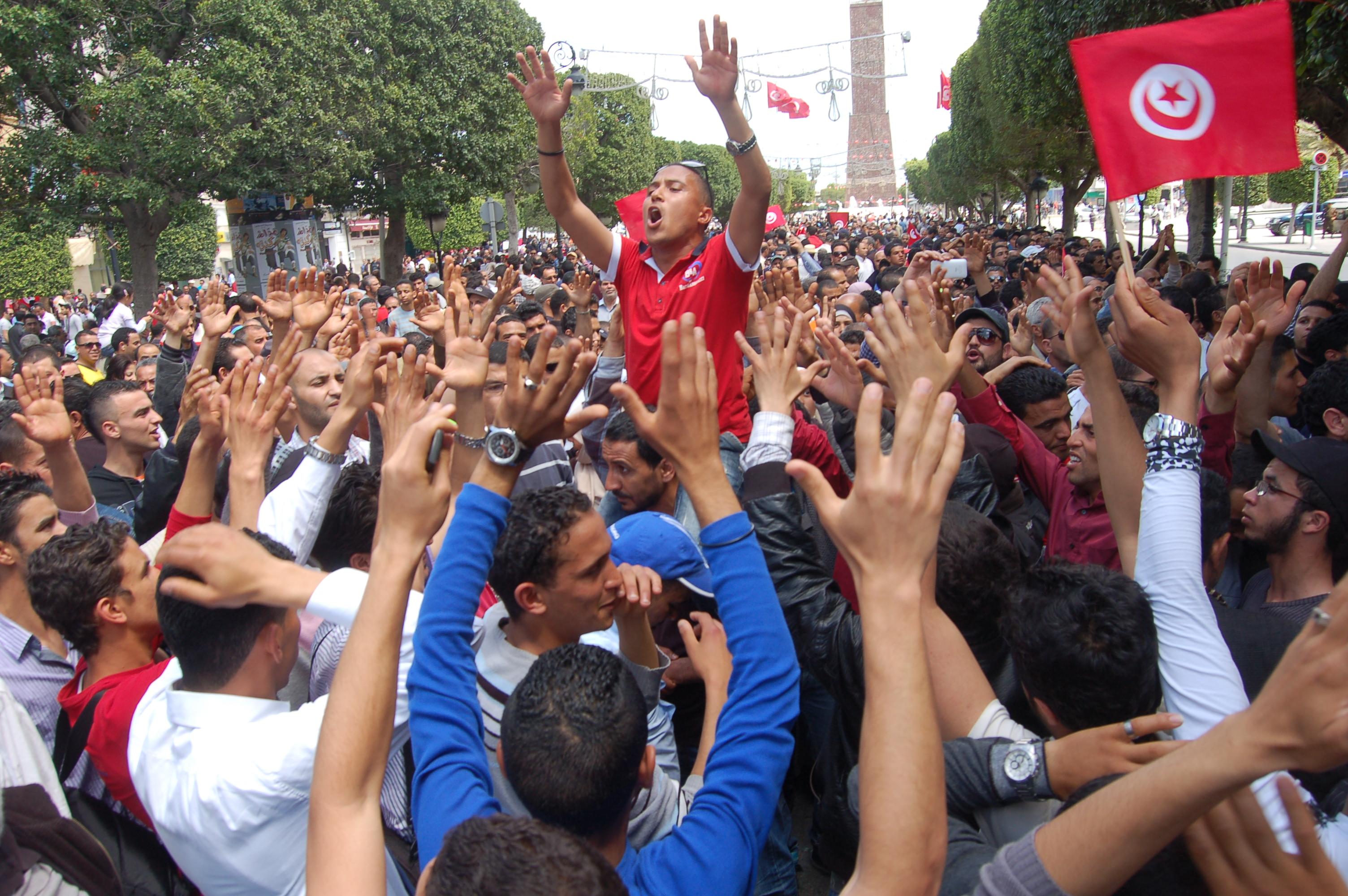
On Saturday, October 17, 2026, thousands of Tunisians marched through the center of Tunis in the largest protest against President Kais Saied in years, accusing him of undermining the country's democracy and mishandling its economy. The demonstration was led by the Tunisian General Labour Union (UGTT), the country's most powerful labor federation, alongside opposition parties, lawyers, doctors, journalists, unemployed workers and civil society groups — a rare show of unity after years of divisions.
The march converged on Habib Bourguiba Avenue, the symbolic heart of the 2011 uprising that toppled Zine El Abidine Ben Ali and ignited the Arab Spring. Hundreds of police were deployed across the capital and several surrounding roads were closed. The crowd chanted "No fear, power belongs to the people" and "Prisons are full, people are hungry," and revived the iconic 2011 slogan: "The people want the fall of the regime."
"Silence will no longer be acceptable — the state cannot be built by concentrating all powers in the hand of one person," UGTT secretary-general Salah Eddine Salmi told the rally, . Yassine Gharseli, who travelled from Sfax, told Reuters: "Enough is enough! The country is collapsing. We suffer from power and water cuts, and one crisis after another."
The demonstrators demanded the release of detained government critics and an end to what they described as attacks on trade union rights. Placards reading "No democracy without freedoms" and "No dignity with poverty" captured the twin political and economic grievances driving the march.
The protest took place on Saturday, October 17, 2026, in central Tunis, organized principally by the UGTT with opposition parties and civil society groups — the largest demonstration against Saied in years. AFP reported more than 3,000 on the march — a figure no outlet could independently confirm, and one the Bureau treats as an estimate, not a count.
The crowd — lawyers, doctors, journalists, the unemployed, activists and members of parties from across the political spectrum — was documented by two independent reporting chains along Habib Bourguiba Avenue, with hundreds of police deployed and surrounding roads closed. Both Reuters' Tunis reporting and Al Jazeera's desk recorded the slogans.
The economic backdrop is not in dispute: Tunisia is living through recurring water and electricity cuts, shortages of medicines and essential goods, rising living costs and persistent unemployment. This was not the first flare-up — on August 20 protesters rallied in Tunis against rising prices and shortages, and last month fuel transport workers staged a two-day strike over wages, led by a UGTT-affiliated federation.
In 2021 Saied suspended parliament and dismissed the government, then dissolved parliament and began ruling by decree; a 2022 constitution expanded presidential powers. Rights groups say he has intensified a crackdown on civil society, journalists and opposition figures. Saied rejects the allegations, says he is not a dictator, and accuses his opponents of engineering economic crises to fuel social unrest.
No reliable independent count of Saturday's crowd exists; "thousands" is the honest ceiling, and the AFP's 3,000-plus figure is a single-wire estimate. Whether the rare unity on display survives the weekend is unknowable from a single march.
We do not know how the presidency will respond: with a conciliatory gesture, with silence, or with the arrests and pressure that rights groups say have become its standard answer to dissent. We do not know whether any detained critics will walk free, or whether the trade-union rights defended on the avenue will be addressed.
Above all, we do not know whether the deeper driver — the economy — turns. If living conditions keep deteriorating, Saturday was a beginning; if they stabilize, it may be remembered as a release of accumulated anger. The next data points: the UGTT's next call and the state's next move.
Tunisia matters out of all proportion to its size: it is the Arab Spring's last surviving experiment. In 2011 the uprising that began in Sidi Bouzid toppled Ben Ali and set the region alight; Tunisia alone built competitive elections and expanded freedoms, with the UGTT itself in the Nobel-winning National Dialogue Quartet. Saturday's march ran down the same avenue, under the same slogans, against a president who has spent five years dismantling what the avenue built.
Second, because of who marched. The UGTT is not another opposition party — it is the country's most organized mass institution. When the union moves, Tunisia's street politics move; 2011, the 2013 crisis talks, every major strike wave ran through it. An opposition that could not unite behind a party banner has united behind a union one — and that changes the arithmetic of pressure on the presidency.
Third, the grievance is material before ideological: "Prisons are full, people are hungry" is a cost-of-living revolt in political dress. Across the Maghreb in 2026 the pattern rhymes — Morocco's youth-led protests press the new government on jobs and prices — and Tunis named the same enemies: cuts, shortages, unemployment. Regimes survive unpopular presidents; they struggle to survive empty pharmacies.
Finally, a signal to outside watchers — European governments managing migration routes, the IMF, investors pricing North African risk: a Tunisia that absorbs a protest this size peacefully is a different bet from one that answers with force.
Geopolitically, Tunisia sits at the hinge of Europe's migration anxiety and North Africa's stability map. Brussels pays Tunis to hold the migration line; a presidency weakened at home negotiates from weakness, and any European answer to a crackdown would collide with that bargain. The IMF's shadow is the other external lever — Tunisia's reform program needs external financing, and lenders read street politics as risk.
Economically: subsidies under strain, import bottlenecks, failing utilities, eroding purchasing power. The protest's economic demands are, in effect, a demand that the state resume basic functions — keep the lights on, stock the pharmacies — a harder test than winning an argument.
Demographically: not just activists but lawyers, doctors, the unemployed — the squeezed middle and locked-out young together. Gharseli's journey from Sfax is the country's geography in miniature: interior and coast, periphery and capital, converging on one avenue. Tunisia's youth has nowhere to go — unemployment first, then the boats.
Historically, 2021 is the hinge. Saied's power seizure was sold as a corrective to a paralyzed, corrupt parliamentary system — and it was initially popular. Five years on, the corrective has become the system, and the 2011 slogans have come back aimed at the man who once claimed the revolution's mantle. The UGTT's presence closes the circle: the same union that midwifed the democratic transition is now leading the march against its undertaker.
Structurally, the story is about the last organized counterweight. Parties divided; the press squeezed; civil society raided — the union federation remained, with dues, offices and a mobilization machine in every governorate. Authoritarian consolidation in Tunisia did not have to defeat the street; it had to outlast organization. Saturday suggests the organization is still there.
The second-order effects branch from the presidency's response. A conciliatory answer — dialogue, a gesture on detainees, a union channel — would validate the UGTT's strategy and demobilize the street, buying economic time the government may not have. A hard answer — arrests of organizers, pressure on the union's leadership, a media squeeze — would confirm the rights groups' narrative and risk turning a one-day march into a rolling confrontation.
Tunisia's 2011 uprising taught the region that one country's street can become every country's template; Algiers, Rabat and Cairo will read Saturday as a weather report. IMF reviews, European budget-support tranches and investor risk notes will soon price in "political instability," tightening the fiscal space the government needs to answer the economic grievances. And watch the union itself — the UGTT has internal currents, and sustained confrontation with the presidency would test its cohesion as much as its courage.
The honest answer is that Saturday was an opening move, not a verdict. The markers: whether the UGTT calls a follow-up and how large; whether the presidency answers with a statement, a negotiation, or arrests; whether detainees are released; whether the shortages ease or deepen.
Beyond that, the structural question stands: can Tunisia's remaining organized counterweight convert a day of unity into durable pressure without triggering the crackdown that would prove its point? The avenue has spoken twice in fifteen years — in 2011 against Ben Ali, on Saturday against Saied. What it demands, both times, is the same unglamorous thing: a state that works and a freedom that holds. The Bureau will keep watching the avenue.
Western wire reporting — Reuters from Tunis, echoed across the Anglophone press — frames Saturday as a democracy story first and an economy story second: "undermining democracy and mishandling the economy," in the wire's own ordering. The sourcing leans on rights groups' documentation of the crackdown and on the opposition's "coup" vocabulary for 2021, while carrying Saied's denials for balance. The implicit question: is the Arab Spring's democratic outlier sliding back into authoritarianism?
At the time of publication, no East Asian outlet — not CNA, NHK, Kyodo or Xinhua — had carried independent reporting on the Tunis march in any source reachable this cycle; the story was hours old and North Africa sits far from the East Asian news agenda's center of gravity. We do not invent their take. Analytically: East Asian wires typically frame Maghreb unrest stability-first — a governance question, not a democracy drama — and Beijing's and Tokyo's material stakes in Tunisia are thin next to the Gulf and the Sahel.
Al Jazeera's reporting, the strongest Southern chain here, inverts the Western ordering: living conditions and freedoms lead together, 2011 is a living reference rather than a footnote, and the revived slogan is continuity, not nostalgia. The Indian press's independent write-up reads the march the same way: an economic-dignity revolt with political consequences. In this lens Tunisia is not "the West's democratic project under threat" but a Southern country working through the same knot — concentrated power, a cost-of-living crisis, a union movement that still knows how to fill a street — that defines politics from Dakar to Dhaka.
Two grievances fused on Habib Bourguiba Avenue: the political — Saied's concentration of power since 2021, the crackdown on critics, journalists and unions, and detained opposition figures — and the material — recurring water and power cuts, medicine and goods shortages, rising living costs and unemployment. The UGTT union, opposition parties and civil society marched together, chanting 'No fear, power belongs to the people' and demanding the release of detainees.
Kais Saied, a constitutional law professor, was elected president in 2019 promising an alternative to a paralyzed political class. In July 2021 he suspended parliament and dismissed the government, then dissolved parliament, dismissed dozens of judges and began ruling by decree — moves opponents called a coup. A 2022 constitution then vastly expanded presidential powers. Rights groups say he has since intensified repression; he denies it and accuses opponents of sabotaging the economy.
The Tunisian General Labour Union is the country's most powerful labor federation and its most organized mass institution, with reach into every workplace and region. It was part of the National Dialogue Quartet that won the 2015 Nobel Peace Prize for steering Tunisia's democratic transition. When the UGTT mobilizes — as in 2011, 2013 and now — Tunisia's street politics move; parties divide, but the union endures as the last structured counterweight to concentrated power.
A single march rarely does, but Saturday changed the arithmetic: an opposition that could not unite behind any party has united behind the union, and the economic grievances driving it are not resolving on their own. What happens next depends on the presidency's answer — dialogue, silence or arrests — and on whether living conditions improve. If they deteriorate further, expect more UGTT-led mobilization; the avenue has now spoken twice in fifteen years.
