LaLiga president Javier Tebas compared Real Madrid's media machine to the propaganda techniques of Joseph Goebbels. The club called it "morally repugnant" and demanded his immediate resignation — the feud over power, money and referees in Spanish football has never been this open.
Published 16 October 2026 · 20:45 GMT
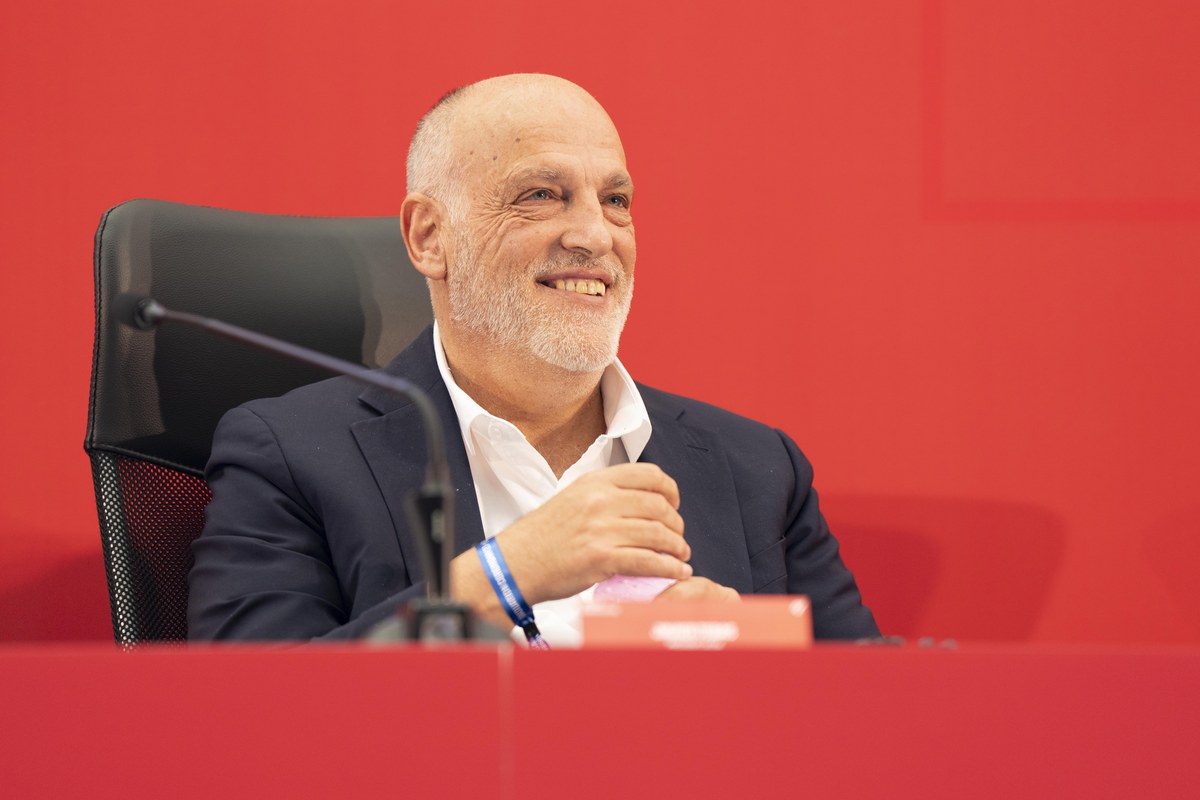
On the morning of Friday, 16 October 2026, Real Madrid published an official statement demanding the "immediate resignation" of Javier Tebas as president of LaLiga — and from his post as vice-president of the Royal Spanish Football Federation (RFEF). It is the most serious escalation yet in a feud between the league's chief administrator and its most powerful club, and it turns a war of words into an institutional crisis for Spanish football.
The trigger was a long post Tebas published on social media on Friday morning. Answering two newspaper articles that accused him and LaLiga of working against Real Madrid's interests, he wrote that "Real Madrid's management directs an orchestra of mouthpieces and Real Madrid TV leads the singing." The club's in-house channel, he argued, runs a permanent campaign against match officials: "Their score is always the same: select the plays that suit them, repeat the grievance, feed the suspicion, and point fingers at the enemies."
Then came the sentence that detonated the row. "That method recalls propaganda mechanisms used by Goebbels, Nazi Germany's Minister of Propaganda," Tebas wrote — "systematic repetition, construction of an enemy, and subordination of facts to the narrative." He added at once that "the comparison is with those propaganda techniques, not with an ideology or, of course, with the Madridista fanbase." Real Madrid's answer arrived within hours, and it did not accept the distinction.
The club's statement called Tebas's remarks "absolutely intolerable and extraordinarily serious." "Real Madrid considers it absolutely intolerable and extraordinarily serious that the person who holds two positions of top responsibility in Spanish football would resort to a comparison with the Nazi regime's propaganda methods to discredit our club, its leadership and its television channel," it said. "The clarification that it doesn't refer to Nazi ideology doesn't alleviate the deeply offensive, morally repugnant and institutionally unworthy character of his statements."
The statement went further, demanding not an apology but his exit: "Tebas's repeated conduct demonstrates a lack of neutrality, respect and impartiality incompatible with his institutional responsibilities," it said — "his constant attacks on Real Madrid and those demanding transparency and regeneration represent, in our club's view, a genuine scourge for Spanish football."
Tebas's post was aimed at two journalists at El Debate, the Spanish newspaper, who had published articles — one on refereeing, one claiming LaLiga was making Real's fixture schedule harder — that he said echoed the club's line. He addressed one of the writers, Tomás González-Martín, directly: "You seem like a parrot, but with a keyboard."
The background is a long-running war. In September, after Tebas dismissed the club's refereeing complaints as a "smokescreen" for poor on-pitch performances, Madrid demanded a new LaLiga president. Real Madrid TV regularly broadcasts compilations of alleged refereeing errors ahead of the club's upcoming fixtures. Coach José Mourinho has said publicly that referees regularly disadvantage his side. Madrid are the 15-time European champions and holders of a record 36 Spanish league titles; Tebas has led LaLiga since 2013 and has clashed with club president Florentino Pérez for years.
Whether Tebas will step down — nothing in his record suggests he will go quietly — or whether he will answer Real's statement with another post. Whether any of LaLiga's other professional clubs will publicly back Madrid or Tebas; so far this is a duel. How the RFEF responds to a resignation demand aimed at its own vice-president. Whether Madrid follows its words with legal action — the statement's vocabulary, "morally repugnant" and "institutionally unworthy," reads like the draft of a defamation filing. Whether the El Debate journalists answer Tebas's "parrot" charge. And what European football's governing bodies make of a league president comparing a member club to Goebbels — UEFA and FIFA have both stayed silent so far.
Spanish football is not a pastime; it is one of the country's largest cultural industries and a multi-billion-euro economy of broadcast rights, sponsorships and global audiences. When its chief administrator publicly compares its biggest club to the machinery of Nazi propaganda, the damage is not rhetorical — it is institutional. Referees will now officiate Real Madrid matches under a cloud their own league president helped create.
Because in Spain the instrumentalisation of football by the Franco dictatorship remains a live and painful subject, a Nazi-propaganda comparison from the league's own president crosses a red line that no qualifier can un-cross. Tebas's caveat — techniques, not ideology — was meant as a firebreak; Madrid treated it as fuel.
The club does, commercially. Real Madrid is LaLiga's global shop window — its matches, its brand, its television channel are what broadcasters pay for. A league president at open war with his premium product is a commercial risk, and sponsors read statements like Friday's the way markets read profit warnings. In a country where football is daily politics — as the Bureau's Spain coverage has tracked — this row will not stay inside the sport pages.
Five dimensions, one power struggle. Geopolitics: this is a fight over who governs Spanish football — the elected administrator of the competition or its most powerful franchise. Tebas's office derives its authority from the clubs themselves; when the biggest club declares him "a genuine scourge," the authority, not just the man, is on trial.
Economics: the fight is ultimately about money. LaLiga sells a product, and its most valuable asset just declared war on the salesman. Demographics and history: the Madridista fanbase is global — hundreds of millions of supporters for whom "Goebbels" and "Real Madrid" in one sentence is an insult to the crest itself, whatever the caveats. Technology: the real novelty is the weapon. Tebas did not attack the club's football; he attacked its media operation. Real Madrid TV — a broadcaster owned by the club, airing referee compilations before matches — is the new terrain of football warfare, and both sides now treat narrative control as a competitive asset. The Bureau tracks how such institutional fractures move the needle on national standing in its country rankings
First-order damage is the relationship between LaLiga and its flagship club. Second-order: every referee who officiates a Madrid match now works under a cloud — the club says the system is rigged, the league president says the club is running a propaganda campaign, and the man in the middle has no credible cover. Sponsors and broadcast partners will price the instability. And a precedent is being set: if a league president can liken a club's television channel to Goebbels, club-owned media across Europe — every in-house channel, every official podcast — becomes a legitimate target in the next dispute. The season is young; the next controversial penalty in a Madrid match will detonate this all over again.
Watch five things. First, Tebas's response — silence would be uncharacteristic. Second, whether any of LaLiga's other clubs break ranks, for Madrid or for Tebas; a lone club can be dismissed, a bloc cannot. Third, the RFEF, whose vice-president has just been told to resign. Fourth, the courts: Madrid's language is already legal in tone, and a defamation filing would drag this through the season. Fifth, the football itself — the next refereeing controversy in a Madrid match is now a political event.
The row will almost certainly surface at LaLiga's next assembly of clubs, where Tebas's authority will be tested in the open. The Bureau's Spain coverage will track each development as the season unfolds.
The Western lens reads this as an institutional-credibility crisis. A league president who publicly likens a member club to Goebbels has spent the neutrality his office requires — and neutrality is the only currency a competition organiser has. From this angle the question is procedural: can Tebas credibly regulate refereeing, scheduling and discipline for a club he has accused of running a propaganda machine? Broadcasters and sponsors, the money behind the spectacle, will be asking the same question in private.
The Eastern lens sees a familiar pattern: football as an instrument of power, fought over by men who treat clubs and leagues as political assets. From Moscow to Riyadh, the modern game is statecraft by other means — sovereign wealth in the boardroom, soft power on the pitch. Against that backdrop, a European league president accusing Europe's most storied club of propaganda techniques reads as the old order's internal war, fought with the vocabulary of twentieth-century ideological combat.
The Global South lens starts with the audience: hundreds of millions of Real Madrid supporters across Africa, Latin America and the Arab world, for whom the club is a weekly ritual, not a balance sheet. From this angle, Friday's row is an elite European quarrel — a league chief and a club president trading historical insults while the game's grassroots, from Dakar to Buenos Aires, watch and wonder what it has to do with football. Governance disputes in the game usually end far from the fans — at the Court of Arbitration for Sport, as the Bureau's AFCON final coverage showed.
In a Friday-morning social-media post, Tebas wrote that "Real Madrid's management directs an orchestra of mouthpieces and Real Madrid TV leads the singing," accusing the club's channel of a permanent anti-referee campaign. "That method recalls propaganda mechanisms used by Goebbels, Nazi Germany's Minister of Propaganda," he wrote — "systematic repetition, construction of an enemy, and subordination of facts to the narrative." He added that the comparison concerned techniques, not ideology or the fans.
The club called the remarks "absolutely intolerable and extraordinarily serious," saying it was intolerable that a man holding two top posts in Spanish football would invoke Nazi propaganda methods to discredit the club. It said Tebas's "repeated conduct demonstrates a lack of neutrality, respect and impartiality incompatible with his institutional responsibilities," and demanded his immediate resignation from LaLiga and the RFEF vice-presidency.
Yes — this is the second resignation demand in weeks. In September, after Tebas dismissed Madrid's refereeing complaints as a "smokescreen" for poor on-pitch performances, the club demanded a new LaLiga president. The feud is years old: Tebas, in charge since 2013, has repeatedly clashed with club president Florentino Pérez over refereeing, scheduling and the league's governance.
All eyes are on Tebas's response, on whether other LaLiga clubs take sides, and on the RFEF — Tebas is its vice-president. Madrid's legalistic language raises the prospect of a defamation suit. In the short term, the next refereeing controversy in a Real Madrid match will become a political event, and the row will likely surface at LaLiga's next assembly of clubs.
