The new Bundibugyo patient, a close relative of Kenya’s first two cases, was already in quarantine when symptoms appeared. No community transmission detected.
Published 16 October 2026 · 19:59 GMT
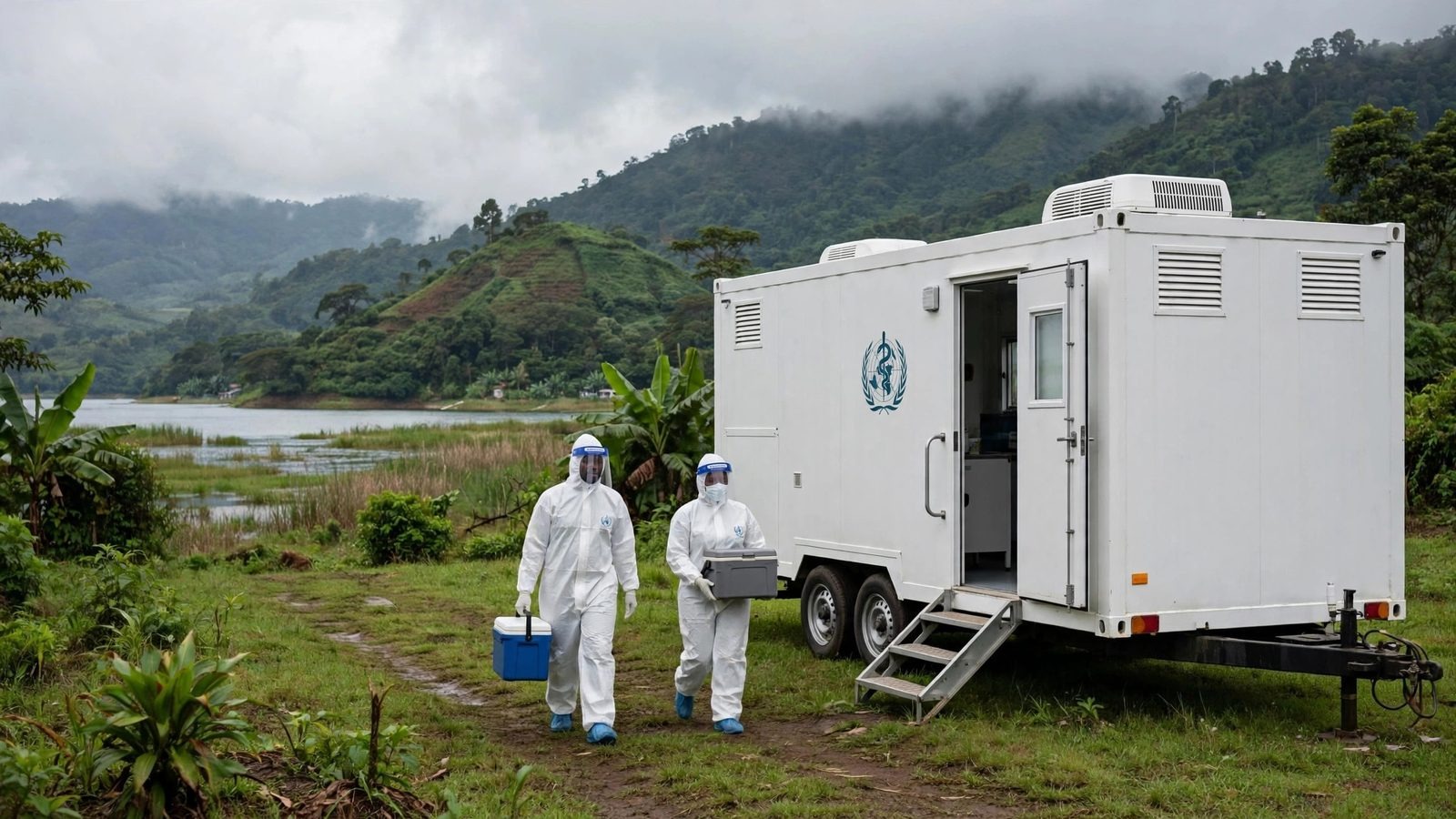
Kenya's Ministry of Health announced on Friday 16 October 2026 that a third person has tested positive for Bundibugyo virus disease, the rare Ebola strain driving the record outbreak in the Democratic Republic of the Congo. The new patient is a 65-year-old woman described by the ministry as a primary contact and a close relative of the country's first two confirmed cases.
The decisive detail is that she was already in quarantine. Health Director General Dr Patrick Amoth said she had been held under quarantine since 6 October as part of the contact list built around the earlier patients. When she developed fever, a sore throat and general malaise, officials isolated her and collected specimens for testing. The samples returned a positive result, and she was transferred to the Infectious Disease Unit, where trained health workers are providing supportive care.
The ministry framed the detection as the system working as designed. "Having been in quarantine, she was diagnosed early and is currently receiving supportive care improving her chances of recovery while limiting risk of further spread," the statement read, according to Vantage KE. The ministry added that the second patient remains stable and is responding well to supportive care. Officials moved to reassure the public that there is no community spread of the disease and that the risk to the Kenyan public remained low.
The chain of transmission begins with Kenya's first recorded case: a Kenyan man who had lived in the Democratic Republic of the Congo for seven years, according to People Daily. He had been ill for about a month and had sought treatment at several hospitals before travelling by road to Kampala, Uganda. From Entebbe airport he boarded Jambojet flight 8523, which landed at Jomo Kenyatta International Airport in Nairobi at 1:10pm on Saturday 3 October. Port health services cleared him on arrival; a relative drove him to hospital. He died three days later, on 5 October.
the second confirmed case followed inside the quarantine net: a 39-year-old man, a close family member of the first patient, who developed symptoms while in quarantine and tested positive at the National Virology Reference Laboratory and the KEMRI-CDC laboratory, according to Channel 15 News. The third case — the 65-year-old woman confirmed on Friday — is also a primary contact and close relative of the earlier patients, and was likewise detected while already in quarantine. Her samples tested positive at both the National Virology Reference Laboratory and the Kenya Medical Research Institute, according to Vantage KE.
The contact-tracing picture is extensive. Of 130 contacts listed by the Health Ministry, 127 have been traced and placed in quarantine — 97.7 per cent — with three still being pursued for tracing and quarantine, according to the ministry's statement reported by Nipashe Biz. The second patient remains stable and is responding well to supportive care, officials said.
Kenya's cases are linked to the DRC outbreak, which Reuters calls the second-largest ever recorded, with more than 9,000 cases and more than 4,000 deaths since it was officially detected in May. The outbreak was declared in mid-May but may have started months earlier. Ebola spreads through direct contact with the bodily fluids of infected people, living or dead, and can cause fever, vomiting, diarrhoea and, in severe cases, internal and external bleeding. The Bundibugyo strain behind the current outbreak has no approved vaccine or treatment, Reuters notes — a gap that shapes everything that follows.
Three questions are unanswered, and each matters. The first is whether the three untraced contacts will be found and quarantined before they develop symptoms — the entire containment logic depends on the net holding. The second is whether further cases will surface among the 127 contacts under surveillance as they move through the incubation window. The third is clinical: how the 65-year-old patient responds to supportive care in the coming days, given that age and underlying health often shape Ebola outcomes.
Beyond Kenya, the trajectory of the DRC outbreak remains uncertain. Unconfirmed reports have circulated of cases detected in a possible eighth province; the DRC health ministry had not formally confirmed them at the time of publication. Whether the outbreak has peaked, is plateauing, or is still accelerating determines how long Kenya — and its neighbours — stay on high alert.
This third case is, paradoxically, both reassuring and alarming. It is reassuring because the patient was caught inside the quarantine net — exactly where the contact-tracing system is supposed to catch her. Kenya listed 130 contacts, traced 127, and the detection of a symptomatic patient already in quarantine is what successful surveillance looks like. The rapid positive result, the transfer to the Infectious Disease Unit, and the second patient's stable condition all point to a health ministry that prepared for this moment.
It is alarming because of how the virus entered the country in the first place. Reuters reports that the first patient managed to cross the border between the Congo and Uganda — which has been closed since May — and then pass through Nairobi's busy Jomo Kenyatta International Airport, one of Africa's major air hubs. The border between a record-breaking Ebola outbreak and East Africa's travel network proved porous. That gap, not the quarantine success, is the story the region's health authorities will have to answer for.
And the stakes are structural. The Bundibugyo strain has no approved vaccine and no specific treatment; supportive care is the only line of defence. When the pathogen is rare, untreatable by vaccine, and arriving through one of the continent's busiest airports, a country's containment system gets tested in public — and Kenya is being watched.
It proves two things at once, and the tension between them is the real story. First, Kenya's post-arrival containment apparatus is working: the contact list was real, the quarantine was real, the detection was early, and the patient is receiving care in a dedicated unit. This is not a health system caught asleep. Second, the pre-arrival defences failed: the first patient crossed a closed land border and passed through JKIA's arrival screening with an infection he had carried for roughly a month. Port health cleared him.
The policy implication is uncomfortable. Post-arrival tracing is expensive, labour-intensive, and — as this case shows — effective. But it is a second line of defence, and it is being asked to do the work of the first. The harder question is why the screening chain leaked twice over: at the land border and at the airport. Until that question is answered honestly, every imported case will require the same heroic, resource-heavy quarantine operation — and luck.
The ripples extend beyond the isolation ward. Airports across East Africa will face renewed pressure to tighten arrival screening and health declarations, and the debate over thermal and symptom screening at JKIA will reopen — with all its known limitations, since infected travellers in the incubation period show nothing to detect. Regional airlines, starting with Jambojet, are already working with the Health Ministry; passengers on flight 8523 and subsequent contacts have become a case study in aviation epidemiology.
There is also a vaccine story gathering force. The Bundibugyo strain has no approved vaccine, and a trial programme would take months to show meaningful impact, according to reports from the region. Each new exported case sharpens the argument for accelerating trial timelines. And there is the economic shadow: Kenya's tourism sector and Nairobi's role as a transit hub both suffer when headlines tie the capital to Ebola — fairly or not, the perception cost is real, and the Health Ministry's insistence that public risk remains low is as much an economic communication as a medical one.
Watch the contact list. The 127 traced contacts are in quarantine and under surveillance; anyone developing symptoms will be isolated and tested, as the third patient was. The three contacts still being pursued are the most urgent operational target — each day they remain unlocated narrows the margin. Kenya's health authorities have also signalled strengthened surveillance at airports and land border points, and further ministry updates are expected as the situation develops.
Watch the DRC outbreak for the other half of the equation. So long as the DRC outbreak burns at record scale, the import risk persists regardless of Kenya's internal measures. Any formal confirmation of spread to a new province would reshape the regional alert level. And watch the global health wires: a third case caught in quarantine is a containment success, but the fourth — if it comes from outside the net — would be a different story entirely.
Western coverage, led by Reuters, has trained its lens on the screening failure: a man crossed a border closed since May and walked through the arrival hall of one of Africa's busiest airports. The frame is one of systemic vulnerability — port health protocols, border enforcement, and the gap between announced closures and ground reality. The subtext is the familiar donor-economy question: how much of the response architecture is funded, equipped, and genuinely operational, and how much is reassurance on paper.
The eastern lens starts at the source: the DRC outbreak, with more than 9,000 cases and over 4,000 deaths since May, is the engine of everything that followed. The border closure since May tells its own story about how seriously regional authorities took the risk — and the first patient's journey tells a story about how porous that closure proved. For the east, the Kenya cases are the export of an outbreak that eastern DRC's health system has been fighting largely on its own terms.
The Global South lens sees competence and vulnerability side by side. Tracing 127 of 130 contacts, detecting a case inside quarantine, and confirming it at two national laboratories is serious public-health work — the kind of capacity that took decades to build in Kenya's health system. But the import route exposes the same asymmetry that has always defined epidemic control in the region: the burden of containment falls on countries that did not originate the outbreak, while the tools — vaccines, therapeutics, surge funding — remain concentrated elsewhere.
Bundibugyo is one of six known Ebola virus species, first identified during a 2007 outbreak in Bundibugyo, Uganda. It spreads through direct contact with the bodily fluids of infected people and can cause fever, vomiting, diarrhoea and, in severe cases, bleeding. Reuters notes there is no approved vaccine or treatment specific to this strain, which makes the record DRC outbreak behind Kenya’s cases especially dangerous.
She is a 65-year-old woman described as a primary contact and close relative of Kenya’s first two confirmed patients. She had been in quarantine since 6 October. When she developed fever, a sore throat and general malaise, health officials isolated her and collected specimens. Tests at the National Virology Reference Laboratory and KEMRI confirmed the infection, and she was moved to the Infectious Disease Unit for supportive care.
The first case was a Kenyan man who had lived in the DRC for seven years and had been ill for about a month. He travelled by road to Kampala, Uganda, then boarded Jambojet flight 8523 from Entebbe, landing at Nairobi’s Jomo Kenyatta International Airport at 1:10pm on 3 October, according to People Daily. Port health cleared him on arrival; a relative drove him to hospital. He died on 5 October.
The Health Ministry says there is no evidence of community transmission and the risk to the general public remains low — all three cases trace back to the imported first case. Of 130 contacts listed, 127 have been traced and placed in quarantine, with three still being pursued. The second patient is stable and responding to supportive care. Health teams are also strengthening surveillance at airports and land border points.
